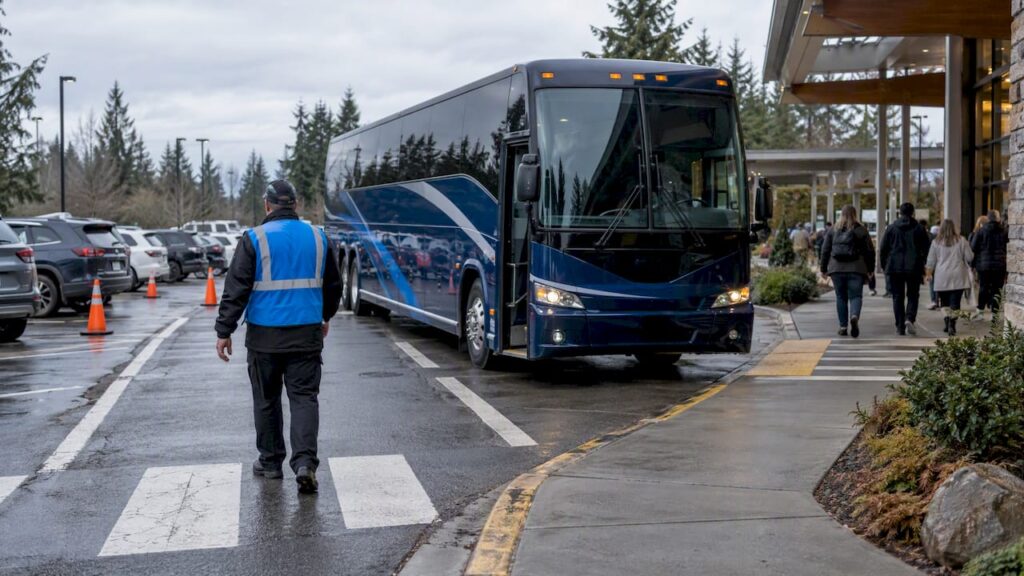
An event transportation plan is the playbook that guarantees orderly, accessible, and safe movement to and from your event. Start by convening your stakeholders, mapping site access, and building a passenger manifest. From there, verify carrier insurance and ADA accessibility early, because both take longer to sort out than most planners expect, and both can delay or derail your event if left until the last minute.
TL;DR:
- Ensuring carrier insurance, ADA accessibility, and vehicle vetting are completed early to prevent delays or cancellations on event day.
- Displaying pre-event signage and providing clear instructions reduce confusion and help manage guest arrivals and shuttle loading efficiently.
- Conducting live system tests and defining contingency triggers before the event allow quick response to delays or emergencies during operations.
- Large events exceeding regional transit requirements need start-to-finish planning across months, while smaller gatherings can be organized within weeks.
- Charter services are best for events requiring strict timing control, consistent branding, or complex routing, unlike free or transit shuttles suitable for simpler trips.
Table of Contents
- 1. What goes into a complete transportation plan
- 2. The five planning phases and when to start each one
- 3. Choosing vehicles and vetting your carrier
- 4. Keeping guests informed before and during the event
- 5. Running the day: your command post and contingency playbook
- 6. Measuring success and improving your next event
- 7. How a regional charter partner operationalizes this plan
- When a charter makes more sense than transit or volunteers
- Getting a quote that actually covers what you need
- FAQ
- Sources
1. What goes into a complete transportation plan
A solid plan covers the same ground every time, no matter if you’re moving 50 wedding guests or 5,000 conference attendees. The FHWA’s Managing Travel for Planned Special Events guidance breaks a comprehensive traffic management plan into seven core components: site access and parking, pedestrian access, traffic flow, traffic control, en-route traveler information, traffic surveillance, and incident management and safety. Treat this as your master checklist, then fill in the specifics for your event.
Site access and parking comes first because everything else depends on it. Assign lots by guest type (VIP, general, staff), sequence your ingress and egress so cars aren’t fighting each other at the gate, and have an overflow plan ready before you need it.
Pedestrian access matters just as much as vehicle flow, especially once buses and cars start sharing space with people on foot. Separate pedestrian paths from vehicle lanes wherever you can, mark crossing points clearly, and confirm your ADA-accessible paths connect parking, drop-off zones, and the venue entrance without detours.
Traffic flow and control cover the mechanics of keeping cars and buses moving. This might mean adjusting signal timing near the venue, staffing manual control points at key intersections, or arranging temporary closures with your local jurisdiction.
En-route traveler information is how you tell people what to expect before they’re already stuck in it. Pre-event messaging, static signage, changeable message signs, and a single status page on your event website all reduce confusion and cut down on last-minute questions to your staff.
Shuttle and transit accommodation deserves its own line item. You’ll need staging areas, layover space for vehicles between runs, a passenger manifest for each run, and a staging map your drivers and staff can reference without guessing.
Incident management means knowing how emergency vehicles reach every part of your site even when it’s packed with guests and parked cars.
Budget checkpoints tie it all together: staffing hours, signage production, temporary traffic control devices, and the charter or transit costs themselves.
Use this as a working checklist:
- Site access and parking: lot assignments, ingress and egress sequencing, overflow routing
- Pedestrian access: separation tactics, marked crossings, ADA-compliant paths
- Traffic flow and control: signal adjustments, manual control points, temporary closures
- Traveler information: pre-event messaging, signage, a status page
- Shuttle and transit planning: staging, layovers, manifests
- Incident management: confirmed emergency vehicle access routes
- Budget: staffing, signage, devices, charter or transit costs
2. The five planning phases and when to start each one
Event transportation planning follows a predictable rhythm once you’ve done it a few times. The FHWA’s planned special events handbook outlines five phases, and mapping your own timeline against them keeps you from scrambling in the final weeks.
- Regional planning and coordination. Start here months ahead of your event, especially for anything large enough to need permits or sign-off from a regional transportation agency. Research on special event management notes that small gatherings can come together in weeks, but larger events that touch regional transit systems need months of lead time to coordinate with the agencies involved.
- Event operations planning. This is where you test feasibility, finalize routing, decide whether you need transit augmentation, and run tabletop exercises to catch problems on paper instead of on the day.
- Implementation activities. Now you’re testing equipment, training staff, and locking in final passenger manifests. This phase should wrap up well before doors open.
- Day-of activities. Your command post goes live, your team monitors conditions in real time, and you make dynamic calls as conditions change.
- Post-event activities. Debrief while details are fresh, collect your data, review KPIs, and write down what you’d change.
Pro tip: Treat your transportation plan as a living document. Run at least one live systems test, not just a tabletop exercise, before a large event so you can confirm staging areas and staff roles under real conditions, not just on paper.
3. Choosing vehicles and vetting your carrier
Matching vehicle type to your route and group size sounds simple until you’re staring at a guest list. A 12-passenger van works for a small wedding party shuttle; a full coach makes more sense for a 200-person conference run between a hotel block and a venue. Minibuses sit in between, useful for mid-size groups or tighter streets where a full-size coach can’t maneuver.
Once you know what you need, vet the carrier before you sign anything.
- Confirm the carrier holds active FMCSA operating authority if the trip crosses state lines, and ask for proof.
- Verify minimum financial responsibility: $5,000,000 for vehicles designed to carry 16 or more passengers, and $1,500,000 for vehicles designed for 15 or fewer, per FMCSA’s passenger carrier guidance.
- Ask about driver qualifications: valid CDL, hours-of-service compliance, and a documented drug and alcohol testing policy.
- Build in ADA accommodations early. FMCSA guidance on motorcoach operations notes that accessible service typically requires 48 hours’ advance notice, so don’t wait until the week of the event to ask.
- Put insurance certificates, hold-harmless language, and cancellation or delay clauses in writing before you sign.
If you want a template for exactly what to put in that agreement, our charter bus contract guide walks through the clauses worth negotiating, and our breakdown of charter bus sizes can help you match capacity to your guest count before you request quotes.
Pro tip: Ask every carrier for their USDOT number and run it yourself before you sign. It takes five minutes and confirms the safety and insurance claims they’re making.
4. Keeping guests informed before and during the event
Most transportation headaches on event day trace back to a communication gap, not a logistics failure. Guests who don’t know where to park or when the last shuttle leaves create the bottlenecks you spent months trying to avoid.
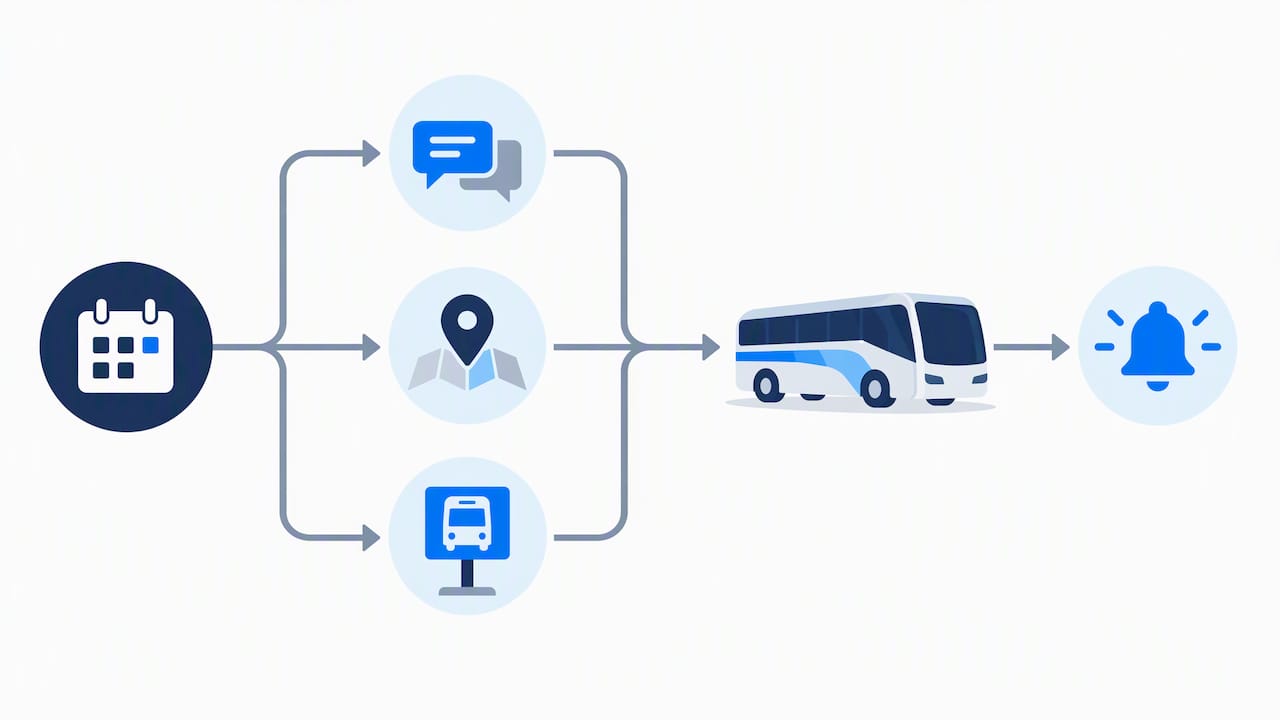
Your pre-event emails and ticketing instructions should spell out arrival windows, transit or shuttle options, and exact pickup points, not just a general address. Vague instructions send everyone to the venue at the same time, which is exactly what you’re trying to prevent.
Signage does the rest of the work on-site. Permanent signage handles year-round wayfinding, but temporary signage and clearly marked shuttle lines carry the weight on event day. Simple, direct wording works best: “Shuttle to Main Stage, Loading Here” beats anything clever. Our guest shuttle signage guide has formats you can adapt for pickup and drop-off points.
- Pre-event emails: arrival windows, shuttle pickup points, parking instructions
- Signage: clear, direct wording on every shuttle line and loading zone
- Changeable message signs and media partnerships to shift arrival patterns before people are already stuck in traffic
- A single status page or app alert system so guests check one place, not five
FHWA’s traveler information research points to pre-event publicity and changeable message signs as some of the most effective tools for shifting travel demand before it creates congestion. Staff your on-site information desk with people who actually know the day’s schedule, and give your team a radio plan so questions get answered in seconds, not minutes.
5. Running the day: your command post and contingency playbook
Your day-of operation lives or dies on how clearly you’ve assigned roles before the first guest arrives. Build a run sheet now and you won’t be inventing decisions under pressure later.
- Set up a command post with a clear role map: who authorizes route changes, who contacts local police if a closure needs adjusting, and who manages shuttle dispatch if a vehicle falls behind schedule.
- Staff your traffic management team with assigned stations, working radios, and a direct contact for signal override requests if your event needs one.
- Define your contingency triggers before the day starts. A delayed flight, a vehicle breakdown, or a sudden storm each needs a pre-agreed response, whether that’s deploying overflow parking or switching to alternate route signage.
- Monitor conditions in real time and know your escalation point. If traffic backs up beyond what your team can manage, know exactly who at the city or regional agency you call, and have that number saved before the event, not searched for during it.
Pro tip: Write your contingency triggers down as “if this, then that” statements before the event. “If a shuttle is delayed more than 15 minutes, dispatch the backup vehicle from staging” is a decision your team can execute instantly. A vague plan to “handle delays as they come up” is not.
6. Measuring success and improving your next event
A plan isn’t finished when the last guest leaves. The data you collect afterward is what makes your next event’s plan better than this one.
Track these KPIs: on-time percentage for scheduled departures and arrivals, average dwell time at pickup points, passenger throughput per shuttle run, incident count, and guest complaints or satisfaction feedback.
- Pull data from ticket scans, GPS traces on shuttle vehicles, and staff logs kept during the event
- Hold a debrief within a week, while details are still fresh for everyone involved
- Invite the people who ran the command post, traffic team, and any outside carrier representatives
- Rank the fixes that matter most, rather than trying to overhaul everything at once
- Update your manifest templates, timeline, and contract language based on what you actually learned, not just what went wrong
7. How a regional charter partner operationalizes this plan
Seeing how a charter provider handles the moving pieces makes the checklist above less abstract. We built our own process around the same components planners need to track.
- Itinerary coordination that maps pickup times, staging, and drop-off against your event’s actual schedule, not a generic template
- Credentialed drivers and a well-maintained fleet, so the vehicle credentials you’re checking on your end match what shows up on event day
- Insurance documentation provided upfront, so it’s part of your contract file before you need it, not chased down after
- Seating charts and amenity details available ahead of time, so your manifest and boarding plan are set before guests arrive
For a wedding shuttle, that typically means confirming pickup windows and vehicle assignments weeks ahead, finalizing the manifest a few days out, and running through drop-off timing with the wedding party the day before. Our seating chart templates and amenities checklist are worth reviewing when you’re building out that manifest and setting guest expectations.
When a charter makes more sense than transit or volunteers
Charter service earns its cost when you need control over timing, a consistent brand experience, or routing too complex for a public transit map. Transit augmentation or volunteer-run shuttles work fine for simple point-to-point runs on a tight budget, where guests have few stops and little tolerance for delay risk. The real trade-off is cost against control: if a missed pickup would wreck your event’s schedule, pay for the control. If it wouldn’t, save the budget for somewhere else.
— Dusty
Getting a quote that actually covers what you need
We offer logistics services including itinerary coordination, passenger manifests, and credentialed drivers with a well-maintained fleet, for weddings, corporate events, limo bus bookings, and general charter needs in the Portland metro area and surrounding regions.
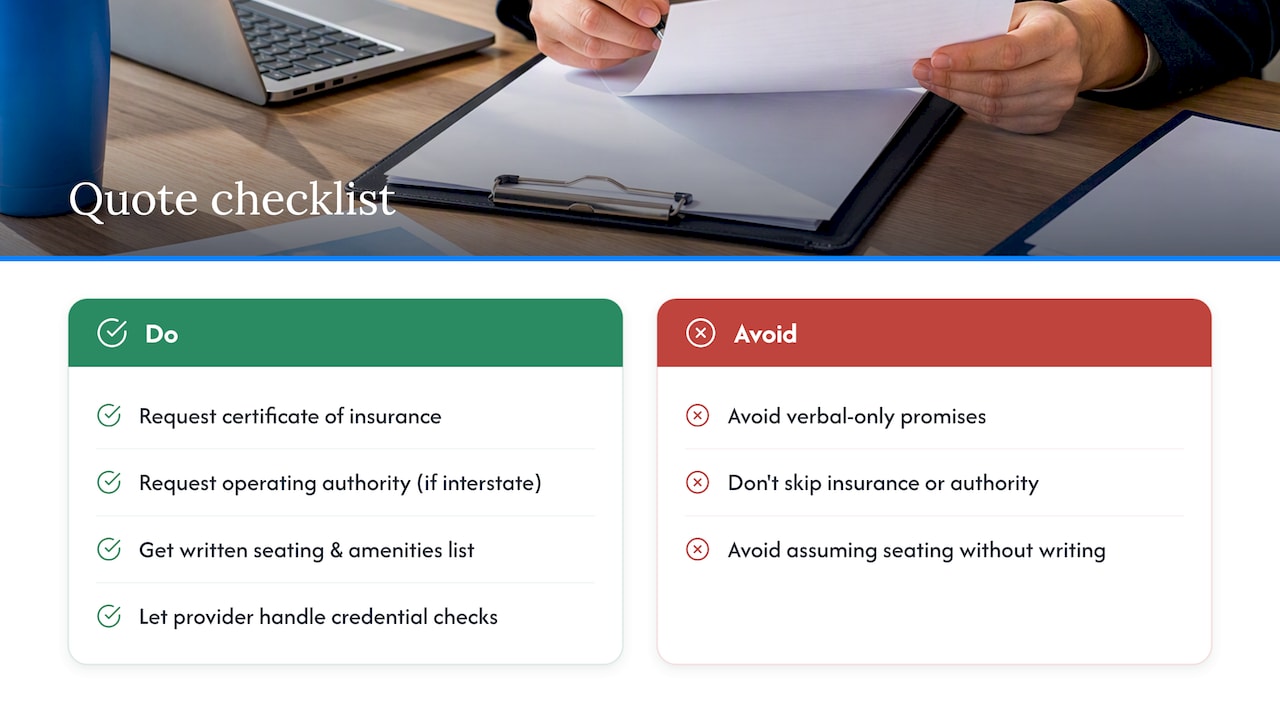
When you request a quote, ask for a certificate of insurance, operating authority documentation if your trip crosses state lines, and a written seating and amenities breakdown so there are no surprises on event day. Reliant Transportation handles the credential checks and documentation so you’re not chasing paperwork during your busiest planning weeks.
Ready to put a number on your plan? Request a quote and reserve your charter and we’ll build the itinerary around your event, not the other way around.
FAQ
What are the 5 C’s of event planning?
There’s no single, universally agreed definition of the “5 C’s” specific to event transportation planning. What matters more for transportation specifically is following the FHWA’s five-phase framework: regional coordination, operations planning, implementation, day-of activities, and post-event review.
What does a transportation plan include?
A complete plan covers site access and parking, pedestrian access, traffic flow and control, en-route traveler information, traffic surveillance, and incident management, according to FHWA guidance on planned special events. Budget planning for staffing, signage, and vehicle costs runs alongside all of these.
What are the three C’s of transportation planning?
This isn’t a standard, defined term in event transportation guidance, so treat any specific “three C’s” framework with caution. The practical equivalents that matter are coordination with regional agencies, communication with attendees, and contingency planning for the day of the event.
What to include in an event plan?
Beyond vehicles and routes, an event transportation plan needs a passenger manifest, a signage and messaging strategy, a command post with assigned roles, and a documented contingency plan for delays or breakdowns. Carrier credentials, including insurance and operating authority verification, belong in the contract stage before the event, not after.
How far in advance should I start planning event transportation?
Lead time depends on event scale: smaller gatherings can come together in weeks, but larger events touching regional transit systems need months to coordinate permits and stakeholder buy-in, according to special event management research. Start the regional coordination phase as early as your venue booking allows.
Sources
- Managing Travel for Planned Special Events (FHWA) — plan components
- FMCSA passenger carrier guidance — insurance and operating authority