
Most charter companies do not allow pets, but every one of them must permit ADA-defined service animals in all passenger areas, no exceptions and no extra fees. If you’re traveling with a service animal or hoping to bring a pet along, your first move is simple: disclose it at booking and get the arrangement confirmed in writing before the day of travel.
TL;DR:
- Most charter companies prohibit pets in passenger areas, but they must allow ADA-defined service animals without extra fees or restrictions.
- Confirm vehicle placement, liability, and relief stop arrangements in writing during booking to avoid misunderstandings on travel day.
- Service animals can only be removed if out of control or not housebroken, while emotional support animals do not have guaranteed access.
- Pets generally need to be in carriers under seats or in luggage bays, and behavior issues like barking or aggression can lead to removal.
- Building relief stops into the route and seating the handler near exits help manage animals comfortably on long trips.
Table of Contents
- Typical charter company pet policies: what operators commonly allow
- Service animals and the ADA: what charter operators must allow
- Booking checklist: what to tell your charter company in writing
- Onboard containment, health, and safety rules for animals
- If access is denied or a dispute occurs on travel day
- Reliant Transportation’s approach to animals on charters
- Planner perspective: balancing group logistics and accessibility
- Get a quote that accounts for your group’s animal needs
- FAQ
- Sources
Typical charter company pet policies: what operators commonly allow
Most charter operators write “no pets” directly into their booking terms, and for good reason. A bus full of guests, luggage, and tight timing leaves little room for allergies, barking, or an accident on a cloth seat. That said, policies vary more than people expect.
Here’s what tends to show up across the industry:
- Default policy: Pets are prohibited in the passenger cabin, with service animals as the standing exception.
- Carrier exceptions: Some companies allow small pets in hard-sided carriers stored in the luggage bay, often with weight or size caps.
- Species restrictions: Dogs and cats are the most commonly permitted pets when carriers are allowed; exotic animals are rarely addressed and usually require a direct call.
- Fees and liability: Operators that permit pets at all often charge a cleaning fee or require the booking party to accept liability for any damage.
Some carriers have started loosening these rules. Trailways recently began allowing small pets on select routes, a reminder that pet policy is not standardized across the industry. Never assume a policy from one company applies to another, and never assume it applies the same way on a private charter as it does on a scheduled intercity route. Confirm it, every time, before you lock in your trip.
Service animals and the ADA: what charter operators must allow
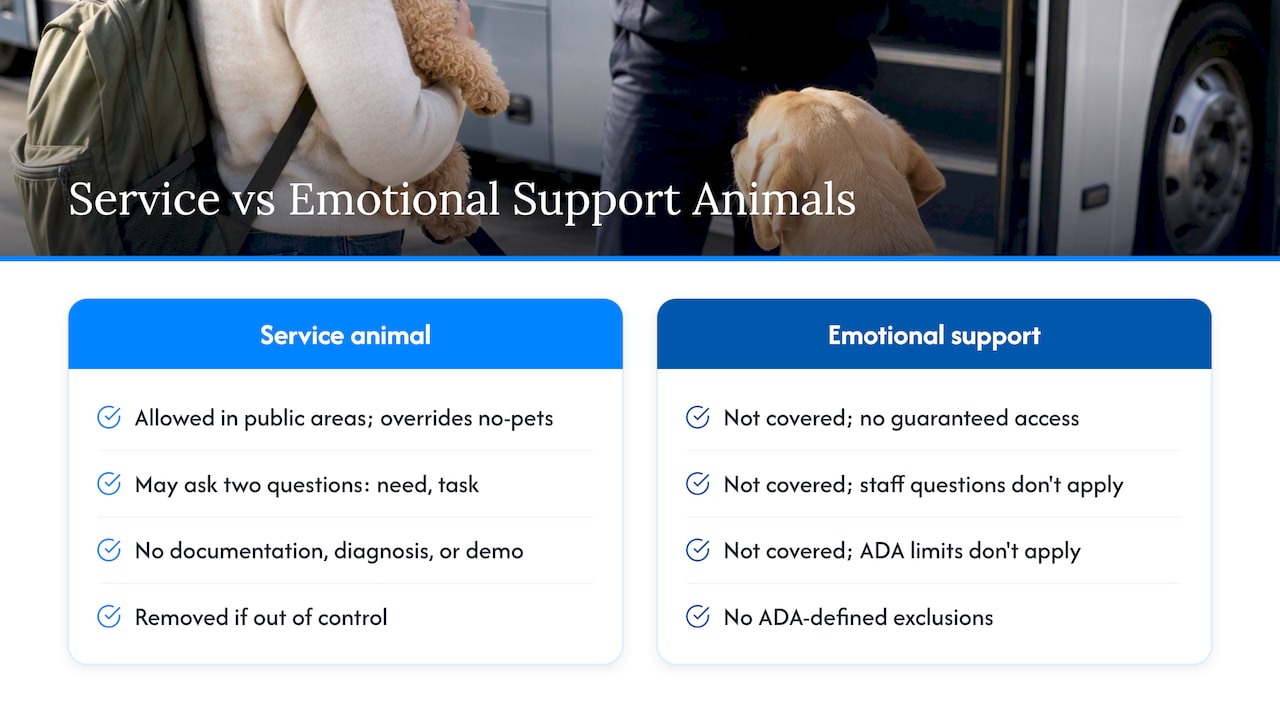
The Americans with Disabilities Act requires private entities operating charter bus services to permit service animals in all areas where the public is allowed, and that requirement overrides any company’s general “no pets” policy. A charter company cannot refuse a service animal because its contract says pets aren’t allowed.
ADA Title III covers charter and intercity bus transportation as a public-facing service, which means these protections apply the same way they would at a restaurant or hotel.
Staff may ask only two questions: whether the animal is required because of a disability, and what task it’s trained to perform. They cannot demand documentation, ask about the handler’s diagnosis, or require the animal to demonstrate its task. A legitimate exclusion still exists, though. Covered entities may remove a service animal that is out of control or not housebroken, or if accommodating it would require a fundamental change to the service itself. Emotional support animals, by contrast, don’t meet the ADA’s service animal definition and aren’t guaranteed the same access.
Booking checklist: what to tell your charter company in writing
A phone call isn’t enough. Get the arrangement in writing so there’s no confusion on travel day, especially with a group booking where multiple people might field questions from the driver.
- State it twice. Mention the animal during your initial inquiry, then confirm it again in your written booking request.
- Label it precisely. Say clearly whether it’s a pet or an ADA-defined service animal, since the rules and any fees differ.
- Ask for placement details. Request contract language confirming where the animal will ride or be stowed, any associated fees, and whether relief stops are built into the route.
- Document the specifics. Record carrier dimensions, liability terms, and a staff contact you can reach with day-of questions.
Our charter bus contract guide breaks down exactly which clauses to request when you want this kind of confirmation in writing.
Pro Tip: Ask for the animal policy in the same email thread as your quote, not a separate conversation. It becomes part of your paper trail if anything is disputed later.
Onboard containment, health, and safety rules for animals
Once you’ve confirmed the policy, the day-of details matter just as much. A pet typically needs a carrier that fits under a seat or in the luggage bay, while a service animal is expected to be leashed or harnessed and under the handler’s control for the entire trip.
- Containment: Pets stay in carriers; service animals stay harnessed or leashed unless the task requires otherwise.
- Health prep: Confirm vaccinations ahead of time and plan for motion sickness on longer routes.
- Relief stops: Build extra stop time into the itinerary rather than hoping the schedule flexes on its own.
- Behavior standards: Excessive barking, aggression, or lack of housebreaking are grounds for removal, even for a service animal.
Carriers like Amtrak draw this same line between service animals, which ride freely in passenger areas, and pets, which stay in approved carriers with set weight and duration limits.
If access is denied or a dispute occurs on travel day
Access disputes are rare, but when they happen, calm documentation matters more than arguing in the moment.
- Ask for a supervisor rather than debating with the driver directly.
- Document the interaction, including time, location, and exactly what was said.
- Collect witness names from other passengers if the exchange happened in front of the group.
- Save your paperwork. Keep booking confirmations and contract language that reference the animal policy.
- File a complaint with the DOJ’s ADA resources if you believe access was wrongly denied, and consult a local attorney if the dispute involves real financial loss.
One caution worth noting: misrepresenting a pet as a service animal can carry legal penalties in many states, so accurate labeling protects you as much as it protects the operator.
Reliant Transportation’s approach to animals on charters
We ask about animal accommodations during the initial booking conversation, not as an afterthought. When a group tells us a service animal will be traveling, we confirm the arrangement in writing and aim to build any needed relief stops into the itinerary before the trip.
- We request animal type, any service-animal tasks, and carrier dimensions up front.
- We document seating or storage placement in the contract so there’s no ambiguity on travel day.
- We coordinate relief stops as part of the route plan for longer trips.
- We stay within ADA requirements for service animals while being upfront about our general pet policy for groups.
Our amenities checklist covers onboard details worth considering alongside your animal accommodations, from restroom access to seating layout.
Planner perspective: balancing group logistics and accessibility
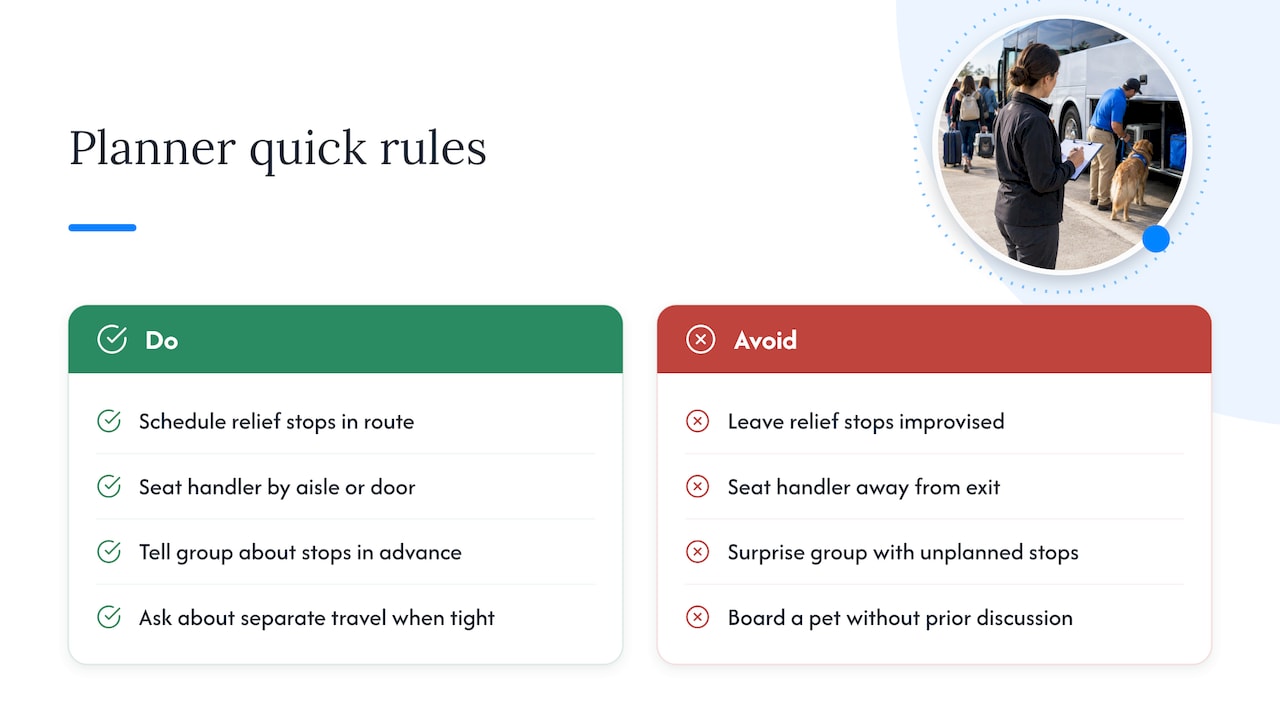
Relief stops are the piece planners forget until the day of the trip. Build them into your route from the start, not as an improvised pullover. Seat the handler near an aisle or door for easy exit, and tell the group ahead of time so nobody’s surprised by a stop.
If the route is long or the vehicle is tight on space, it’s worth asking whether a pet should travel separately. Not every trip can safely accommodate one, and that’s a better conversation to have before boarding than after.
— Dusty
Get a quote that accounts for your group’s animal needs

If you’re planning a group trip that includes a service animal or a pet in a carrier, we take those details into account when preparing your quote. When you reach out, we’ll ask about the animal’s role, any carrier specs, and whether your route might need relief stops addressed.
- Tell us upfront whether it’s a pet or a service animal, and any task the animal performs.
- Ask for written confirmation of placement arrangements and any fees.
- Request a relief-stop plan if your itinerary runs long.
For longer trips where pets also need travel prep beyond the bus itself, resources like these pet-safety tips for long-distance moves cover containment and comfort basics worth reviewing. When you’re ready to lock in your trip, book a charter bus and request a quote, or browse our full services page to see what fits your group.
FAQ
Can I take my dog with me on a bus?
It depends on whether your dog is a pet or an ADA-defined service animal. Service animals must be permitted in all passenger areas under the ADA, while pets are subject to each operator’s own policy, which often requires a carrier and may include a fee.
Is it stressful for a dog to be on a bus?
Travel stress varies by dog and by how well the trip is planned. Scheduling relief stops, keeping the animal secured, and avoiding long stretches without a break all help reduce discomfort on longer routes.
Can I take my dog with me on a Greyhound bus?
Policies differ by carrier and route, so you’ll need to confirm directly with whichever bus service you’re booking. ADA protections for service animals apply regardless of the carrier, but pet policies for non-service animals are set individually by each operator.
Do you tip your charter bus driver?
Tipping charter bus drivers is a common courtesy, though it isn’t required. Many groups tip based on trip length and service quality, similar to how they’d tip any professional driver.
Sources
- Ada
- Penalties for using a service dog or emotional support animal under false pretenses | Nolo
- Amtrak service animals policy