
A charter bus contract is a legally binding agreement that defines the scope of transportation services, establishes payment obligations, and allocates risk between the client and the carrier. Before you sign anything, here are the seven elements every solid agreement must include:
- Scope of services and itinerary — vehicle type, passenger count, route, pickup/drop-off times
- Vehicle and driver specifications — make, model, capacity, CDL requirement, drug-test policy
- Payment terms — deposit amount and due date, final payment window, invoicing process
- Cancellation and termination policy — tiered fee schedule, refund timeline, written notice requirements
- Insurance and COI requirements — coverage minimums, certificate of insurance delivery timing, additional-insured status
- Liability and indemnification — mutual vs. one-way language, hold-harmless scope
- Subcontracting rules — prohibition on unauthorized subcontracting, prequalification requirements for any approved sub-vendor
Start with an institutional template (university or K-12 procurement offices publish excellent ones), then have legal counsel or procurement review the indemnity and insurance language before you finalize.
Key Takeaways
A solid charter bus contract requires a COI naming the client as additional insured, a mutual indemnification clause, an express subcontracting prohibition, and verified driver credentials collected before departure.
| Point | Details |
|---|---|
| Require additional-insured COI | The COI must name your organization as additional insured, not just a certificate holder, and arrive at least 2 business days before departure. |
| Prohibit unauthorized subcontracting | Add an express clause requiring written approval for any subcontract; unauthorized subcontracting should trigger immediate termination rights. |
| Use tiered cancellation fees | Negotiate a sliding-scale schedule (10%–100% by lead time) with a force majeure credit option rather than a flat forfeiture. |
| Collect driver and vehicle evidence early | Confirm driver CDL, medical card, and vehicle inspection documentation at least 2 business days before the trip, not on departure day. |
| Use institutional templates | Start from ECSU, Trinity, University of Alaska, or Ithaca College templates and have legal review indemnity and insurance language before signing. |
| Reliant Transportation | For Portland, Willamette Valley, and Hood River events, Reliant Transportation provides COI documentation, credentialed drivers, and trip addendum support. |
Table of Contents
- Where to find sample charter bus contracts and templates
- Complete clause checklist for a charter bus agreement
- What each clause means and how to negotiate it
- Insurance, COI details, and regulatory compliance
- Subcontracting and vendor prequalification
- Pricing, deposits, incidental charges, and cancellation fees
- Itinerary details, trip addenda, and vehicle specifications
- Contract administration and pre-departure document collection
- Common pitfalls and risk-management recommendations
- Ready-to-use sample clauses for common contract sections
- Who should review and negotiate the contract
- Data privacy and passenger information handling
- A note from Reliant Transportation
- Reliant Transportation: a local carrier that handles the paperwork with you
- Sources
Where to find sample charter bus contracts and templates
The fastest way to build a solid agreement is to start from a proven institutional template rather than the carrier’s standard booking form. Several universities and risk-management organizations publish their contracts publicly.
Recommended institutional templates:
- Elizabeth City State University (ECSU) Charter Bus Contract — shows scope of services, COI timing (within 2 business days of departure), trip itinerary addendum format, and cancellation/termination language. One of the most complete publicly available samples.
- Trinity University Charter Bus Agreement — demonstrates a multi-year pre-approved carrier approach, independent-contractor status, assignment and subcontracting approval clauses, and a provision that institutional terms prevail over any conflicting provider invoice.
- University of Alaska Bus Charter Template — requires ICC and DOT numbers, a DOT safety rating of “Satisfactory,” and driver CDL plus medical card verification before service begins.
- Ithaca College Bus Chartering Procedures and Sample Contracts — includes sample COI language, deposit and payment guidance, and a clear warning not to accept vendor-supplied contracts when a master agreement already exists.
- DocHub fillable charter bus contract template — a digital, e-sign-ready template covering parties, itinerary, booking and payment procedures, liability, insurance, and force majeure. Useful for smaller organizations without a procurement department.
Trip addendum fields to fill in for each booking:
- Trip dates and departure/return times
- Pickup and drop-off addresses (staging plan included)
- Confirmed passenger count
- Vehicle type and minimum capacity
- Driver name and CDL number
- Total contract price and deposit amount paid
- Any special requirements (ADA accessibility, on-board amenities)
Pro Tip: Never let the carrier’s booking confirmation substitute for a signed contract. Ithaca College’s procurement guidance is explicit: if a master agreement exists, the provider’s confirmation is the only acceptable transactional document from the carrier. Your signed contract governs.
Always route the final draft through procurement or legal counsel before execution, especially for indemnity and insurance sections.
Complete clause checklist for a charter bus agreement
Use this checklist to audit an existing contract or build one from a template. Every item below should appear in the agreement before you sign.
Scope of services and performance specifications
- Vehicle type, year, make, and minimum passenger capacity
- Route obligations: specific pickup and drop-off locations, not just general areas
- On-board amenities required (restroom, Wi-Fi, climate control, luggage bays)
- Obligation to provide a substitute vehicle of equal or greater specification if the original is unavailable
Booking, trip addendum, and term
- Process for adding individual trips under an annual or multi-year master agreement
- Required lead time for submitting a trip addendum (typically 5–10 business days)
- Contract start and end dates, renewal options, and amendment process
- Confirmation that institutional terms prevail over any conflicting provider invoice or booking form
Payment terms
- Deposit percentage (typically 10%–20%) and due date (often within 10–14 days of booking)
- Final payment due date (typically 14–30 days before departure)
- Invoicing timeline and acceptable payment methods
- Late-fee rate for overdue invoices
- Billing audit rights: client’s right to request itemized receipts for incidental charges
- Cost caps or not-to-exceed clauses for variable charges
Cancellation, termination, and force majeure
- Tiered cancellation fee schedule (e.g., 10% at 30+ days, 50% at 15–29 days, 100% within 7–14 days)
- Written notice requirements and notice delivery method
- Refund timeline after cancellation
- Force majeure definition and which events excuse performance without penalty
- Client’s right to terminate for cause (nonperformance, safety violations) with no cancellation fee
Insurance and COI
- Minimum coverage amounts for commercial auto, general liability, employer’s liability, and passenger liability
- Requirement that the client be named as additional insured on all policies
- COI delivery deadline (ECSU’s sample contract requires delivery within 2 business days of scheduled departure)
- Carrier’s obligation to notify client of any policy cancellation or material change
- Minimum A.M. Best carrier rating requirement
Liability and indemnification
- Mutual indemnification language (both parties protect each other from their own negligence)
- Red flag: one-way indemnity requiring the client to indemnify the carrier for the carrier’s own negligence
- Limitation of liability cap, if any, and whether it applies to both parties equally
- Exclusion of consequential damages
Subcontracting
- Express prohibition on subcontracting without prior written client approval
- Requirement that any approved subcontractor meet identical insurance and safety standards
- Right to terminate immediately for unauthorized subcontracting
Pro Tip: If the contract you receive does not address subcontracting at all, that is a red flag. Risk management guidance from Gallagher/AJG identifies failing to address subcontracting as one of the most common organizer oversights. Add the clause yourself before signing.
What each clause means and how to negotiate it
Understanding the practical effect of a clause is the difference between a contract that protects you and one that looks fine until something goes wrong.
1. Payment clause
Deposits typically run within a reasonable percentage range of the total contract price, due shortly after booking, with the balance due a few weeks before departure. The timing matters because it directly determines your cancellation exposure: the closer to departure your final payment is due, the more money you have at risk if the trip is canceled. Negotiate for the longest possible final-payment window, and confirm whether the deposit is refundable if the carrier cancels.
2. Cancellation and termination
Tiered cancellation schedules are standard. What you want to negotiate: a weather or emergency exception that converts the fee to a credit rather than a forfeiture, and a mutual termination-for-cause clause that lets you exit without penalty if the carrier fails a safety inspection or substitutes an unacceptable vehicle.
3. Indemnity and hold-harmless
Ask for this language instead: “Each party shall indemnify, defend, and hold harmless the other party from and against any claims, damages, or expenses arising out of or resulting from that party’s own negligent acts or omissions.” That single sentence eliminates the most common one-sided indemnity trap.
4. Warranty and performance standards
A good contract specifies measurable service levels: on-time departure within a defined window (e.g., 15 minutes), a substitute vehicle of equal specification available within a set timeframe if the original breaks down, and a named remedy (partial refund, price reduction, or right to terminate) if the carrier fails to meet those standards. Vague language like “carrier will use best efforts” is not enforceable in any meaningful way.
5. Dispute resolution and jurisdiction
Mediation before arbitration is the most cost-effective path for transportation disputes. Arbitration clauses that require binding arbitration in the carrier’s home state can be expensive and inconvenient for institutional clients. Negotiate for mediation first, then arbitration in a mutually agreed neutral venue, and confirm which state’s law governs the agreement. For Oregon-based events, specifying Oregon jurisdiction keeps enforcement local.
Insurance, COI details, and regulatory compliance
Insurance is where most charter bus contracts fail in practice. Clients receive a COI, assume they are covered, and later discover they were never listed as additional insured. That gap can leave you without direct coverage in a third-party claim.
Typical insurance minimums to require
| Coverage Type | Suggested Minimum | Notes |
|---|---|---|
| Commercial auto liability | commercial auto minimum coverage | Per occurrence; covers vehicle operation |
| General liability | general liability minimum coverage | Covers non-vehicle incidents |
| Employer’s liability | employer’s liability minimum coverage | Covers carrier’s employees |
| Passenger liability | commercial auto minimum coverage | Specifically covers passengers |
Sample COI clause language:
“Carrier shall provide a Certificate of Insurance naming [Client Organization] as additional insured on all required policies no later than two (2) business days prior to the scheduled departure date. Carrier shall notify Client in writing within five (5) business days of any cancellation, non-renewal, or material change in coverage.”
Step-by-step verification checklist:
- Confirm the carrier’s USDOT number at the FMCSA Safety Measurement System and verify the safety rating is “Satisfactory”
- Check that the carrier’s operating authority is active (not revoked or suspended)
- Verify the COI lists your organization by name as additional insured, not just as a certificate holder
- Confirm policy effective and expiration dates cover the full trip period
- Check the A.M. Best rating of the insurer (A- or better is a standard institutional requirement)
- Require the carrier to provide updated COIs for any renewal or policy change before the trip
The University of Alaska’s bus charter template requires ICC and DOT numbers and a “Satisfactory” DOT safety rating as contract conditions, not just recommendations. That standard is worth adopting regardless of whether you are a university or a private event organizer.
Pro Tip: A COI that lists you as a “certificate holder” only means you receive notice of cancellation. It does NOT give you additional-insured status or direct coverage. Always confirm the words “additional insured” appear on the face of the certificate.
Subcontracting and vendor prequalification
Subcontracting is the single most underestimated risk in charter bus contracting. You book a carrier, sign a contract, and on the day of the trip a different company’s bus shows up, driven by a driver you have never vetted. That scenario is more common than most organizers realize, and Gallagher/AJG’s risk management guidance identifies it as a top organizer oversight.
Prequalification checklist for any approved subcontractor:
- Active USDOT number with “Satisfactory” FMCSA safety rating
- COI meeting the same minimums as the primary carrier, naming the client as additional insured
- Driver CDL and current medical card on file
- Written drug and alcohol testing policy
- Evidence of vehicle inspection within the past 12 months
- On-site visit or third-party audit (for high-risk or student travel)
Template restrictive subcontracting clause:
“Carrier shall not subcontract, assign, or delegate any portion of the services described herein without the prior written consent of Client. Any approved subcontractor must meet all insurance, safety, and licensing requirements applicable to Carrier under this Agreement. Unauthorized subcontracting shall constitute a material breach and entitle Client to terminate this Agreement immediately without penalty and recover all amounts paid.”

Pro Tip: The Trinity University Charter Bus Agreement handles this by maintaining a pre-approved carrier list with a multi-year term. If you run recurring events, that approach eliminates the subcontracting risk entirely: you only work with carriers you have already vetted.
Pricing, deposits, incidental charges, and cancellation fees
Knowing what you will actually pay, including the extras that rarely appear in the headline quote, is as important as negotiating the base rate.
Deposit and payment windows
| Timing | Typical Range | What It Means for You |
|---|---|---|
| Deposit due | Within 10–14 days of booking | Locks in the reservation; usually 10%–20% of total |
| Final payment due | 14–30 days before departure | Sets your maximum cancellation exposure |
| Cancellation at 30+ days | 10%–25% forfeited | Low risk window; negotiate for full refund here |
| Cancellation at 15–29 days | 25%–50% forfeited | Moderate exposure; credit option is worth requesting |
| Cancellation within 7–14 days | Up to 100% forfeited | High exposure; force majeure clause is critical here |
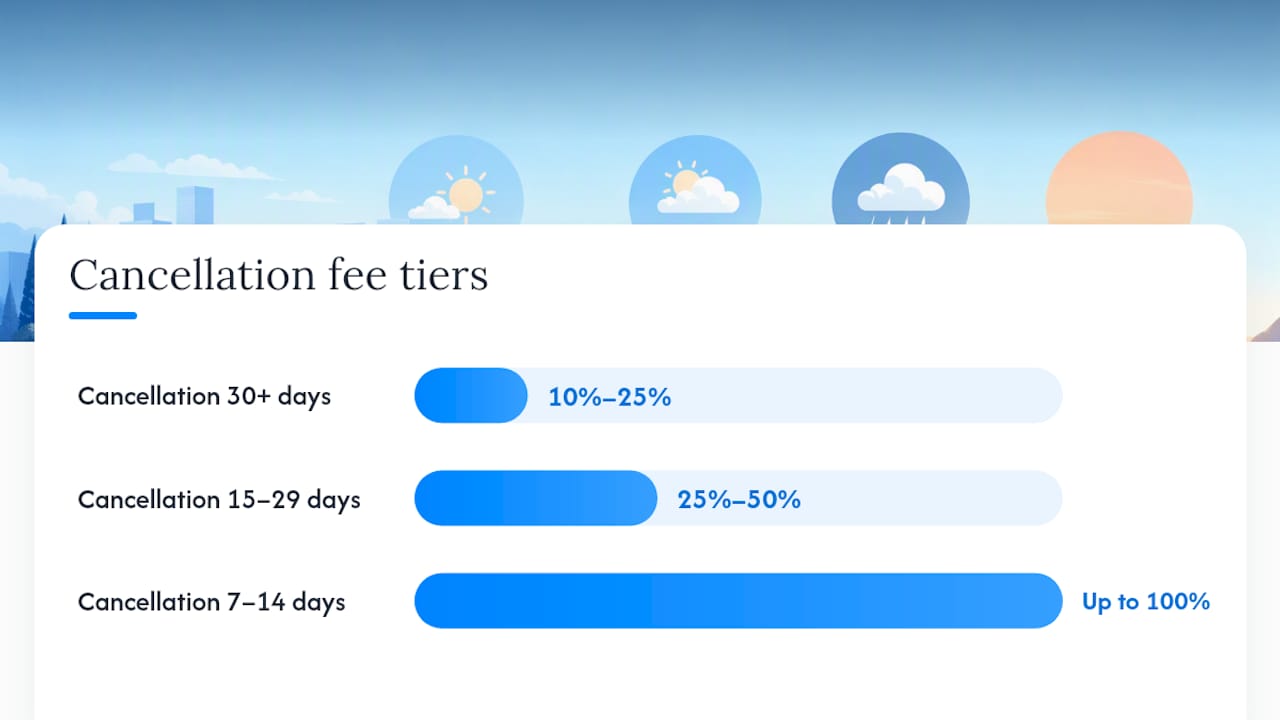
These ranges reflect the deposit and cancellation structures documented in Ithaca College’s bus chartering procedures.
Common chargeable extras to address in the contract:
- Driver overnight accommodations (specify who pays and the per-night cap)
- Tolls, parking, and fuel surcharges (require itemized receipts)
- Waiting time beyond the contracted window (specify the per-hour rate)
- Detour or route change fees (define what triggers a charge)
- Cleaning fees for excessive mess (define the threshold and maximum charge)
Billing audit clause to request:
“Client reserves the right to audit any invoice within thirty (30) days of receipt. Carrier shall provide itemized receipts for all incidental charges upon request within five (5) business days. Disputed amounts shall be withheld pending resolution without triggering a late-payment fee.”
Itinerary details, trip addenda, and vehicle specifications
A trip addendum is the document that turns a master agreement into an actionable booking. Getting it right prevents the most common day-of disputes.
What a trip addendum must capture:
- Exact departure date and time, with a buffer window (e.g., driver on-site 30 minutes before departure)
- All pickup and drop-off addresses, in sequence, with staging plan (where the bus parks, where passengers board)
- Confirmed passenger count and any ADA accommodation needs
- Vehicle type, minimum capacity, and required amenities
- Driver name and contact number
- Total price, deposit paid, and balance due date
- Any special instructions (no food/drink policy, luggage limits, chaperone contact)
Stephen F. Austin State University uses an annual form contract that generates individual trip addenda without re-executing the base agreement, which is a practical model for organizations that run multiple events per year.
Vehicle specification checklist:
- Minimum seated passenger capacity (confirm it matches your confirmed headcount plus a buffer)
- Luggage bay capacity (cubic feet or number of standard bags)
- Restroom on board (required or optional)
- ADA lift or ramp (required for any trip with mobility-impaired passengers)
- Climate control, Wi-Fi, power outlets, and entertainment system (specify which are required vs. preferred)
- Acceptable substitute vehicle specifications: document in writing what the carrier may substitute and what requires client approval
Passenger manifest and chaperone rules:
For student or youth travel, the contract should require a passenger manifest submitted to the carrier at least 24 hours before departure. Designate a trip monitor or chaperone in the addendum, name that person as the carrier’s on-trip point of contact, and specify their authority to approve minor route changes or delays.
Contract administration and pre-departure document collection
The contract is only as good as the documents collected before the bus rolls. A clear timeline prevents last-minute scrambles and protects you if something goes wrong.
- At contract execution: Collect the carrier’s USDOT number, FMCSA safety rating confirmation, and proof of operating authority. Confirm the carrier’s insurance broker contact for COI requests.
- 30 days before departure: Send the trip addendum for carrier countersignature. Confirm vehicle assignment and request the driver’s name and CDL number.
- 10 business days before departure: Request the COI naming your organization as additional insured. Verify FMCSA rating has not changed since execution.
- 2 business days before departure: Confirm COI is received and correct (per the ECSU sample contract standard). Verify driver CDL and medical card are current. Confirm vehicle inspection date and result.
- Day of departure: Trip monitor confirms vehicle matches the contracted specification. Driver presents CDL on request. Emergency contact numbers are confirmed with the driver.
Roles and signoffs:
- Procurement or contract administrator: executes the master agreement and approves any amendments
- Risk management: reviews and approves insurance and COI before departure
- Event coordinator or trip monitor: confirms addendum details and day-of logistics
- Legal counsel: reviews indemnity and liability language before execution
Emergency contact template to include in the contract:
- Carrier dispatch: 24-hour phone number
- Driver direct cell: provided in trip addendum
- Client trip monitor: named in addendum
- Client emergency contact (not on the trip): name and phone number
- Local emergency services: 911 plus any venue-specific security number
Common pitfalls and risk-management recommendations
Most contract failures are predictable. The same mistakes appear in institutional post-mortems and risk-management guidance across the industry.
The four highest-risk mistakes and how to fix them:
- Accepting the carrier’s standard booking terms as the contract. Carrier forms are written to protect the carrier. Use your own master service agreement and accept only a short confirmation or trip addendum from the provider. Ithaca College’s procurement guidance makes this point explicitly.
- One-way indemnity clauses. A clause requiring the client to hold the carrier harmless for the carrier’s own negligence is a significant and often overlooked risk transfer. Reject it and propose mutual indemnification language instead.
- Late or incomplete COI delivery. Receiving a COI after the trip has departed is not protection. Require delivery at least 2 business days before departure and verify additional-insured status on the face of the certificate, not just in the policy documents.
- No subcontracting prohibition. If the contract is silent on subcontracting, the carrier may legally assign the trip to any third party. Add an express prohibition with a termination-for-breach remedy.
Mitigation steps:
- Maintain an approved-vendor list with prequalification documentation on file for each carrier
- Require a performance warranty with a measurable service level and a named remedy
- Build a procurement signoff rule: no trip addendum is valid without risk management’s COI sign-off
- For contracts over $25,000, consider requiring a payment bond (K-12 guidance from AJG recommends this threshold)
Ready-to-use sample clauses for common contract sections
These clause snippets are starting points. Fill in the bracketed placeholders, then send the full indemnity and insurance sections to legal counsel before execution.
Indemnification (mutual):
“Each party (‘Indemnifying Party’) shall indemnify, defend, and hold harmless the other party and its officers, employees, and agents from and against any claims, losses, damages, or expenses (including reasonable attorneys’ fees) arising out of or resulting from the Indemnifying Party’s own negligent acts or omissions in connection with this Agreement.”
Insurance and COI:
“Carrier shall maintain, at its own expense, the following minimum insurance coverages throughout the term of this Agreement: (a) commercial auto liability of not less than $ combined single limit; (b) commercial general liability of not less than $ per occurrence; © employer’s liability of not less than $ per occurrence. Carrier shall name [Client Organization] as additional insured on policies (a) and (b) and shall deliver a Certificate of Insurance evidencing such coverage no later than business days prior to each scheduled departure.”
Cancellation:
“Client may cancel this Agreement upon written notice to Carrier. Cancellation fees shall be assessed as follows: (a) of the total contract price if notice is given or more days before departure; (b) if notice is given to days before departure; © if notice is given fewer than days before departure. Cancellation due to a declared state of emergency or force majeure event shall result in a full credit applicable to a rescheduled trip within months.”
Subcontracting prohibition:
“Carrier shall not subcontract, assign, or otherwise delegate performance of any services under this Agreement without Client’s prior written consent. Any approved subcontractor must satisfy all licensing, safety, and insurance requirements applicable to Carrier. Unauthorized subcontracting constitutes a material breach entitling Client to immediate termination without penalty and recovery of all amounts paid.”
Vehicle substitution:
“If the contracted vehicle becomes unavailable, Carrier shall provide a substitute vehicle of equal or greater passenger capacity and equivalent amenities. Carrier shall notify Client of any substitution no later than hours before departure. Client reserves the right to reject a substitute vehicle that does not meet the contracted specifications and to terminate without penalty.”
Driver qualifications:
“All drivers assigned under this Agreement shall hold a valid Commercial Driver’s License (CDL) with the appropriate passenger endorsement, a current DOT medical certificate, and shall have completed all required drug and alcohol testing under 49 CFR Part 382. Carrier shall provide driver name, CDL number, and medical card expiration date upon Client’s request and no later than days before each scheduled departure.”
The DocHub fillable template is a practical starting point for smaller organizations that want a complete, e-sign-ready document they can customize without building from scratch.
Who should review and negotiate the contract
Getting the right people involved early saves time and prevents expensive rework after the carrier has already been engaged.
- Procurement or purchasing officer — reviews the overall contract structure, confirms the carrier is on an approved-vendor list, and ensures institutional terms govern over any conflicting provider documents. This person should be the first reviewer.
- Risk management — focuses on insurance minimums, COI language, additional-insured status, and the indemnification clause. No trip should be approved without risk management’s sign-off on the COI.
- Legal counsel — reviews indemnity, hold-harmless, limitation of liability, dispute resolution, and jurisdiction clauses. For recurring or high-value contracts, legal review at execution saves significant exposure later.
- Event coordinator or trip monitor — reviews the trip addendum for accuracy: dates, times, passenger count, vehicle specs, and pickup/drop-off logistics. This person catches operational errors that procurement and legal may miss.
Negotiation priority order:
- Insurance and COI (highest financial exposure if wrong)
- Indemnification and hold-harmless (determines who pays when something goes wrong)
- Cancellation and termination (determines your financial exposure if plans change)
- Price, fees, and incidental charges (important, but lower risk than the above three)
Final signoff checklist:
- Master agreement signed by authorized signatories on both sides
- Trip addendum countersigned and attached
- COI received, verified, and filed (additional-insured status confirmed)
- Driver name, CDL, and medical card on file
- Vehicle inspection documentation received
- Emergency contact list distributed to trip monitor
Recommended turnaround: procurement review within 3 business days of receiving the draft; legal review within 5 business days; COI verification completed no later than 2 business days before departure.
Data privacy and passenger information handling
Charter bus contracts increasingly need a data privacy section, particularly when the client collects passenger names, contact information, or medical/accessibility needs to share with the carrier.
What to address in the contract:
- Purpose limitation: the carrier may use passenger information only to perform the contracted transportation services, not for marketing or any other purpose.
- Data minimization: specify exactly which fields the carrier receives (name, seat assignment, accessibility needs) and prohibit collection of anything beyond that scope.
- Storage and retention: require the carrier to delete or return all passenger data within a defined period after the trip (30 days is a common standard).
- Security obligations: the carrier should be required to maintain reasonable administrative, technical, and physical safeguards for any passenger data it holds.
- Breach notification: require the carrier to notify the client within 72 hours of discovering any unauthorized access to passenger information.
- Subprocessor restrictions: if the carrier uses a third-party dispatch or booking system, the same data-handling obligations must flow down to that subprocessor.
For organizations subject to state privacy laws, such as the California Consumer Privacy Act (CCPA) or similar frameworks, a data processing addendum (DPA) may be required. Even for smaller events, a brief data privacy clause protects both parties and signals to passengers that their information is handled responsibly.
A note from Reliant Transportation
Working in Portland, the Willamette Valley, and Hood River for over a decade, we see the same contract gaps come up repeatedly: COIs that arrive the morning of the trip, subcontracting clauses that are missing entirely, and cancellation schedules that leave the client with no recourse when weather forces a change. The single most practical thing a local event planner can do is require the COI at least 48 hours before departure and confirm additional-insured status before that window closes. That one step catches most of the insurance problems before they become claims.
Reliant Transportation: a local carrier that handles the paperwork with you
For high-stakes events like student travel, weddings, and multi-city corporate logistics, negotiating a complex template from scratch is often slower and riskier than working directly with a carrier that already operates to institutional standards. Reliant Transportation serves the Portland metro area, the Willamette Valley wine country, and Hood River with a DOT-compliant fleet, professional CDL drivers, and a straightforward process for COI delivery and verification.

When you book with Reliant Transportation, you get a carrier that provides COI documentation naming your organization as additional insured, confirms driver credentials before departure, and brings local route knowledge that generic national carriers simply do not have. For wedding shuttles, corporate event runs, or Willamette Valley wine tours, the logistics are handled so you can focus on the event itself.
Ready to skip the template negotiation and work with a carrier that already meets institutional standards? Contact Reliant Transportation to request a sample COI, check availability for your event date, or get help drafting a trip addendum that covers everything on this checklist.
Sources
These are the core institutional templates and guidance documents referenced throughout this article. Download the originals for your legal team before finalizing any agreement.
- Bus Chartering Procedures and Samples of Contracts and Certificate of Insurance | Ithaca College
- K-12 charter bus guidelines and risk-management guidance (Gallagher/AJG)
- Charter Bus Contract (Elizabeth City State University)
- University of Alaska bus charter template
- TRINITY UNIVERSITY CHARTER BUS AGREEMENT
- Charter Bus Contract Template: Fill out & sign online | DocHub