

To book a charter bus, gather your trip details, request an itemized quote, and confirm the reservation with a deposit. That’s the whole process, but getting a quote you can actually trust depends on what you hand over up front.
Before you request pricing, have these five details ready:
- Exact date and start/end times
- Full pickup and drop off addresses
- Headcount (with a small buffer)
- Luggage or equipment needs
- Rough itinerary, including any stops
Submit those details through an online quote form or by calling the operator directly. A written, itemized quote is the single most useful safeguard you have in this whole process, since it locks in scope before money changes hands. Most reputable operators respond within one business day and will ask follow-up questions if anything is vague.
Key Takeaways
Booking a charter bus successfully comes down to preparing accurate trip details, comparing itemized quotes, and verifying safety credentials before you pay a deposit.
| Point | Details |
|---|---|
| Gather trip details first | Confirm date, exact addresses, headcount, luggage, and itinerary before requesting a quote. |
| Compare itemized quotes | Check hourly versus mileage rates, deadhead, fuel surcharge, tolls, and overtime terms. |
| Verify operator credentials | Ask for a USDOT number and confirm FMCSA safety status before booking. |
| Book early for peak dates | Reserve 6 to 8 weeks ahead for weddings and major events, 2 to 4 weeks for standard trips. |
| Reliant Transportation option | Serves Portland metro, Willamette Valley, and Hood River with itemized online quotes and local route knowledge. |
Table of Contents
- Which Charter Bus Fits Your Trip?
- When Does a Charter Bus Make Sense?
- How to Book a Charter Bus Step by Step
- What Does a Charter Bus Cost?
- What’s Included in a Charter Bus Rental?
- What Should You Ask Before You Hire a Charter Bus Company?
- How Far in Advance Should You Book?
- What Do Experienced Planners Wish They’d Known?
- A Local Perspective on Booking with Reliant Transportation
- Ready to Reserve Your Bus in the Portland Area?
- Useful Resources for Planning Your Trip
- Frequently Asked Questions
- Sources
Which Charter Bus Fits Your Trip?
Picking the right vehicle starts with your itinerary, not your guest list. A wedding shuttle running loops between a hotel and a vineyard has different needs than a school trip hauling instruments and coolers across town.
- Minibus (15 to 25 passengers): short transfers, small wedding parties, airport runs.
- Shuttle or limo bus (20 to 30 passengers): upscale group outings, bachelorette parties, corporate mixers.
- Mini coach (25 to 35 passengers): mid-size weddings, wine tours, day trips.
- Full-size motorcoach (40 to 56+ passengers): multi-day tours, conferences, large school groups, long-distance travel.
Pro Tip: Don’t size the bus off headcount alone. A 40-person group with three coolers, luggage for an overnight trip, and a stop at a winery needs more cargo room than the same 40 people going straight to a football game.
When Does a Charter Bus Make Sense?
A charter bus earns its cost when a group needs to move together, on a schedule, without twenty separate cars trying to find parking.
- Wedding shuttles between ceremony, reception, and hotel blocks
- Corporate shuttles for conferences or client site visits
- School trips and field trips with chaperone accountability needs
- Airport transfers for large travel parties
- Multi-day tours, wine trips, and sports team travel
The real advantage is one point of contact and one driver responsible for the whole group, instead of a scattered convoy of rideshares. For a party of 30 or more, a chartered vehicle also tends to run cheaper per person than a fleet of shared shuttles or rideshare cars, especially once you factor in reliability. A wedding shuttle is a common example of that math working in a couple’s favor.
How to Book a Charter Bus Step by Step
Booking online is straightforward once you know what to prepare and what to check on the quote before you sign anything.
- Nail down your trip details first. Date, exact addresses (not just city names), start and end times, headcount with a small buffer, luggage or equipment, accessibility needs, and whether the same driver stays with you for a multi-day trip.
- Request quotes from more than one operator or use an online quote tool to compare pricing quickly. Getting two or three quotes matters more for cost accuracy than any single “best price” claim.
- Read the written quote line by line. It should itemize hourly rate versus mileage, deadhead charges (time and mileage the bus travels before and after your trip), fuel surcharge, tolls, gratuity guidance, overnight lodging costs if the trip runs multiple days, the overtime rate, and the cancellation terms.
- Confirm the reservation with the requested deposit. Get the confirmation and contract in writing, not just a verbal “you’re all set.”
Pro Tip: If your headcount isn’t locked yet, say so upfront. Give the operator a range (“40 to 45 guests”) instead of a single number, and ask whether they offer a hold-and-change policy that lets you adjust vehicle size closer to the date without losing your deposit.
What Does a Charter Bus Cost?
Charter pricing usually runs on an hourly or daily rate, sometimes blended with a per-mile charge for longer routes. Several factors push that number up or down before you ever see a final quote:
- Vehicle size and amenities (restroom, Wi-Fi, reclining seats)
- Hours booked versus miles driven
- Deadhead time, meaning the drive to and from the operator’s yard
- Fuel surcharges during high fuel-price periods
- Tolls along the route
- Peak-date premiums for weekends, holidays, and wedding season
- Driver gratuity, typically not included in the base rate
- Overnight lodging for the driver on multi-day trips
- Minimum booking hours, which most operators enforce even for short trips
A three-day multi-day trip typically costs more per day than a single-day rental once you add overnight driver lodging, extended mileage, and a higher minimum hour commitment. A request for a 50-passenger motorcoach generally runs higher than a 40-passenger mini coach, both because the vehicle itself costs more to operate and because fewer large coaches are available on short notice. Treat any number you see online as a rough range, not a locked figure, since fuel costs, dates, and regional demand all shift the total.
Pro Tip: Ask for one all-in number, not a headline hourly rate. A $150-per-hour quote that hides a fuel surcharge, deadhead fee, and mandatory overtime rate can end up costing more than a $175-per-hour quote that includes everything. Confirm overtime and cancellation terms in writing before you pay a deposit.
What’s Included in a Charter Bus Rental?
Most quotes include the driver, basic vehicle cleaning, and standard liability insurance. Everything else tends to be itemized separately, and this is where surprise charges sneak in if you don’t ask.
Cleaning or damage fees usually kick in for spills, smoking, or excessive trash left behind. Driver lodging applies any time a multi-day trip runs long enough that the driver can’t legally return home under federal hours-of-service rules.
What Should You Ask Before You Hire a Charter Bus Company?
Vetting a provider takes five minutes and protects you from a canceled trip or an uninsured vehicle showing up on your event day.
Ask every operator for their USDOT number and confirm it against FMCSA safety records. Ask about insurance limits, driver CDL and P-endorsement status, background check policies, recent maintenance records, and what backup plan exists if a bus breaks down. The United Motorcoach Association publishes safety guidance that’s worth reviewing if you want a sense of what “good” looks like industry-wide.
- Vague or verbal-only pricing with no written itemization
- Refusal to share a USDOT number or insurance certificate
- No stated backup vehicle plan
- Unclear or missing cancellation policy
A refundable deposit window that isn’t spelled out in writing isn’t a deposit you can count on. If the contract doesn’t state exactly when your money becomes nonrefundable, ask before you sign, not after.
How Far in Advance Should You Book?
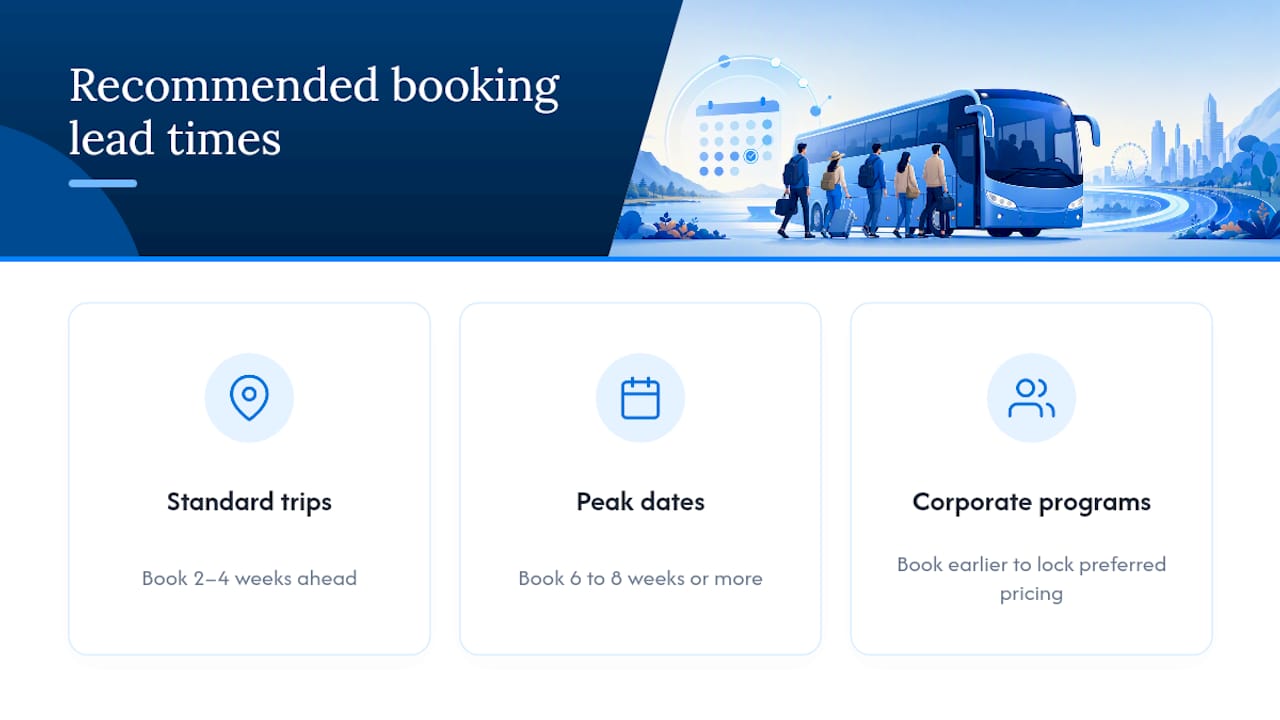
Standard trips book comfortably 2 to 4 weeks out. Peak dates, weddings, prom season, and major local events call for 6 to 8 weeks or more, since the best vehicles get reserved first. Recurring corporate programs benefit from booking even earlier to lock in preferred pricing.
Lock your itinerary once addresses and times are firm, but hold flexible options (headcount ranges, tentative dates) as long as the operator allows it.
What Do Experienced Planners Wish They’d Known?
A few habits separate a smooth trip from a stressful one:
- Designate one lead contact for all driver communication, not a group chat of five people.
- Build in a 10 to 15 minute boarding buffer for every stop.
- Confirm the exact entrance or loading zone at each venue, not just the street address.
- Book headcount with a realistic buffer instead of an exact guess.
Pro Tip: Ask where the operator’s yard is located. If your pickup point is far from it, you’re paying deadhead time on both ends of the trip. Staging your pickup closer to the yard, when feasible, can shave real dollars off the final invoice.
A Local Perspective on Booking with Reliant Transportation
We built our quoting process around one idea: you shouldn’t have to chase down hidden fees to know what your trip actually costs. When you reach out, we walk through your addresses, timing, and headcount up front, then send an itemized quote that spells out gratuity guidance, fuel surcharges, and overtime terms before you commit to anything.
Because we serve the Portland metro, Willamette Valley wine country, and Hood River almost exclusively, we know the yard-to-pickup math cold, which means fewer deadhead surprises and fewer permit scrambles on your event day.

Ready to Reserve Your Bus in the Portland Area?
Reliant Transportation is the local alternative to guessing your way through a national booking platform: you get a Portland-based team that already knows the wine country back roads, the Hood River loading zones, and the wedding venues that require a specific pickup lane, so your quote reflects reality instead of a generic national rate.
Booking is simple. Request a quote online through our services page to see fleet options and amenities, or call our team directly for same-day answers on availability. We serve weddings, corporate shuttles, school trips, and multi-day tours across the Portland metro, Willamette Valley, and Hood River, and our fleet ranges from minibuses to full-size motorcoaches with restrooms and Wi-Fi. If you’re planning a regional trip, our Oregon touring page shows how groups use our coaches for wine country and scenic day trips. For planners juggling multiple pickup points and schedules, a tool like TravelEngine can help coordinate logistics on your end before you even request a quote.
Ready to lock in a date? Request your itemized quote today and get a firm number back within one business day.
Useful Resources for Planning Your Trip
Check venue-specific loading zone rules early, since many parks, campuses, and attractions restrict where a large coach can stop.
- United Motorcoach Association for safety standards and operator vetting guidance
- University of Washington as an example of campuses with multiple restricted entrances
- Pike Place Market for an example of urban loading-zone constraints
- Kerry Park — Seattle Parks for municipal bus parking and drop-off guidance
Frequently Asked Questions
How much does it cost to book a charter bus for a 3-day trip?
A 3-day trip typically costs more per day than a single-day rental because of overnight driver lodging, extended mileage, and higher minimum-hour requirements. Ask for a full itemized quote to see the actual total rather than relying on a headline daily rate.
What does a 50-passenger charter bus cost compared to a 40-passenger bus?
A 50-passenger motorcoach generally costs more than a 40-passenger mini coach, both because the larger vehicle is more expensive to operate and because fewer large coaches are available on short notice during peak season.
How far in advance should I book a charter bus?
Book standard trips 2 to 4 weeks ahead. For weddings, prom season, or major local events, book 6 to 8 weeks out or more to secure your preferred vehicle.
What’s typically not included in a charter bus quote?
Gratuity, fuel surcharges, tolls, permits, overtime beyond contracted hours, and overnight driver lodging on multi-day trips are usually billed separately from the base rate.
How do I verify a charter bus company is legitimate?
Ask for their USDOT number and check it against FMCSA safety records, confirm insurance limits, and ask about driver background checks and backup vehicle plans before signing a contract.


Pingback: COI and Driver Roster for School Field Trip Buses, Book 4–8 Weeks
Pingback: Portland Coaches: 3 Documents to Demand Before Team Bus Travel
Pingback: Travelers: Confirm 110V and USB Bus Power Outlets Before You Book
Pingback: Portland to Hood River: What Operators Add to Charter Bus Costs
Pingback: $150–$300 PDX Transfers: Portland Corporate Shuttle Costs & Checklist
Pingback: What to Demand in Portland Wedding Shuttle Quotes: 3 Pricing Types
Pingback: Portland Party Bus Prices: 3 Inputs for Hood River Event Planners