
For school field trips, hire a vetted charter operator that supplies CDL drivers, proof of insurance, and current inspection records. Before you commit, request a certificate of insurance naming your district, a driver credential list, and the vehicle’s inspection history. Send that request today so your business office has time to approve the paperwork before the trip date.
TL;DR:
- Charter buses with documented safety compliance, current insurance, and licensed drivers are essential for smooth and accountable school trips.
- Full-size motorcoaches are best suited for large groups and long-distance trips, with accessible options available for students with mobility needs.
- Precise planning, early booking, and detailed contingency arrangements help prevent delays, roadside issues, or unqualified drivers from disrupting schedules.
- School districts require procurement approval, insurance proof, and an appropriate timeline of two to three weeks for vendor approval before trip dates.
- Clear supervision, boarding protocols, and tailored accommodations are crucial for student safety, especially during loading, unloading, and emergency situations.
Table of Contents
- Why Charter Buses Are the Practical Choice for School Field Trips
- Bus Types and Capacity: Picking the Right Vehicle
- What Safety and Compliance Checks Should Schools Require?
- How Do You Choose the Right Charter Operator?
- Costs, Budgeting, and When to Book
- Amenities, Accessibility, and Student Comfort
- What Timeline and Approvals Do Schools Typically Need?
- Emergency Procedures and Contingency Planning
- Child Supervision and Chaperone Responsibilities During Transport
- Loading and Unloading Protocols for School Children
- Special Accommodations for Students With Disabilities or Medical Needs
- Reliant Transportation’s Perspective on School Field Trip Planning
- How to Get a Quote From Reliant Transportation
- Sources
- FAQ
Why Charter Buses Are the Practical Choice for School Field Trips
Coordinating parent drivers for a field trip means juggling a dozen different vehicles, insurance policies, and arrival times. A charter bus collapses all of that into one driver, one route, and one point of accountability.
That single-driver model isn’t just convenient. It also cuts down the number of variables that can go wrong on a trip:
- One trained, credentialed driver instead of several parent volunteers of varying experience
- A single pickup and drop-off point, which simplifies headcounts and supervision
- Flexible itineraries that can include multiple stops, waiting time, and same-day return
- Enough room for gear, luggage, and equipment on longer or multi-school outings
- Onboard restrooms and climate control for full-day trips or long-distance travel
Charters earn their keep most clearly on all-day excursions, trips spanning multiple schools, or any outing where a two-hour drive each way makes a restroom onboard a necessity rather than a nice-to-have.
Bus Types and Capacity: Picking the Right Vehicle
Charter fleets break down into a few standard categories, and knowing them helps you request the right vehicle instead of guessing.
- Minibus or van (12 to 24 passengers): Best for small groups, short distances, or when a full-size coach would run mostly empty.
- Shuttle bus (28 to 35 passengers): A middle ground for classroom-size groups with a chaperone or two, often used for local museum or park trips.
- Full-size motorcoach (40 to 60 passengers): The standard choice for larger classes, multi-school trips, or longer drives where storage and restroom access matter.
- Multi-function activity buses: Configured for equipment-heavy trips like sports outings or overnight excursions.
If any student uses a wheelchair or needs a lift-equipped vehicle, say so when you request quotes. Not every bus in a fleet carries a lift or ramp, and operators need advance notice to assign the right one. Reliant Transportation’s guide to charter bus sizes breaks down capacity and legroom differences in more detail if you’re still deciding between a shuttle and a full coach.
What Safety and Compliance Checks Should Schools Require?
Regulatory oversight of school transportation is more layered than most planners expect, and knowing where the lines fall changes what you should ask an operator for.
The Federal Motor Carrier Safety Administration explains that Federal Motor Carrier Safety Regulations apply differently depending on the trip. A charter contractor running an interstate extracurricular trip generally falls under FMCSRs, while a district’s own home-to-school routes are often exempt. That distinction matters less than you’d think in practice, because most reputable charter operators comply with FMCSR driver and vehicle standards voluntarily, even when a strict exemption applies.
Even when the rules don’t technically require it, most established charter operators follow federal safety standards anyway. Ask to see the paperwork rather than assuming compliance.
Before you sign anything, request:
- Proof the driver holds the correct commercial driver’s license, since FMCSA guidance confirms CDL and drug and alcohol testing requirements apply broadly to school bus operators
- Recent vehicle inspection logs and a summary of the operator’s maintenance schedule
- Confirmation of the operator’s DOT or MC number, which you can cross-check against FMCSA’s SAFER system
State oversight varies too. The Government Accountability Office found that all 50 states require school bus inspections, but frequency and enforcement differ by state. That’s exactly why you request the inspection log yourself instead of taking a company’s word for it.
How Do You Choose the Right Charter Operator?
A good operator makes verification easy. A shaky one gets vague fast. Here’s the order to work through when vetting a charter bus company for a school trip.
- Request the document packet first. Ask for a certificate of insurance naming your district as an additional insured, current vehicle inspection records, and a driver roster showing CDL endorsements and drug and alcohol testing compliance.
- Read the contract closely. Confirm pricing, cancellation terms, overtime and extra-hour rates, liability limits, and exactly which stops and passenger counts are covered. Reliant Transportation’s guide to charter bus contracts walks through the clauses worth negotiating before you sign.
- Ask direct questions. Has the company transported student groups before? Can it provide school references? What’s the backup plan if the assigned bus or driver becomes unavailable the morning of the trip?
- Watch for red flags. An operator that hesitates to share a COI or driver credentials, gives vague answers about maintenance, or quotes a price far below competitors with no itemized breakdown is not one to book.
Pro Tip: Ask every operator for the same document packet, in the same order, so you’re comparing apples to apples instead of trying to remember who sent what three weeks ago.
Costs, Budgeting, and When to Book
Charter pricing depends on more than distance. Mileage, trip duration, driver hours, seasonality, and amenities like a restroom or Wi-Fi all factor into the quote, and so does deadhead time, the miles the bus drives empty before and after your trip.
Most operators price using one of three models: a per-mile rate, an hourly rate with a minimum, or a flat day rate for longer bookings. Confirm upfront whether overtime, tolls, and parking fees are included or billed separately, since these are the line items that quietly inflate a final invoice.
Because state inspection and oversight standards vary widely, and demand for buses spikes hard during spring field trip season, booking early protects both your budget and your options.
- Request quotes 4 to 8 weeks ahead for a routine single-bus trip
- Book further out for multi-bus trips, peak spring dates, or trips requiring specialized accessible vehicles
- Get an itemized quote rather than a lump sum, so you can budget accurately for chaperone seating and contingency overtime
Amenities, Accessibility, and Student Comfort
Not every trip needs every feature, but a few amenities stop being optional once the trip runs long or the group has specific needs.
- Restroom access: Close to essential for any trip over two hours or with young children.
- Seat belts and HVAC: Standard on most modern motorcoaches, worth confirming on older shuttle fleets.
- Power outlets and Wi-Fi: Nice for longer trips but rarely a dealbreaker.
- Accessibility: If any student requires a wheelchair, request a lift-equipped or ramped vehicle and plan seating space in advance rather than at the curb.
- Seating and supervision: Assign a seating chart with chaperones distributed through the bus, not clustered at the front, to manage behavior and monitor students with medical needs.
- Medical readiness: Confirm where medications and the first-aid kit are stored, and make sure the driver and lead chaperone both know.
Reliant Transportation’s amenities checklist and seating chart templates give planners a starting point for both decisions.
What Timeline and Approvals Do Schools Typically Need?
Most districts require more than a signed contract before a bus can roll. Business offices typically need a certificate of insurance naming the district as an additional insured, and many require the vendor to be entered into the district’s procurement or approved-vendor system before payment can be processed.
That approval step is where trips get delayed, not the actual booking. A charter industry guide notes that vendor approval often requires the operator to already be set up in a district’s procurement system, and an operator with no prior history with your district can add weeks to that process alone.
Here’s a realistic sequence to follow:
- Request the operator’s COI, W9, and any standard district vendor forms as soon as you have a date and headcount.
- Submit those documents to your business office at the same time you request quotes, not after you’ve chosen a vendor.
- Confirm whether your district requires a background check disclosure for the driver or company, since some do even when the driver isn’t a district employee.
- Build in at least two to three weeks of buffer between vendor approval and the trip date, longer if it’s your first time booking with that operator.
An operator that has worked with your district before, or with nearby schools in your area, can shortcut this considerably. Ask directly whether they’re already an approved vendor with any school in your region.
Emergency Procedures and Contingency Planning
Ask every operator, before you book, what happens if the bus breaks down or the driver becomes unavailable. The answer tells you more about the company than almost any other question on your checklist.
A reliable operator should be able to describe a specific backup plan: a second driver on call, a spare vehicle in the fleet, and a communication protocol for notifying the school if a delay happens. Vague reassurance without specifics is a warning sign, not a policy.
Build your own contingency plan alongside the operator’s:
- Confirm the driver’s cell number and the dispatch office’s number before departure, and share both with your lead chaperones.
- Establish a plan for what happens if the bus is delayed by more than 30 minutes, including who notifies parents.
- Know the operator’s protocol for a roadside breakdown, including whether they dispatch a replacement bus or arrange alternate transportation.
- Confirm chaperone responsibilities in the event of an accident, including who stays with students and who handles communication with the school and emergency services.
The NHTSA’s pupil transportation guideline recommends running a brief evacuation drill and safety talk with students before departure on activity and charter trips. It takes five minutes and means students already know what to do if the driver ever needs them to move quickly.
Child Supervision and Chaperone Responsibilities During Transport
The bus driver’s job is driving. Supervision is the chaperones’ job, and that division needs to be explicit before the wheels start turning.
A workable ratio for most elementary and middle school trips runs one chaperone for every 8 to 10 students, tighter for younger children or students with medical or behavioral support needs. Assign each chaperone specific seats or a specific section of the bus, not a vague “keep an eye on things” instruction that nobody actually owns.
Chaperones should know, before boarding:
- Where the emergency exits and first-aid kit are located
- Which students have medical needs, allergies, or medications, and where those are stored
- The plan for restroom or rest stops on longer trips
- Who counts heads at every stop, and how that count gets confirmed against the original roster
Assign one adult, usually the lead teacher, as the point of contact with the driver for the entire trip. That keeps communication clean if a problem comes up mid-route, rather than three different chaperones giving the driver three different instructions.
Loading and Unloading Protocols for School Children
Loading and unloading is where most minor incidents happen on field trips, not the driving itself. A clear protocol at both ends of the trip prevents the chaos of dozens of kids trying to board or exit at once.
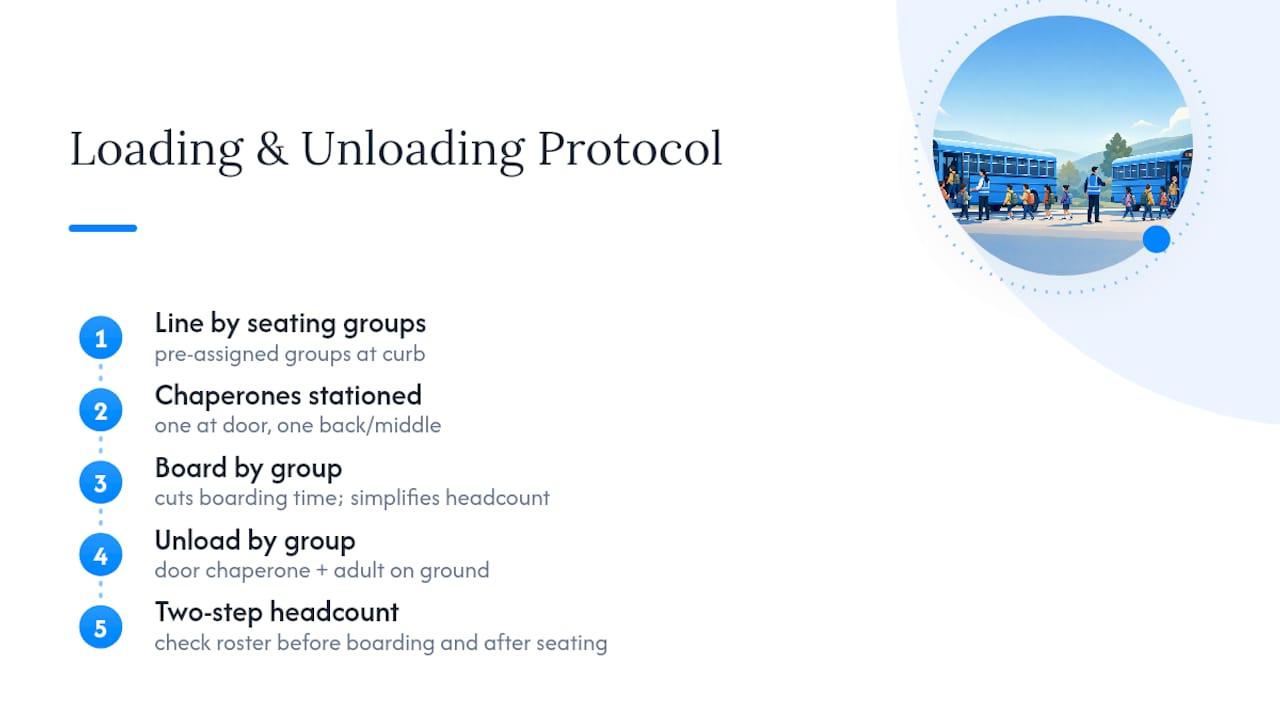
Line students up by pre-assigned seating groups before boarding, rather than letting them board in whatever order they arrive at the curb. This cuts down boarding time and makes the headcount simple to verify. Have one chaperone stationed at the bus door counting students on, and another at the back or middle of the bus confirming seating.
At the destination, unload the same way you boarded: by group, with a chaperone stationed at the door and another already on the ground to receive students. Never let students exit into a moving parking lot or active drop-off lane without an adult positioned to guide them.
Before departure from the destination, run a full headcount against the original roster twice, once before boarding and once after everyone is seated. This two-step check is the single most effective way to catch a missing student before the bus pulls away, and it costs less than a minute.
Special Accommodations for Students With Disabilities or Medical Needs
Students with mobility limitations, medical conditions, or other support needs require planning that starts when you request the quote, not the morning of the trip.
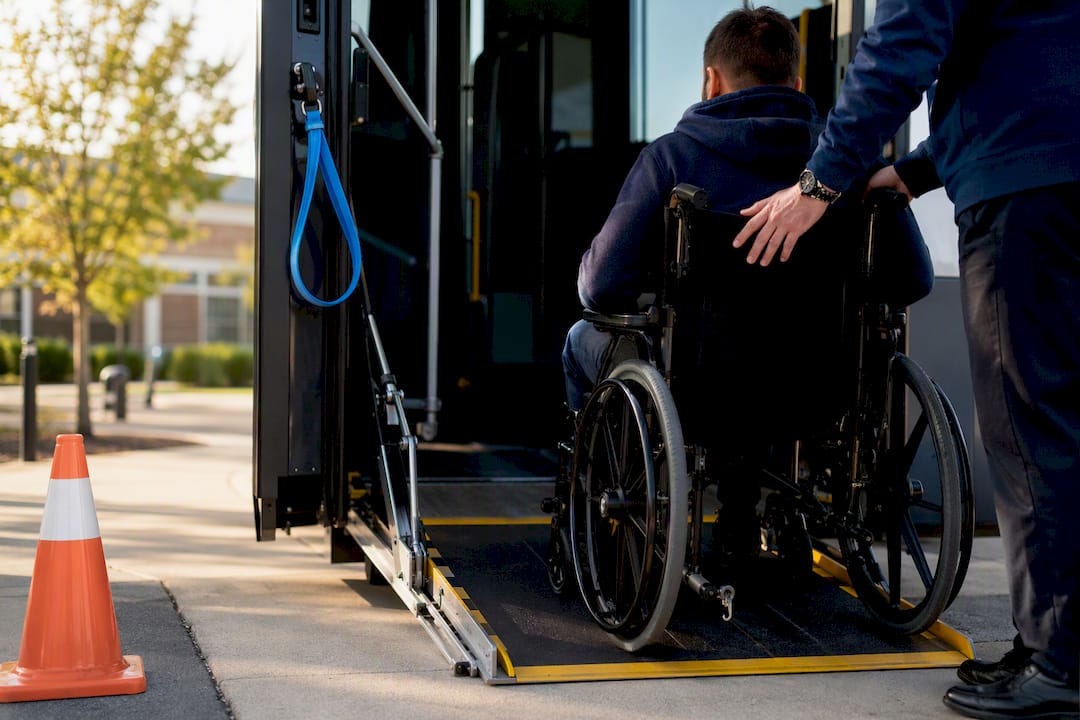
If a student uses a wheelchair, request a lift-equipped or ramped vehicle explicitly, and confirm the operator has one available for your date, since not every bus in a fleet carries this equipment. Space planning matters too. A wheelchair position near an exit, with a chaperone assigned specifically to that student, works better than trying to figure it out once everyone’s already seated.
For students with medical conditions requiring medication, such as an EpiPen or an inhaler, designate one chaperone as the person responsible for that specific student’s medication, and make sure the driver knows where it’s stored in case of an emergency stop. The same safety caveat applies here as with any other emergency plan on the bus: know the location, know who’s responsible, and confirm it out loud before departure, not after something happens.
If a student has a behavioral support plan, share the relevant parts with the assigned chaperone in advance so seating and supervision can be arranged accordingly, rather than reacting mid-trip.
Reliant Transportation’s Perspective on School Field Trip Planning
The planning mistakes we see most often at Reliant Transportation aren’t about the bus itself. They’re about paperwork arriving too late to clear a district’s approval process, or a seating chart getting sketched out on the morning of the trip instead of the week before.
We keep our certificates of insurance, driver rosters, and inspection documentation ready to hand over the moment a school requests them, because we know your business office is often the real bottleneck, not the booking. We also encourage every planner to build in an arrival buffer of at least 15 minutes on both ends of the trip, plan restroom and meal stops before departure rather than mid-route, and ask directly about backup driver and vehicle policies before signing anything, with any operator, not just us.
Our own seating chart templates and amenities checklist exist because these are the two documents planners ask for most, and having them ready in advance saves a full week of back and forth with your school office.
— Dusty
How to Get a Quote From Reliant Transportation
A direct option for school groups in the Portland, Oregon metro area, the Willamette Valley wine region, and Hood River is a bus service that provides the necessary paperwork in advance, not just a driver behind the wheel.
When you’re ready to request a quote, send us your trip date, passenger count, full itinerary including stops, and any accessibility or medical accommodations your group needs. We’ll provide a certificate of insurance and driver documentation formatted for school district approval, so your business office isn’t chasing us for paperwork the week before departure. Our general charter services cover school and group outings alongside corporate and event transportation, and if you’re ready to lock in a date, you can request a quote and reserve online now, before peak field trip season fills up the calendar.
Sources
- Education-Related Transportation | FMCSA
- School Bus Safety: Crash Data Trends and Federal and State Requirements (GAO-17-209)
- Highway Safety Program Guideline No. 17: Pupil Transportation Safety | NHTSA
- Field Trips Without the Fuss: Your Complete Guide to Organizing Student Travel | CharterUP
FAQ
How much does it cost to rent a school bus for a field trip?
Cost depends on mileage, trip duration, driver hours, and the season, with most operators pricing by the mile, the hour, or a flat day rate. Reliant Transportation’s pricing is available directly through a quote request, since it depends on your specific itinerary and passenger count.
What does a school bus cost in 2026?
There’s no single published number, since pricing varies by region, vehicle type, trip length, and season. Requesting itemized quotes from a few operators, as recommended in charter industry planning guides, is the most reliable way to budget accurately.
Which company is best for school field trip buses?
The best choice is any operator that can produce a current certificate of insurance, driver CDL and drug testing records, and vehicle inspection logs on request. In the Portland, Oregon metro area, Willamette Valley wine region, and Hood River, some operators supply this documentation directly to support school vendor approval.
Do school buses still exist as a transportation option?
Yes, traditional school buses and charter motorcoaches both remain common options for field trips, and many districts use charter operators specifically for trips beyond regular bus routes. Charters are typically chosen for longer distances, larger groups, or trips needing amenities like restrooms that standard school buses may lack.
Are FMCSA rules required for school field trip buses?
It depends on the trip. FMCSA guidance notes that interstate charter trips run by contractors generally fall under Federal Motor Carrier Safety Regulations, while many school-run local routes are exempt, though most reputable operators follow the same standards voluntarily either way.