
For most organized groups, choose a charter bus once your headcount hits about 15 people, since cost per person, safety data, and comfort all tip in the bus’s favor at that size. Choose a van only for smaller, flexible groups, split itineraries, or short hops under 10 miles. If a charter makes sense for your trip, Reliant Transportation, serving Portland, the Willamette Valley wine region, and Hood River, is built to size the right vehicle to your group and handle the logistics from there.
TL;DR:
- Charter buses become more cost-effective than multiple ride-shares when group sizes reach 15 to 20 passengers, especially during peak times with surge pricing.
- A 15-passenger van carries significant safety risks due to its tendency to rollover when fully loaded, and most rental drivers lack the specialized experience required for safety and liability.
- Long trips over 90 minutes demand amenities like restrooms and climate control, which are standard on full-size coaches but limited or absent in vans.
- For groups under 12 or short trips under 10 miles, vans provide better flexibility and lower costs, but safety and comfort decline with trip length and size.
- Booking in advance (2 to 3 months for full-size coaches) ensures availability during busy seasons, and providing detailed group info upfront avoids costly last-minute changes.
Table of Contents
- Charter Bus vs Van: Comparing Seats, Luggage, and Amenities
- Cost Breakdown: When the Charter Bus Actually Wins
- Why 15-Passenger Vans Carry Real Safety Risk
- How to Choose: A Quick Checklist Before You Request Quotes
- When a Van Actually Makes More Sense
- Environmental Impact and Fuel Efficiency
- Accessibility Features for Passengers With Disabilities
- Booking Timelines: How Far Ahead to Reserve
- Pros and Cons by Group Size and Trip Length
- What Actually Trips Up Organizers
- Get a Clear Quote From Reliant Transportation
- Sources
Charter Bus vs Van: Comparing Seats, Luggage, and Amenities
The vehicle classes available to organizers break down by seat count, and each tier changes what you can realistically fit and carry. A Sprinter van seats 12 to 15 passengers and works fine for a quick airport run, but legroom and headroom shrink fast once every seat fills. A 15-passenger van is the smallest option most rental fleets offer, and it’s also the one with the most documented safety concerns, which the safety section below covers in detail.
Minibuses step things up to 18 to 35 passengers, often with higher ceilings, more legroom, and actual underbody luggage bays instead of a cargo shelf behind the last row. Full-size coaches top out around 50 to 56 seats and typically include the amenities that make longer trips tolerable: reclining seats, onboard restrooms, individual climate vents, and Wi-Fi on many fleets.
Luggage capacity is where vans quietly fail organizers. A 15-passenger van has maybe enough room for a duffel bag per person if you’re lucky, and golf clubs, wedding décor, or ski gear will not fit once the seats are full. Minibuses and coaches carry that same gear in dedicated bays instead of eating into passenger space.
What actually changes the trip experience:
- Restrooms matter on anything over 90 minutes, especially with older guests or kids in the group.
- Reclining seats turn a long drive into rest time instead of dead time.
- Climate control zones prevent the front-of-van, back-of-van temperature battle common on shuttle buses.
- Wi-Fi keeps corporate groups working and wedding parties entertained between stops.
Our charter bus amenities guide breaks down which features come standard versus which you should confirm before booking.
Cost Breakdown: When the Charter Bus Actually Wins
Run the real math instead of assuming a van is automatically cheaper, because the totals shift hard once your group crosses a certain size. Every quote, van or coach, carries the same buckets: a base or hourly rate, a driver charge, fuel surcharge, gratuity, and often parking or airport access fees. Rideshare and multi-van strategies add a hidden cost most planners forget: surge pricing.
By the numbers: a typical full-size coach runs $150 to $275 per hour with a common 3-hour minimum, putting a realistic all-in total for a 5-hour wedding shuttle around $1,250 to $1,600, according to charter bus cost data from Buslane. Split that across 40 riders and you’re near $35 to $40 a head, all in, no surprises.
Compare that to rideshare math at event pickup time. Buslane’s research shows surge multipliers of 1.5x to 2.5x are common right when an event ends, which can double or triple what you budgeted for six or eight separate cars.
The crossover point where a charter wins on cost typically lands around 15 to 20 passengers. Three practical rules follow from that:
- Right-size the vehicle. A 27-passenger mini-coach costs less than a full 56-seat coach, so don’t book bigger than you need.
- Book midweek or off-peak when possible; rates often drop with flexible dates.
- Confirm whether gratuity is baked into your quote. Many quotes leave it off and expect 15% to 20% added on top.
Why 15-Passenger Vans Carry Real Safety Risk
This is the part organizers skip, and it’s the part that matters most. The NHTSA’s rollover propensity study found that fully loaded 15-passenger vans see rollover risk climb sharply compared to lightly loaded ones, with some measures showing roughly a 40% increase. The reason is physical: as more passengers fill the rear seats, the van’s center of gravity shifts up and back, which makes the vehicle less stable in a sudden lane change or tire blowout.
The NTSB has separately documented that 15-passenger vans show up disproportionately in single-vehicle rollover crashes, enough that the agency has recommended specific measures around their use.
There’s also a driver and insurance gap most renters never think about. Charter bus drivers typically hold a commercial driver’s license and operate under commercial insurance policies with far higher liability limits than a personal auto policy covers. A rental van, by contrast, often gets handed to whoever on staff is willing to drive it.
Before you put anyone behind the wheel of a 15-passenger van, check these:
- Confirm every seat has a working, buckled seat belt, and enforce it.
- Verify the driver has real experience with a fully loaded van, not just a standard car.
- Have tires and tire pressure checked before departure, every trip.
- Never load cargo on the roof; it raises the center of gravity even further.
Pro Tip: If your group is anywhere near 15 people, that’s exactly the range where van rollover risk climbs and charter cost drops. Both trends point the same direction: toward the bus.
How to Choose: A Quick Checklist Before You Request Quotes
Nail down these numbers before you call anyone, because vague headcounts produce vague quotes you can’t compare:
- Final headcount, plus a buffer for last-minute adds.
- Luggage and equipment count. Ask for underbody bay dimensions if you’re hauling anything bulky.
- Any ADA accommodation needs, including wheelchair access or space for mobility devices.
- Number of stops and the full route, not just origin and destination.
- Your event timeline, including buffer time for loading and unloading.
When you get quotes back, ask providers directly: Is the driver included in the hourly rate? What’s the insurance liability limit? Are there hidden fees for parking, tolls, or extra stops? What’s the cancellation policy?
Watch for quotes that look suspiciously low. They often exclude gratuity, fuel surcharge, or driver hours-of-service compliance, all of which show up later as add-ons. Our seating chart planning guide helps you map exact headcounts and gear before you ever pick up the phone.
When a Van Actually Makes More Sense
A charter isn’t the answer for every group, and pretending otherwise wastes money. Vans earn their place in a few specific situations:
- Small, flexible groups under 12 people, especially when different subgroups need to leave at different times.
- Short trips under 5 to 10 miles with light luggage, like a quick hotel-to-venue shuttle for a handful of guests.
- Multi-destination itineraries where the group needs to split up repeatedly throughout the day rather than move as one unit.
Vans work fine for decentralized tasks. They’re a poor fit for anything where everyone absolutely must arrive together on schedule, like a wedding ceremony, a flight, or a cruise departure, since a single van running late strands the whole group.
Environmental Impact and Fuel Efficiency
Fuel efficiency comparisons between vans and buses almost always miss the number that matters: emissions per passenger, not per vehicle. A 15-passenger van gets better miles per gallon than a 56-seat coach, but if that coach is carrying 40 people instead of four vans carrying 10 each, the per-person fuel burn and emissions drop substantially.
This is basic transportation math, not a green marketing angle. One coach engine idling in a pickup line beats four or five van engines doing the same thing, and it beats a fleet of individual rideshare cars even more. Fewer vehicles also means less traffic congestion around venues, which matters at wedding venues and event centers throughout the Willamette Valley wine region where parking and access roads are often narrow.
Organizers looking to minimize their event’s footprint should think in terms of seats filled, not vehicle type alone. A half-empty coach isn’t actually a green choice over two full vans. The efficiency gain comes specifically from consolidating riders who would otherwise take separate trips.
If sustainability is part of your event planning, ask your charter provider how they handle route consolidation and vehicle sizing. A guide like Reliant’s piece on cutting a charter bus’s carbon footprint by filling seats covers the specifics of how seat utilization drives the actual environmental math for group trips.
Accessibility Features for Passengers With Disabilities
Accessibility needs should shape your vehicle choice long before cost does. Standard 15-passenger vans are the weakest option here. Most aren’t built with wheelchair lifts or the floor space needed for mobility devices, and getting in and out often requires climbing a step that isn’t accessible for everyone.
Minibuses and full-size coaches handle this far better. Many charter fleets include vehicles with wheelchair lifts, securement systems, and wider aisles built for mobility device access, along with lower first-step heights that make boarding easier for elderly guests or anyone with limited mobility.
If your group includes any passenger with an accessibility need, say so when requesting quotes, not after the vehicle shows up. Ask specifically whether the provider has an ADA-compliant vehicle in that size range, how the lift or ramp system works, and how much boarding time it typically adds to the schedule. That last detail matters for tight timelines like a wedding processional or a flight connection.
Skipping this step is one of the most common planning mistakes we see. A gorgeous coach that can’t accommodate one guest’s wheelchair isn’t the right vehicle for that group, no matter how nice the interior looks.
Booking Timelines: How Far Ahead to Reserve
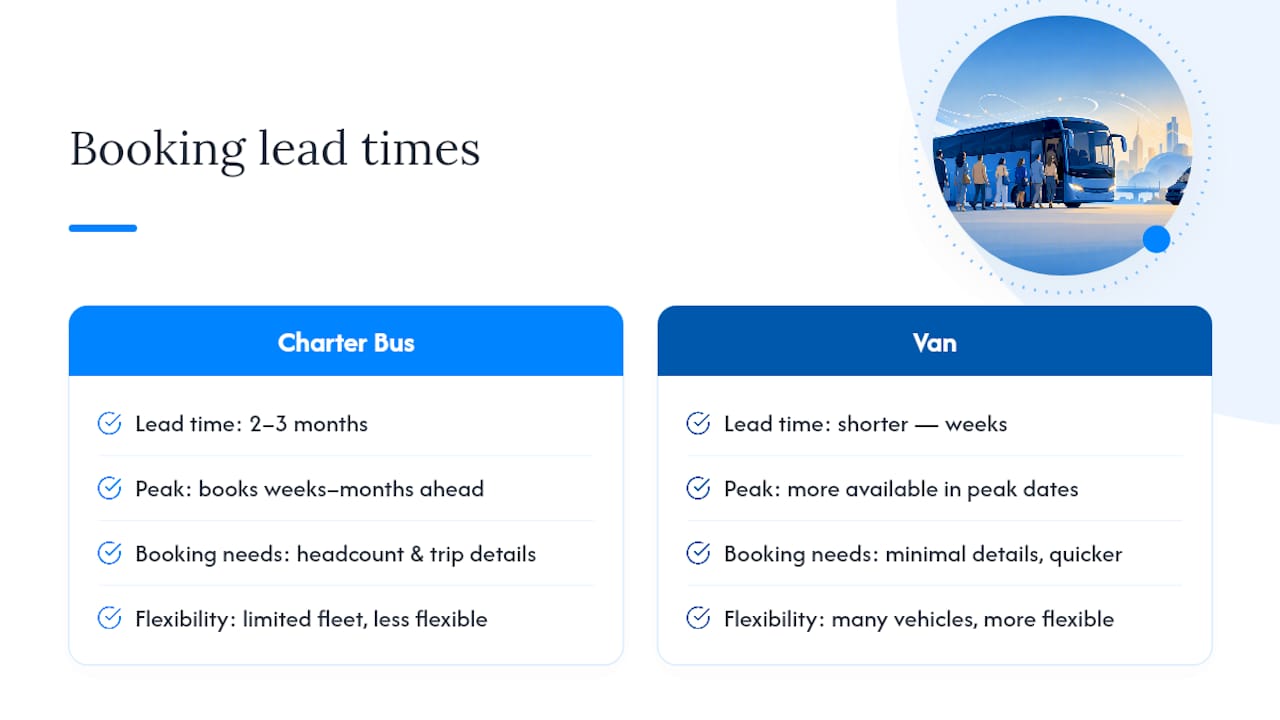
Lead time separates a smooth booking from a scramble. Charter buses, especially full-size coaches, need more advance notice than vans because there are simply fewer of them in any regional fleet. Wedding season weekends and major event dates in Portland and the wine country book out weeks or months ahead.
For a wedding or corporate event with a firm date, book your charter 2 to 3 months out if possible, and even earlier during peak wedding season from late spring through early fall. Vans have shorter lead times since rental companies carry more of them and they turn over faster, but that flexibility comes with the tradeoffs already covered on safety and capacity.
The booking process itself also differs. Charter providers typically want your final headcount, luggage details, route, and timeline locked in before issuing a firm quote, since those variables change which vehicle in the fleet actually fits. Van rentals are usually quicker: pick a size, pick dates, and you’re often driving it yourself with far less coordination.
If your date is flexible, midweek bookings and off-peak seasons often come with lower rates and shorter lead-time requirements. If it isn’t flexible, the smart move is calling early and locking in the vehicle size you need rather than waiting and hoping something’s available. Our fleet sizing guide walks through which vehicle class fits which headcount so you can request the right thing the first time.
Pros and Cons by Group Size and Trip Length
Matching vehicle to trip isn’t just about headcount. Duration matters just as much.
For small groups (under 12) on short trips, a van wins on flexibility and cost. It’s easy to park, easy to drive, and overkill to charter a bus for four people going two miles. The downside shows up if the trip runs long or the roads get complicated, since van comfort drops fast after the first hour.
For mid-size groups (12 to 20) on any trip over 30 minutes, this is the crossover zone. Vans start losing on safety and comfort while charters start winning on cost. This is exactly the range where organizers should run the numbers rather than default to habit.
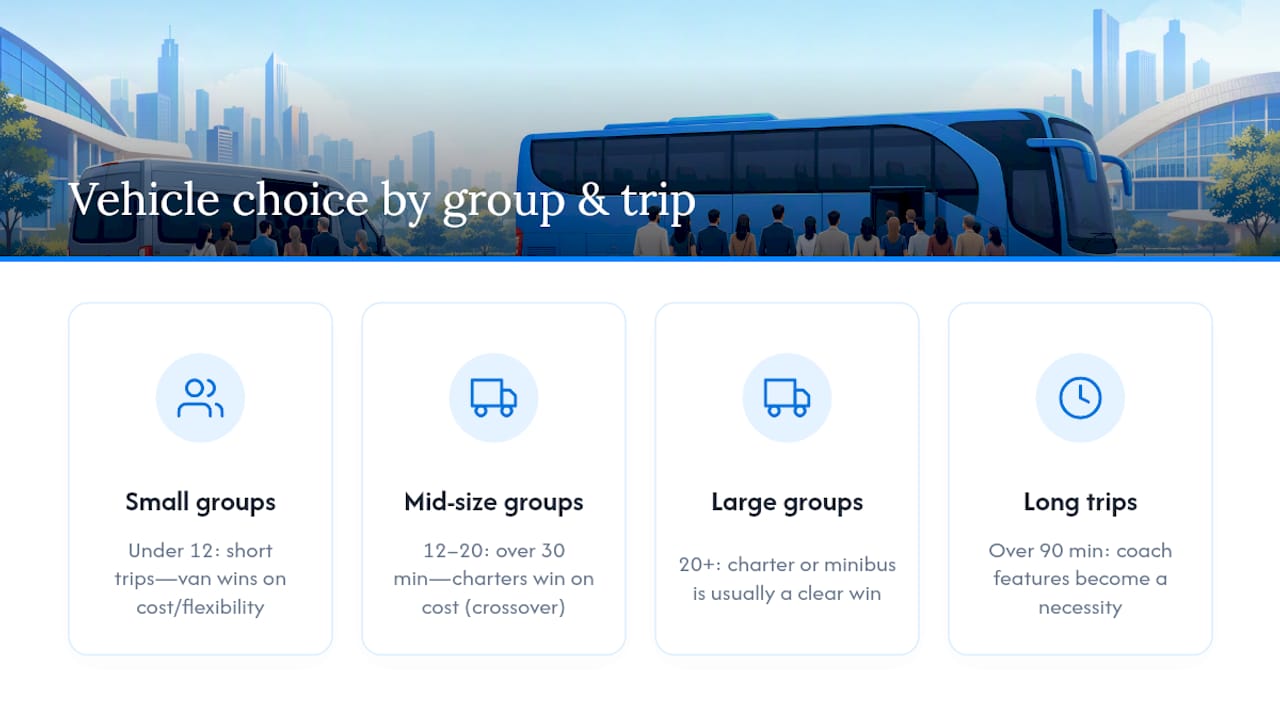
For large groups (20 plus) on any trip length, a charter bus or minibus is close to a clear win. Luggage space, restroom access, and driver qualifications all favor the bus, and the per-person cost usually beats splitting the group across multiple vans.
For long trips (over 90 minutes) regardless of group size, a coach’s reclining seats, climate control, and restroom access become less of a comfort perk and more of a necessity, especially for weddings, wine tours, or corporate retreats where guests need to arrive relaxed rather than cramped.
What Actually Trips Up Organizers
The most common mistake we see at Reliant Transportation isn’t picking the wrong vehicle. It’s guessing at headcount and locking in a size too early. Groups that lock in a van early and then add ten more guests end up scrambling for a second vehicle at a worse rate, right when they need reliability most.
Reliant handles wedding shuttles, corporate events, and group outings across Portland, the Willamette Valley wine region, and Hood River, and the pattern holds across all of them: right-sizing up front beats fixing it later. Our seating chart resources exist specifically to solve that guessing problem before it costs anyone money.
— Dusty
Get a Clear Quote From Reliant Transportation
If your group has crossed that 15-person threshold, Reliant Transportation is the local charter option built for exactly this decision, serving Portland, the Willamette Valley wine region, and Hood River with a fleet sized from Sprinter vans up through full coaches. We handle wedding shuttles, corporate event travel, and group outings with professional drivers who hold commercial licenses and operate under commercial insurance, not a rental key handed to whoever volunteers to drive.
Start by checking our charter bus sizes guide to see which vehicle class actually fits your headcount and luggage, or map your group with our seating chart templates. When you’re ready for real numbers, request a quote and reserve online and get a firm answer instead of a guess. If you’re comparing van specs directly, Sprinter Van Rentals’ fleet page has detailed layouts worth reviewing before you decide.
Sources
- Evaluation of the Rollover Propensity of 15-passenger Vans (NHTSA / crashstats)
- Evaluation of the Rollover Propensity of 15-passenger Vans (NTSB)