
A charter bus driver can drive a maximum of 10 hours after getting 8 consecutive hours off duty, and cannot stay on duty longer than 15 hours in that same window. Add in weekly caps of 60 hours over 7 days or 70 over 8, and the math behind your wedding timeline or multi-city tour gets real fast. Build in buffers, or plan for a relief driver, before you lock your itinerary.
TL;DR:
- A charter bus driver cannot drive more than 10 hours after 8 hours off duty and must not exceed 15 hours on duty in that timeframe.
- Total weekly duty limits are 60 hours over 7 days or 70 hours over 8 days, with a 34-hour restart required to reset weekly hours.
- All on-duty time includes inspections, waiting, loading, fueling, and paperwork, often exceeding initial expectations for event planning.
- For multi-day trips, track weekly hours carefully and consider sleeper-berth splits and driver swaps to stay within legal limits.
- Buffer buffers and early planning are essential; adrenaline-fueled last-minute adjustments risk violations, driver violations, and stranded groups.
Table of Contents
- What FMCSA Rules Actually Govern Bus Driver Hours
- What Counts as On-Duty Time for Your Event
- Building an Itinerary That Keeps Your Driver Legal
- Multi-Day Trips and How to Extend Service Legally
- Common Scheduling Mistakes and Same-Day Fixes
- Rest Break Requirements During a Shift
- How Drivers Track and Prove Their Hours
- What Happens When a Carrier Violates Hours-of-Service Rules
- Interstate vs. Intrastate: Does the Route Change the Rules?
- Why These Limits Exist: Fatigue, Safety, and the Driver Behind the Wheel
- Reliant Transportation’s Approach to Managing Driver Hours
- Book a Timeline-Aware Charter With Reliant Transportation
- Sources
What FMCSA Rules Actually Govern Bus Driver Hours
Every charter bus driver in the country operates under one federal rulebook, and it isn’t optional or negotiable by the mile. The Federal Motor Carrier Safety Administration sets hours-of-service limits specifically for passenger-carrying drivers, and these are the numbers that determine whether your itinerary is realistic or a liability waiting to happen.
Here’s the framework, straight from 49 CFR §395.5:
- 10-hour driving limit: A driver may drive a maximum of 10 hours after 8 consecutive hours off duty.
- 15-hour on-duty limit: A driver cannot drive after being on duty for 15 hours, even if they haven’t used up all 10 hours behind the wheel. On-duty time includes far more than driving, which we’ll get into next.
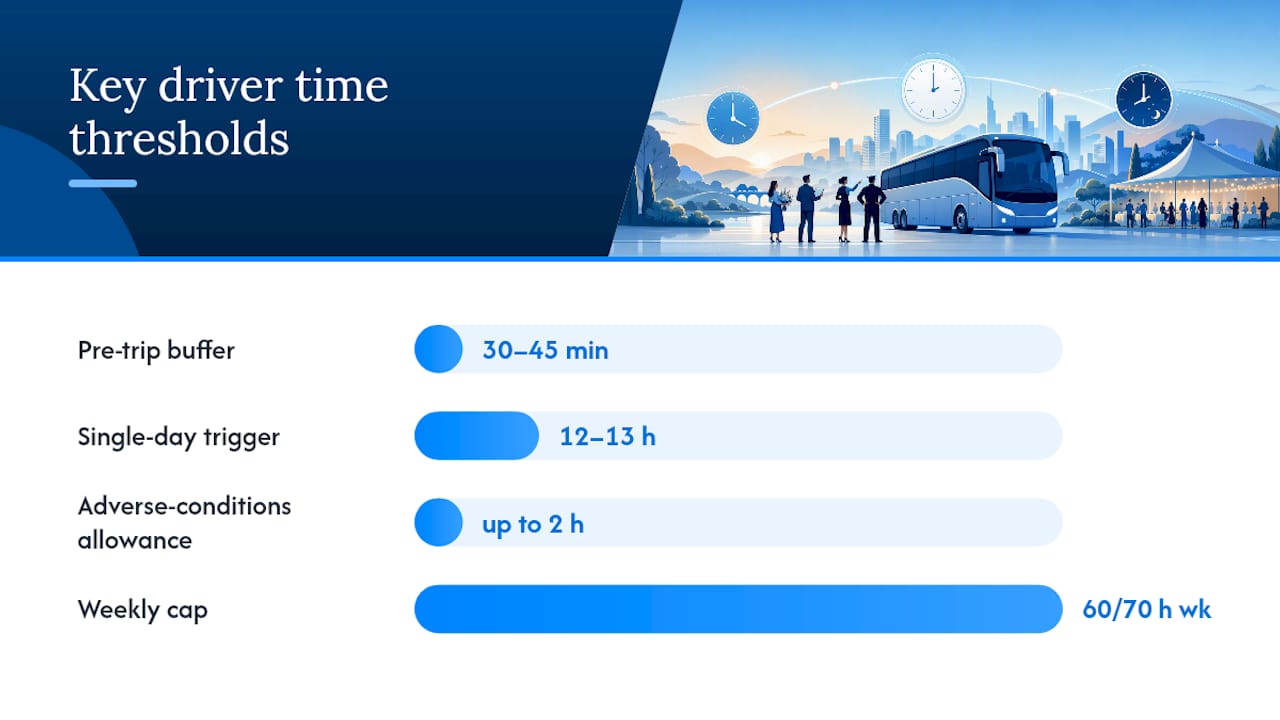
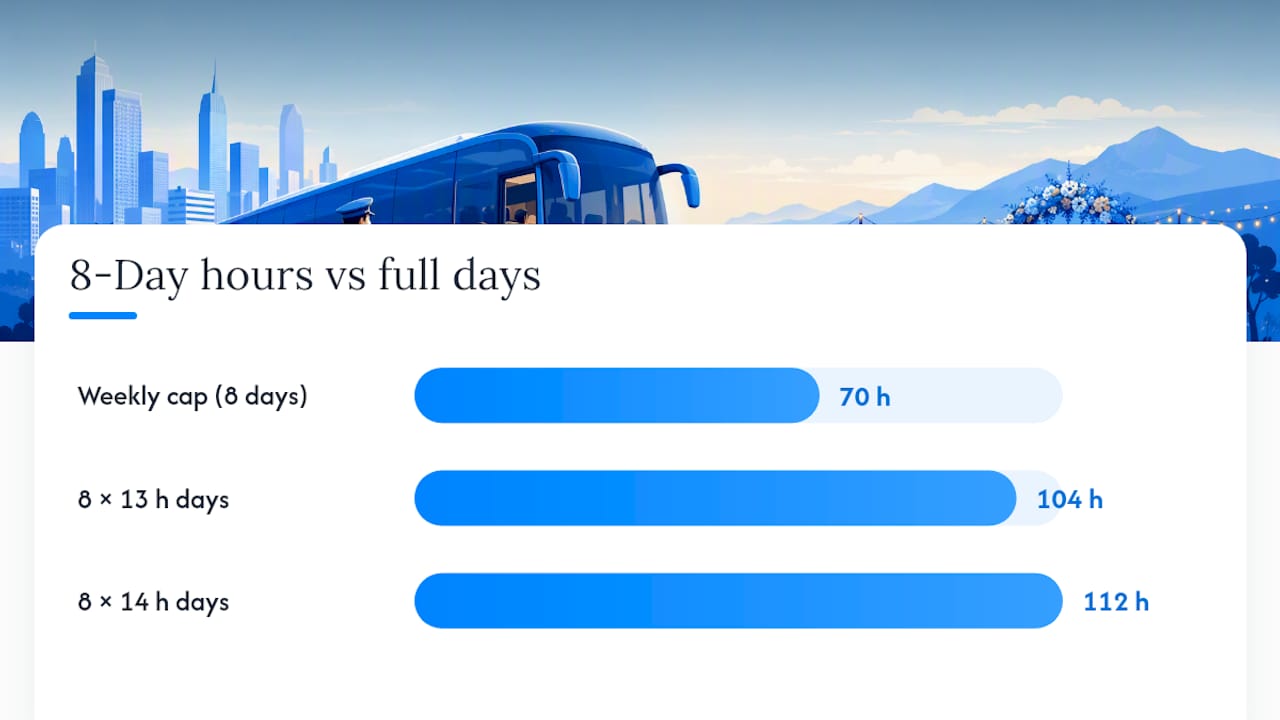
- 60/70-hour weekly caps: Drivers can’t exceed 60 hours on duty in 7 consecutive days, or 70 hours in 8 consecutive days, depending on the carrier’s operating schedule.
- 34-hour restart: A driver can reset their weekly clock with 34 consecutive hours off duty.
- Adverse conditions exception: If weather or traffic beyond the driver’s control eats into the schedule, FMCSA allows up to a 2-hour extension on the driving or on-duty limit, but this isn’t a scheduling crutch. It’s an emergency valve, not a plan.
Modified sleeper-berth provisions also give carriers some flexibility to split rest periods on longer trips, which we’ll cover in more detail further down.
What Counts as On-Duty Time for Your Event
This is where most planners get tripped up, and it’s the single biggest reason a “simple” wedding shuttle run turns into a scheduling headache. On-duty time isn’t just when the bus is moving. It’s everything the driver does while responsible for the vehicle or its passengers.
Here’s what counts toward that 15-hour on-duty ceiling:
- Pre-trip and post-trip vehicle inspections
- Loading and unloading passengers or luggage
- Waiting time at a venue while responsible for the bus and its passengers
- Fueling stops
- Paperwork, including the logs that document all of the above
Picture a wedding shuttle booked for a 4 PM ceremony and a reception that runs until 11 PM. The driver isn’t just working the two shuttle runs. They’re on the clock from the moment they report for duty, through every idle hour parked outside the venue, until the last guest is dropped off. A sightseeing charter with a long lunch stop in Hood River works the same way. That waiting time at the winery or restaurant isn’t a break for the driver unless they’re formally released from duty, which rarely happens mid-event.
Pro Tip: A rough rule of thumb: take your total event window, from driver report time to final drop-off, and assume nearly all of it counts as on-duty time. If that number creeps past 13 or 14 hours, you’re cutting it close to the legal ceiling before you’ve even accounted for traffic.
Building an Itinerary That Keeps Your Driver Legal
The mistake most planners make is scheduling from the guest experience backward instead of the driver’s reporting time forward. Reliant Transportation always starts the clock the moment a driver reports for duty, not when passengers board, because that gap between the two eats into available hours fast.
A workable planning checklist looks like this:
- Start your timeline at driver report time, not pickup time.
- Build a pre-trip buffer of at least 30 to 45 minutes for inspections and positioning at the pickup location.
- Add an event buffer for loading delays and reception overruns. Weddings almost never end on schedule.
- Add a post-event buffer for the final inspection and driver release, especially if another duty period follows the next day.
- For any single-day event stretching past 12 to 13 hours of driver responsibility, start pricing out a relief driver or an earlier end time.
- On multi-day bookings, track weekly totals daily, not just at the start, since day three or four is where the 60/70-hour cap sneaks up on you.
One detail that surprises a lot of first-time charter clients: the adverse conditions exception only extends the driving or on-duty window by up to 2 hours, and only for conditions the driver couldn’t have anticipated at dispatch. A reception that runs long isn’t an adverse condition. It’s a planning gap, and it’s on the organizer to build in the slack ahead of time, not lean on an emergency provision that doesn’t apply.
Long receptions, scenic wine country stops with extended waits, and full-day Hood River tours are exactly where that math gets tight — event planners can benefit from using a restroom trailer rental checklist to better coordinate onsite amenities during these long events. Build the buffer in at booking, not the week of the event.
Multi-Day Trips and How to Extend Service Legally
When an itinerary spans more than one day, whether it’s a multi-city wedding weekend or a Willamette Valley wine tour with overnight stops, the weekly caps become the real constraint, not the daily ones. A driver capped at 70 hours over 8 days can burn through that total faster than expected if each day runs a full 13 to 14 hours of on-duty time.
Modified sleeper-berth provisions allow drivers to split their required off-duty time between the sleeper berth and another off-duty period, which can help stretch a multi-day tour without violating the daily limits. These splits come with specific qualifying conditions, and they require advance coordination at the carrier level. They are not something a dispatcher improvises the morning of a trip.
Practical steps for multi-day bookings:
- Book driver-friendly lodging near the route, not just guest hotels, so layovers actually count as legitimate rest.
- Document rest periods carefully. Recordkeeping requirements under the eCFR apply to multi-day charters just as much as single-day runs.
- Coordinate a driver swap at a logical endpoint if the weekly total is projected to run close to the cap partway through the trip.
Common Scheduling Mistakes and Same-Day Fixes
Most hours-of-service problems trace back to the same handful of errors, and they’re avoidable if you know what to watch for.
- Counting only drive time. Planners often build a schedule around GPS drive time and forget the hour spent loading, waiting, and inspecting the vehicle before and after each leg.
- Assuming waiting is off-duty. It almost never is, if the driver remains responsible for the bus.
- Skipping inspection time. Pre-trip and post-trip checks add 15 to 30 minutes each that has to fit inside the legal window.
- Ignoring weekly totals on multi-day trips. A fine day-one schedule can push a driver over the weekly cap by day three.
If a same-day disruption threatens to blow past a limit, the fixes are straightforward: activate a relief driver, shorten the route, request a second vehicle, or use a qualifying sleeper-berth split if the carrier has one available. Tell your client and vendors about the hard cutoff time early, so a late reception doesn’t turn into a logistics emergency at 10 PM.
Rest Break Requirements During a Shift
Beyond the big-picture driving and on-duty limits, drivers also need structured breaks within a shift to stay legal and, more importantly, alert. Federal rules generally require a break after a set number of consecutive driving hours, and that break has to be a genuine off-duty or non-driving period, not a quick stop to check email while still responsible for the coach.
For event planners, this matters most on long single-day charters, like a full-day Willamette Valley wine tour with multiple stops. If your itinerary has the driver behind the wheel for several hours straight between venues, factor in a real break, not just a five-minute pause at a gas station. Tacking a break onto a fueling stop or a scheduled lunch for guests often works well, since it serves double duty without adding extra time to the overall schedule.
The safety logic here isn’t bureaucratic box-checking. Fatigue is consistently identified as a primary factor in commercial vehicle crash risk, and the entire hours-of-service structure exists to interrupt long stretches of continuous driving before fatigue becomes a hazard. When you’re planning a wine country loop with three or four tasting stops, treat those stops as functional rest points for the driver, not just photo opportunities for guests.
How Drivers Track and Prove Their Hours
Every commercial driver operating under hours-of-service rules has to log their status, and almost all of them now do it electronically rather than on paper. Electronic Logging Devices, or ELDs, automatically record driving time by connecting to the vehicle’s engine, which removes the guesswork and the temptation to round numbers that came with old paper logs.
For a charter client, this matters in a practical way: your driver’s schedule isn’t flexible on the honor system. The ELD is recording drive time in real time, and once the 10-hour or 15-hour threshold is reached, the driver is legally required to stop, regardless of how close you are to the final drop-off. This is exactly why the buffers discussed earlier aren’t optional extras. They’re the difference between a smooth pickup and a driver who has to stop the coach short of the destination because the log says he’s out of hours.
Carriers are also required to retain these records, which matters for multi-day tours where weekly totals need to be documented and verified. If your event involves a driver swap or a sleeper-berth split, the ELD data is what confirms the change was handled legally, not just conveniently.
What Happens When a Carrier Violates Hours-of-Service Rules
Hours-of-service violations carry real consequences, and they don’t just fall on the driver. Carriers face fines, and repeated violations can affect a company’s federal safety rating, which in turn affects insurance costs and the ability to keep operating. A driver caught driving beyond the legal limit can also be placed out of service on the spot, which means the trip stops immediately, regardless of where the group is or what’s left on the itinerary.
For an event organizer, this is the scenario you’re actually trying to avoid when you build in buffers and ask about a carrier’s hours tracking during booking. A driver pulled out of service mid-route because of a hours-of-service violation isn’t a minor scheduling hiccup. It’s a stranded wedding party or a corporate group stuck at a venue with no way home until a replacement driver or vehicle arrives, which can take hours in a region without dozens of backup charter options on standby.
This is also why reputable carriers build hour tracking into their planning process from the first phone call, rather than hoping the math works out. Asking a charter company directly how they monitor driver hours during booking is a completely fair question, and any operator worth hiring should have a clear answer.
Interstate vs. Intrastate: Does the Route Change the Rules?
Most charter clients assume hours-of-service rules only apply to long interstate hauls, but that’s not accurate for passenger-carrying vehicles. The federal 10-hour driving and 15-hour on-duty limits under 49 CFR Part 395 generally apply to interstate commerce, meaning trips that cross state lines or are part of interstate transportation even if the vehicle itself stays within one state.
Intrastate operations, meaning trips that begin and end entirely within a single state and never involve interstate commerce, can fall under state-specific hours-of-service rules instead of the federal framework. States often adopt limits that mirror the federal standard closely, but they’re not always identical, and the details can matter for compliance purposes.
For most events booked through a regional charter operator serving the Portland metro area, the Willamette Valley wine country, and Hood River, this distinction rarely changes the practical planning advice. A driver still needs adequate off-duty time, a schedule that respects on-duty limits, and buffers for the unpredictable parts of an event. But it’s worth knowing that the specific regulatory citation can differ slightly depending on whether a trip crosses state lines, and a professional carrier should be able to tell you which framework applies to your route.
Why These Limits Exist: Fatigue, Safety, and the Driver Behind the Wheel
It’s easy to see hours-of-service rules as red tape standing between your itinerary and getting guests where they need to go. That framing misses the actual point. These limits exist because fatigue impairs reaction time and judgment in ways that are well documented in commercial vehicle safety research, and a bus carrying 30 or 40 passengers is not the place to test how tired is too tired.
The research consensus on driver fatigue treats hours-of-service compliance as a core safety intervention, not a bureaucratic formality. A driver operating on hour 14 of a 15-hour on-duty window is measurably more prone to slower reaction times and lapses in attention, even if they feel fine. That’s precisely why the rules cap on-duty time rather than relying on drivers to self-assess when they’re too tired to continue safely.
For event planners, this reframes the entire conversation. A tight buffer isn’t just a compliance checkbox. It’s the margin that keeps your group’s driver rested enough to navigate Portland traffic, mountain roads near Hood River, or a dark rural highway through wine country at 10 PM after a long reception. When a charter company pushes back on an unrealistic timeline, that pushback usually comes from this exact safety logic, not inflexibility for its own sake.
Reliant Transportation’s Approach to Managing Driver Hours
Reliant Transportation has spent over a decade coordinating charter logistics across Portland, the Willamette Valley wine country, and Hood River, and hours-of-service planning happens at booking, not the day of the event. We check reporting times, build in buffers, and line up relief drivers before an itinerary is confirmed, so your event doesn’t hit a legal wall mid-reception.
— Dusty
Book a Timeline-Aware Charter With Reliant Transportation
Reliant Transportation is the direct, local alternative to guessing at your own hours-of-service math. Instead of building your wedding or event schedule around drive time alone and hoping it holds up, you get a charter partner who already factors in reporting time, on-duty buffers, and relief-driver planning before your date is locked in.

We serve the Portland metro area, the Willamette Valley wine country, and Hood River, with a fleet and driver team built around exactly the kind of long-reception, multi-stop-tour, and multi-day-itinerary challenges covered above. If you’re planning a wedding shuttle, a wine country day trip, or a multi-day group tour, request a timeline-aware quote through our services page and we’ll map out a schedule that keeps your driver legal and your guests on time from pickup to final drop-off.
Sources
For planners who want to verify these limits directly or forward them to a client or vendor, these are the primary sources:
- Hours of Service for Motor Carriers of Passengers | FMCSA
- eCFR :: 49 CFR Part 395 – Hours of Service of Drivers
- Commercial Motor Vehicle Driver Fatigue, Hours-of-Service, and Vehicle Safety