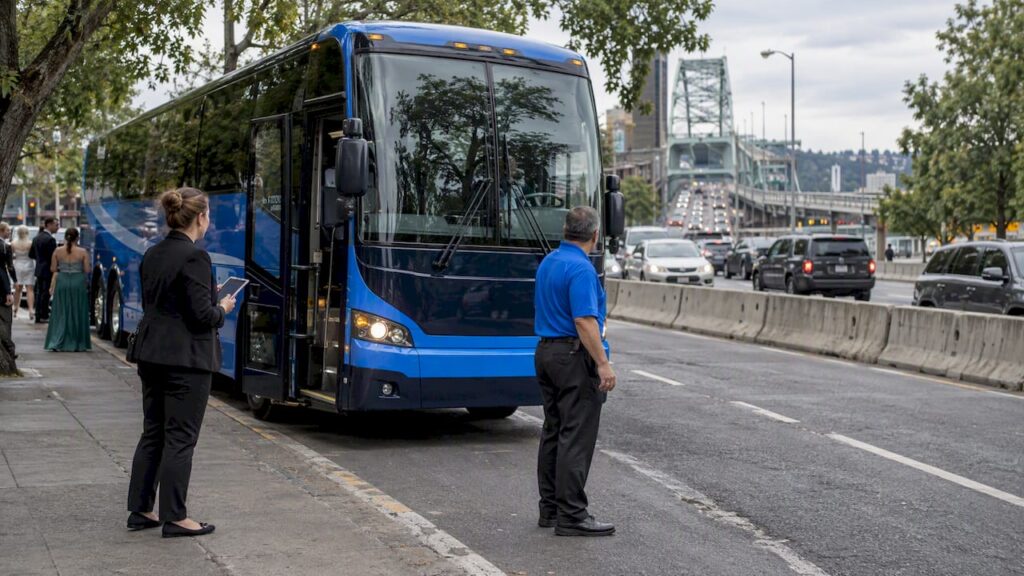
For most summer weddings in Portland, the simplest reliable plan is a local charter or minibus for your guest shuttles, paired with a Sprinter van or sedan for the wedding party. That combination covers hotel loops and ceremony-to-reception runs without overbooking your budget. Summer construction and bridge work around the metro mean you should build in buffer time on every route, and most couples should plan to lock their transportation 4 to 9 months out.
TL;DR:
- Booking transportation four to nine months in advance is crucial for summer weddings due to high demand from festivals, graduations, and roadwork congestion.
- Large guest groups of 20 or more are best served by minibuses or charter buses, while smaller parties of 10 to 14 people find Sprinter vans or party vans more suitable.
- Confirm insurance, driver credentials, routing logistics, and clear fee structures early, and avoid vendors who refuse written agreements or reference checks.
- Incorporate at least 20 to 40 percent extra travel time into routes crossing bridges or heading to popular outdoor venues during summer construction and traffic advisories.
- Budget around $1,075 on average for Portland wedding transportation, with costs varying based on vehicle size, hours, and distance, often ranging from $300 to over $5,000 for larger setups.
Table of Contents
- Matching vehicle types to your guest list and wedding party
- How do you choose a wedding transportation provider?
- When should you book transportation for a summer Portland wedding?
- What should you budget for wedding transportation in Portland?
- Planning routes around summer traffic and construction
- How a Portland charter provider handles summer wedding logistics
- Accessibility options for guests with mobility issues
- Eco-friendly and sustainable transportation choices in Portland
- Parking and loading at popular Portland wedding venues
- What this guide gets right that most wedding advice misses
- Ready to lock in your summer wedding transportation?
- Sources
- FAQ
Matching vehicle types to your guest list and wedding party
Picking the right vehicle starts with two numbers: how many people need a ride, and how far they’re going. Get those right, and the quotes you request will actually be comparable.
- Minibus or charter bus: best for guest shuttles and hotel loops, especially when you’re moving 20 or more guests between a hotel block and the venue; check staging space at pickup since larger buses need room to idle and turn.
- Sprinter van or party van: a natural fit for the wedding party and smaller guest groups, usually 10 to 14 people, and flexible enough for quick stops like a photo location on the way to the reception.
- Luxury sedan or town car: right for the couple, parents, or VIP guests needing a short, private point-to-point transfer rather than a shared ride.
- Specialty vehicles: vintage buses or double-deckers can make a statement, but confirm access routes and any permit needs before booking one for a downtown or vineyard venue.
If you’re unsure where your guest count lands, a quick read on charter bus sizes can help you settle on a vehicle class before you start calling vendors.
How do you choose a wedding transportation provider?
Once you know what vehicle you need, the real work is vetting who drives it. A short checklist on the phone saves you from a bad surprise two weeks before the wedding.
- Confirm insurance and operating authority. Ask for proof of commercial liability insurance and, if your venue requires it, a certificate naming you or the venue as additional insured.
- Check driver credentials. Ask whether drivers hold a commercial license with a passenger endorsement, go through background checks, and follow a regular vehicle maintenance schedule; Oregon’s CDL passenger-safety guidance outlines what that should cover.
- Ask who handles logistics. Find out who plans routing and staging, who you contact if the timeline shifts on the day, and whether that person is reachable by phone during the event.
- Get the fee structure in writing. Hourly minimums, wait-time charges, mileage caps, deposit amounts, and cancellation terms should all be spelled out before you sign anything.
- Watch for red flags. No written contract, vague answers about fees, or an unwillingness to share references are good reasons to keep calling other vendors.
Pro Tip: Ask every vendor the same five questions in the same order. It makes comparing quotes a lot closer to comparing apples to apples.
When should you book transportation for a summer Portland wedding?
Summer Saturdays fill up fast. Plan to reserve your transportation 4 to 9 months ahead for a popular summer date, and you can usually get away with less lead time for a weekday or brunch wedding.
- Graduation season, prom weekends, and summer festivals all compete for the same fleets, which tightens availability from June through August.
- Put a tentative hold on your date as soon as you have a headcount estimate, then confirm with a deposit once your venue and timeline are set.
- Most providers will ask for a final guest count and route confirmation a few weeks before the wedding, so keep that deadline on your planning calendar.
What should you budget for wedding transportation in Portland?
The Knot’s Real Weddings Study puts the national average spend on wedding transportation at about $1,075, and that figure is a solid starting point for a Portland budget since West Coast costs tend to track close to the national number.
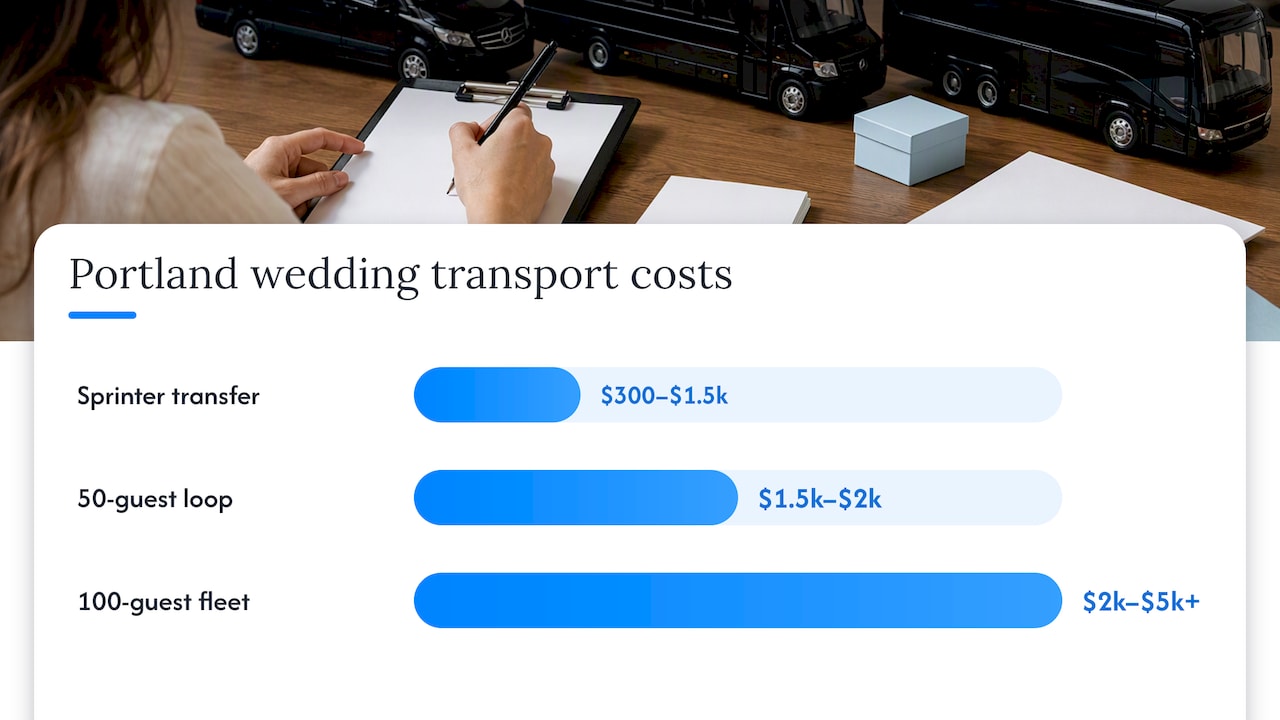
The main drivers behind your quote are vehicle class, hours booked, mileage, and whether your date falls on a premium summer weekend. A pricing guide aggregating operator quotes shows single-vehicle bookings commonly running $300 to $1,500 or more, with larger guest shuttles or luxury fleets reaching $2,000 to $5,000 or beyond depending on vehicle class and hours.
To put that in perspective: a small bridal-party transfer with one Sprinter van for a few hours sits at the lower end of that range. A 50-guest hotel loop with a minibus running multiple trips lands in the middle. A 100-guest wedding using multiple vehicles across several venues, with extra hours for staging and late-night returns, sits at the top. For a deeper breakdown of these scenarios, see what to budget for wedding transportation in 2026.
Planning routes around summer traffic and construction
Portland summers mean construction season, and that can turn a 20-minute drive into something much longer if you don’t plan for it. Before you finalize any route, check what’s happening on the roads you will actually use.
- Check PBOT’s traffic advisories before mapping your route: a bridge replacement advisory for summer weekends flagged major congestion and closures that affect wedding-day travel across the river.
- Review ODOT’s Region 1 summer construction update, which lists lane closures and full closures on I-5, I-205, and I-84 that can force a last-minute reroute.
- Add extra travel time for any route crossing a bridge or heading out toward the Gorge or Hood River, since both carry higher congestion risk during summer.
- Build in alternate pickup points and staggered hotel loops so one delay doesn’t stall your entire guest list.
Pro Tip: Add 20 to 40% to your mapped drive time for any multi-venue route that crosses the river or heads toward Hood River during summer construction season, a margin supported by PBOT’s own advisory on summer bridge work.
How a Portland charter provider handles summer wedding logistics
Some Portland charter providers plan routes around PBOT and ODOT advisories, building pre-wedding route checks and staging plans into their summer bookings. A typical wedding booking may include a passenger manifest, a staging plan for hotel loops, and a single on-day driver point-of-contact so last-minute timeline changes don’t become a scramble.
Accessibility options for guests with mobility issues
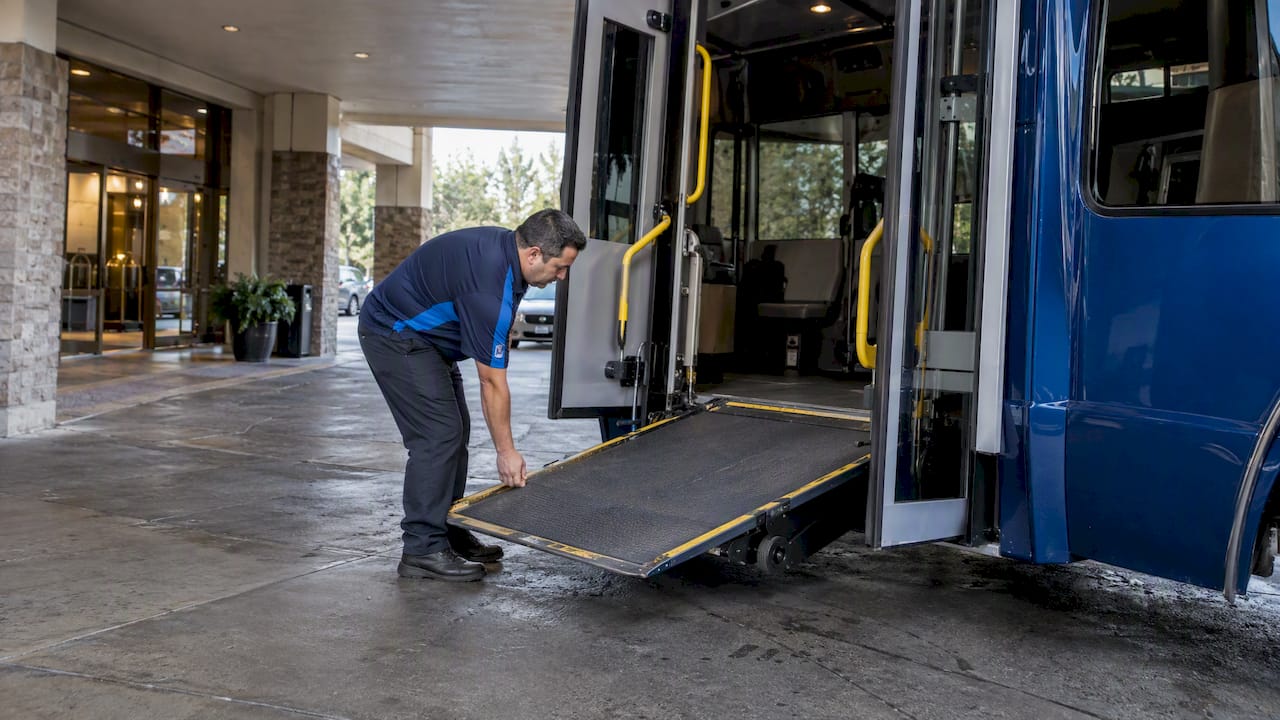
If anyone on your guest list uses a wheelchair, walker, or has limited mobility, say so when you first request quotes rather than waiting until the week of the wedding. Wheelchair-accessible vans and buses with ramps or lifts exist, but they’re a smaller slice of most fleets, so early notice matters.
Ask providers directly whether their accessible vehicles are available on your date, since a popular summer Saturday can book out the standard fleet while accessible vehicles are still sitting on the lot, or the reverse. Confirm the loading method (ramp versus lift), how many wheelchair positions the vehicle holds, and whether a companion seat is next to that spot.
Pickup location matters as much as the vehicle itself. A hotel with a flat, covered loading area is a far easier pickup than a gravel vineyard driveway, so walk through the route with your provider and flag any uneven ground, stairs, or long walks between the drop point and the ceremony seating. If your venue has a separate accessible entrance, give your driver that address in writing, not just verbally, so it’s not left to memory on the day.
Eco-friendly and sustainable transportation choices in Portland
Shuttling guests in shared vehicles is already one of the lower-impact choices available for a wedding, since filling a bus or minibus seat by seat cuts down the number of individual cars on the road compared to everyone driving separately. For couples who want to go further, ask providers about their newer vehicles, since fleet upgrades over the past several years have generally shifted toward more fuel-efficient engines.
The simplest lever you control is seat utilization. Booking one well-filled minibus instead of three half-empty vans is a straightforward way to cut the carbon footprint of your event transportation without changing anything else about your plan. If a guest shuttle loop is already on your list, you’re getting that benefit automatically.
Parking and loading at popular Portland wedding venues
Portland’s most-booked wedding venues range from downtown hotels and riverside event spaces to Willamette Valley vineyards and Hood River properties, and each comes with its own loading quirks. Downtown venues often have tight curb space and limited idling zones, so your driver needs the exact loading door address, not just the venue’s general address, and a plan for where the bus waits between drop-off and pickup.
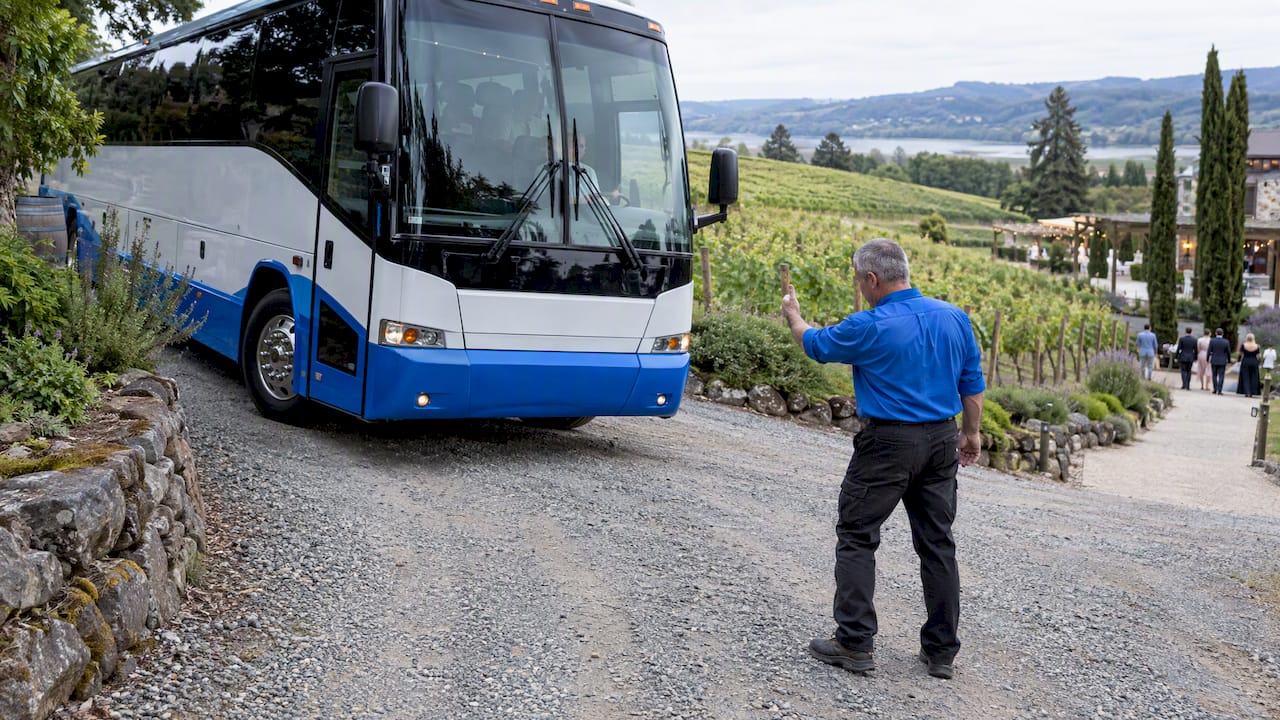
Vineyard and valley venues tend to have more room but less pavement: gravel lots, slight grades, and longer walks from the drop point to the ceremony area are common. Ask your venue coordinator where buses and vans are permitted to park during the event and whether there’s a separate loading zone for photography timing. Confirm this before the day, and pass the specifics to your transportation provider in writing so the driver isn’t guessing when the bus pulls in.
What this guide gets right that most wedding advice misses
Most wedding transportation advice treats routing as an afterthought, something to figure out the week of the wedding once the florist and caterer are locked in. That’s backwards for a Portland summer wedding. Construction season and bridge work aren’t a minor inconvenience here, they’re a scheduling variable as real as your photographer’s availability, and couples who treat routing as a late-stage detail are the ones who end up with a bride stuck on a bridge closure.
The conventional wisdom to “book transportation a few months out” also undersells how fast summer fleets disappear in a city where graduation parties, festivals, and weddings all compete for the same minibuses in June and July. If you take one thing from this guide, make it this: check the construction advisories before you fall in love with a venue’s drive time, and lock your vehicle earlier than you think you need to. Everything else, vehicle class, pricing, even accessibility, is easier to sort out once that timing is settled.
— Dusty
Ready to lock in your summer wedding transportation?
Once you know your vehicle mix and rough timeline, getting a quote from a local charter provider is quick, and it means one less thing competing for your attention this summer. Providers may serve the Portland metro, the Willamette Valley wine area, and Hood River, planning routing and staging around your ceremony and reception locations.
Before you request a quote, have these details ready:
- Wedding date and backup date, if you have one
- Ceremony and reception addresses, plus any hotel pickup points
- Guest count and wedding party size
- Pickup and drop-off time windows
- Any special requests, like accessible vehicles or multiple staging stops
| What to have ready | Why it speeds your quote |
|---|---|
| Date and venue addresses | Lets the provider check availability and map the route |
| Guest count | Determines vehicle class and number of vehicles needed |
| Pickup time windows | Confirms whether staggered loops or one run will work |
| Special requests | Flags accessible vehicle or multi-stop needs early |
Reliant Transportation’s services page walks through weddings, corporate events, and limo bus options, and you can book a charter bus and get a clear quote directly once you’re ready to check availability for your date.
Sources
Before locking your route, check PBOT and ODOT advisories, explore pricing studies, and your venue’s permit contact for staging rules.
- Portland Bureau of Transportation traffic advisory: bridge replacement weekend impacts (2026-07-07)
- The Knot: Wedding transportation costs, tips and trends
- How much does wedding transportation cost? — Sortra (pricing guide)
FAQ
How far in advance should you book wedding transportation in Portland?
Most couples should book 4 to 9 months ahead for a summer Saturday, since graduation and festival season compresses fleet availability across the metro. Weekday or off-season dates generally allow shorter lead times.
How much does wedding transportation typically cost?
The national average spend on wedding transportation is about $1,075, and that figure holds up as a reasonable planning anchor for the Portland area. Actual quotes vary with vehicle class, hours booked, and guest count, with single-vehicle bookings commonly running $300 to $1,500 or more.
Should you offer a guest shuttle for a Portland wedding?
A guest shuttle is worth it anytime you have a hotel block, limited venue parking, or a reception site that’s a drive from the ceremony. It also cuts down on guests driving unfamiliar roads after dark.
What happens if a bridge or road closes on your wedding day?
Check PBOT and ODOT advisories in the weeks before your wedding so your provider can plan an alternate route in advance. A provider that builds in buffer time and staggered pickups can usually absorb a closure without throwing off your timeline.
Does Reliant Transportation serve Hood River and the Willamette Valley?
Yes, Reliant Transportation serves the Portland metro, the Willamette Valley wine area, and Hood River for wedding and event transportation. You can check availability for your date through Reliant’s booking page.