
For groups, weddings, and scheduled transfers to an airport or event, a shuttle usually wins on price and reliability. For a solo traveler needing a quick, unscheduled ride from door to door, a rideshare usually wins on flexibility. The right pick comes down to group size, how fixed your schedule is, and how much you value predictable cost over on-demand convenience. Keep reading for the cost math, the logistics, and the environmental trade-offs behind that call.
TL;DR:
- Shuttles are best for fixed schedules and group transport, offering predictable prices and designated pickup points, especially for weddings or corporate events.
- Rideshares provide on-demand door-to-door service suitable for solo travelers or last-minute trips, but surge pricing can significantly increase costs during peak times.
- Booking shuttles in advance and sharing rides can reduce costs, whereas rideshare fares spike with demand, especially during late-night, rush hour, or busy event periods.
- Shuttle schedules with flight tracking reduce delays, while rideshare pickups may require navigating designated lots or waiting times, impacting timing in tight connections.
- Large groups or events benefit environmentally by filling shuttle vehicles fully, lowering per-passenger emissions, whereas solo trips in single-occupancy cars have higher carbon footprints.
Table of Contents
- Shuttle vs rideshare: a quick side-by-side look
- How shuttle and rideshare pricing actually works
- Booking, wait times, and getting through the airport smoothly
- What each option means for your environmental footprint
- A quick decision checklist by trip type
- What happens if plans change: cancellation and refunds
- What years of event shuttles have taught us
- How Reliant Transportation can help with your next group trip
- Where these numbers and policies come from
- Sources
- FAQ
Shuttle vs rideshare: a quick side-by-side look
Before you book anything, it helps to see where each option actually shines. Shuttles are built for predictability. Rideshares are built for speed and personalization. Here’s how they stack up:
- Shuttle pros: fixed pricing, scheduled departures, and strong fit for groups, weddings, and events.
- Shuttle cons: less door-to-door flexibility, and you’ll need to meet at a designated pickup point.
- Rideshare pros: on-demand availability, true door-to-door service, and flexibility for solo or last-minute trips.
- Rideshare cons: surge pricing, unpredictable wait times, and confusing lot or curb rules at busier airports.
If your trip has a set time and a set group, a shuttle removes a lot of guesswork. If your trip is spontaneous or solo, a rideshare adapts to you instead of the other way around.
How shuttle and rideshare pricing actually works
Shuttle pricing is usually straightforward: a flat per-seat rate, a per-vehicle contracted rate for groups, or a set fare for a known route. You know the number before you book, and it doesn’t change because your flight landed during rush hour.
Rideshare pricing works differently. Fares combine a base charge with time and distance, then layer in dynamic pricing when demand outpaces available drivers. Industry reporting on rideshare pricing explains that surge pricing exists to balance driver supply with rider demand, and it can push costs up sharply during peak arrival windows like late-night flights or the moment a concert lets out.
Rideshare surge pricing is a demand-balancing mechanism, according to pricing coverage from PYMNTS, which means the same trip can cost noticeably more on a Friday evening than on a quiet Tuesday morning.
A few tactics help either way:
- Book shuttles or charters in advance to lock in a flat rate before demand tightens availability.
- Share rides when traveling with even one other person to split a rideshare fare.
- Travel off-peak when possible, since rideshare fares climb fastest around flight banks and event end times.
Booking, wait times, and getting through the airport smoothly
Shuttle bookings typically involve reserving a seat ahead of time, sometimes with flight tracking built in so the driver adjusts for delays, and a set schedule of stops. Rideshare apps work in the opposite direction: you request a ride when you’re ready, watch a live ETA, and at many airports you’re routed to a designated rideshare lot rather than picked up right at the curb.
- Luggage: shuttles built for groups usually have dedicated storage; rideshare trunk space varies by vehicle.
- Accessibility: ask about wheelchair-accessible options ahead of time for both, since availability differs by provider and city.
- Curb access: shuttles often use marked loading zones, while rideshares may require a walk to a separate pickup lot.
- Timing: shuttles run on a schedule, so build in a buffer if your flight is running early or late.
Logistics tend to override price when you’re facing a tight connection, a late-night arrival, or bad weather. A scheduled shuttle with flight tracking can absorb a delay better than hoping a rideshare is nearby at 11 p.m. in a storm.
Pro tip: For group airport pickups or multi-stop events, assign one pickup point, share it with everyone in advance, and build a 10 to 15 minute buffer into the schedule so stragglers don’t stall the whole group.
What each option means for your environmental footprint
Occupancy is the deciding factor here, not the vehicle type alone. EPA emission factor data provides per-vehicle-mile figures for passenger cars and buses, and a typical passenger vehicle emits about 4.6 metric tons of CO2 per year under average driving conditions. Research on shuttle bus passenger emissions finds that shuttle buses generally produce lower per-passenger emissions than single-occupancy cars when the bus is reasonably full.
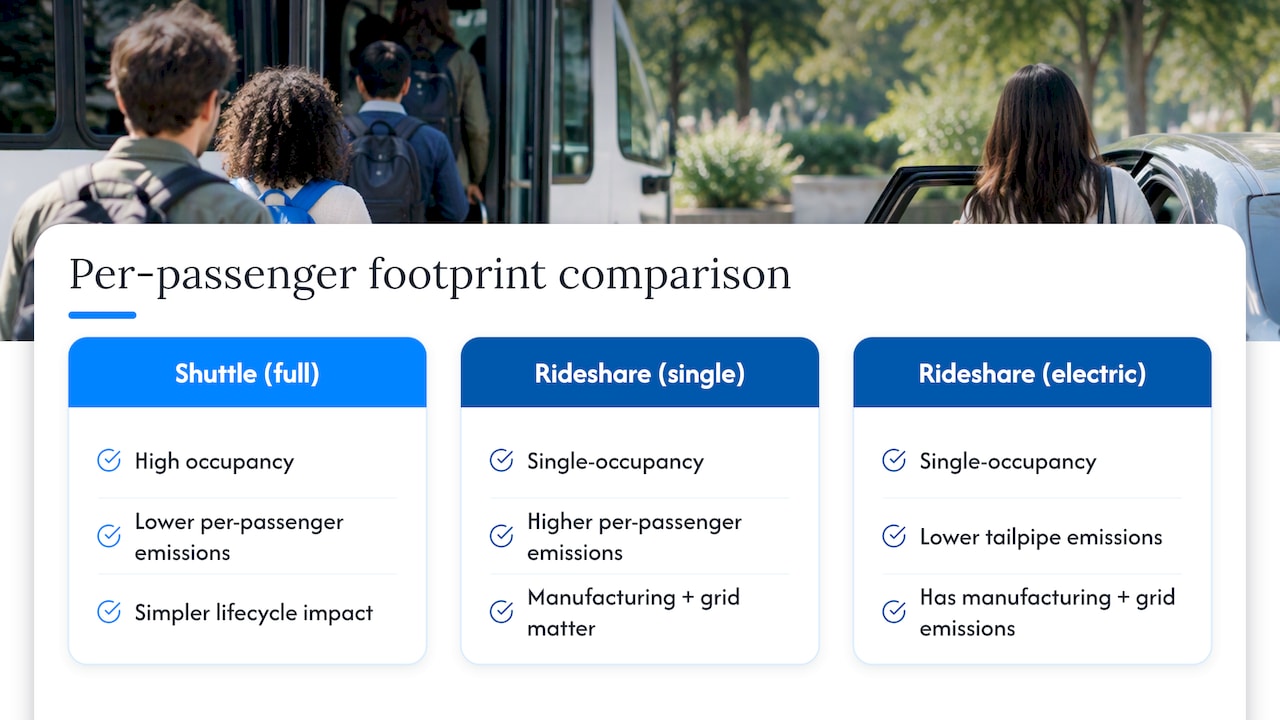
Here’s a simple way to see load factor at work:
A shuttle running near full capacity typically produces lower emissions per passenger than the same number of people taking separate single-occupancy rideshare trips, based on EPA vehicle emission factors and shuttle occupancy research. Electric rideshare vehicles narrow that tailpipe gap, but they still carry beyond-tailpipe emissions from manufacturing and electricity generation, so filling seats on a scheduled shuttle remains one of the simpler ways to cut a charter bus’s carbon footprint for a large event.
A quick decision checklist by trip type
Match your trip to the questions below and the answer usually falls out on its own:
- How many people are traveling together? One or two people generally lean rideshare; five or more usually favor a shuttle or charter.
- Is your departure time fixed or flexible? A known event end time or flight schedule favors a shuttle; a spontaneous or shifting plan favors a rideshare.
- Does the venue restrict vehicle access? Weddings, conferences, and large venues often require pre-arranged shuttle drop-off points rather than ad hoc rideshare pickups.
Solo travelers and couples with flexible timing do well with a rideshare. Families with luggage and a set flight time often prefer the peace of mind a reserved shuttle seat provides. Large groups and events almost always come out ahead with a shuttle or charter, both on cost per person and on keeping everyone together.
What happens if plans change: cancellation and refunds
Shuttle and charter bookings typically involve a cancellation window, often tied to how far out you cancel relative to the reserved date. Many providers apply a sliding scale: cancel further in advance and you get a fuller refund, cancel close to the event and you may forfeit part or all of the deposit, since a vehicle and driver have already been held for you. Reserved seat shuttles usually publish a specific booking cutoff, and missing it can mean losing your seat without a refund.
Rideshare cancellations work on a shorter clock. Canceling shortly after a driver accepts your request often triggers a small cancellation fee, while canceling well before pickup is usually free. The trade-off is flexibility in exchange for less certainty: a rideshare cancellation policy protects the driver’s time in minutes, while a shuttle or charter contract protects a vehicle reservation that was made weeks or months out.
If you’re planning transportation for a wedding or corporate event, it’s worth asking any provider directly about deposit terms and cancellation cutoffs before you sign, since these details vary by company and aren’t always spelled out clearly upfront.
What years of event shuttles have taught us
Running shuttles for weddings and corporate events for many years has taught providers that logistics fail quietly long before they fail loudly. Clear signage at the pickup point, a timing buffer built into the schedule, and a single point of contact for passengers prevent most of the confusion that derails group transportation. Seating allocation matters too: assigning groups to specific vehicles ahead of time keeps loading fast and avoids the scramble that happens when everyone tries to board at once.
— Dusty
How Reliant Transportation can help with your next group trip
If your event calls for coordinated group transportation rather than a scattered set of solo rides, a charter bus takes the guesswork out of the day. Reliant Transportation handles the logistics so you’re not tracking down stragglers or hoping enough rideshares show up on time.
- Weddings: coordinated shuttle service for guests and the bridal party.
- Corporate events: reliable group transfers for conferences and company outings.
- Limo buses: a step up in comfort for special occasions.
- General charter needs: flexible booking for any group outing.
The service area includes the Portland, Oregon metro area, the Willamette Valley wine region, and the Hood River area. Get a clear quote and reserve your charter bus for your next event.
Where these numbers and policies come from
- EPA greenhouse gas emission factors hub (2025)
- EPA: greenhouse gas emissions from a typical passenger vehicle
- Shuttle buses and passenger emissions research (2026)
- Rideshare pricing dynamics reporting (PYMNTS, 2025)
- Guest transportation planning resource
Sources
- Emission factors for greenhouse gas inventories (EPA, 2025)
- Greenhouse gas emissions from a typical passenger vehicle | US EPA
- Shuttle buses and passenger emissions (2026)
- Reporting on rideshare pricing dynamics (PYMNTS, 2025)
FAQ
Is Uber Shuttle the same as Uber?
No, Uber Shuttle is a separate, scheduled service with fixed routes and set pickup times, distinct from Uber’s standard on-demand rides. It functions more like a shared shuttle line than an individual door-to-door trip.
Do I tip shuttle drivers?
Tipping shuttle drivers is customary but not required, and the amount typically depends on service length and group size. A few dollars per passenger, or a modest tip for the driver on a group charter, is a common practice.
Which is cheaper, rideshare or shuttle?
It depends on group size and timing: a shuttle is usually cheaper per person for groups because of flat, contracted pricing, while a rideshare can be cheaper for a single traveler outside peak demand. Surge pricing during busy windows often erases any rideshare cost advantage for a solo trip.
Why is Uber Shuttle shutting down?
Availability for scheduled shuttle-style rideshare offerings has shifted over time as companies adjust services based on rider demand and route profitability in different cities. Coverage varies by location, so it’s worth checking current availability directly with the provider before planning around it.