The best way to handle multiple pickup planning is to run everything through one centralized coordinator, lock in agreed pickup windows for each stop, and confirm a communication plan before the day starts. Success looks specific: every passenger boards inside their window, accessibility requests are already accommodated, and everyone knows the backup plan if something goes sideways. Some charter providers build their event logistics around exactly this structure, and it’s worth checking that any provider you consider does the same.
TL;DR:
- Confirm pickup windows are based on working backward from the arrival time, with a 10 to 15-minute buffer per stop to handle traffic and slow boarding.
- Reserve a backup vehicle and driver with clear trigger conditions known to all stakeholders before the event starts.
- Ensure all accessibility requests are documented at least 48 hours in advance and carriers meet the $5 million liability insurance and safety standards.
- Maintain a single communication hub and assign a dedicated person to activate backup plans quickly during delays or emergencies.
- Set manifest deadlines at least 72 hours before pickup to allow time to correct errors and finalize logistics without last-minute issues.
Table of Contents
- Building your pre-trip planning checklist
- Turning arrival times into pickup windows
- Setting up each stop for fast, safe boarding
- Meeting accessibility and safety requirements
- Keeping everyone informed and ready for the unexpected
- What I’ve learned about pickup planning that actually holds up
- How Reliant Transportation puts this plan into action
- Where to verify the safety and accessibility rules
- Sources
- FAQ
Building your pre-trip planning checklist
Before you commit to a vehicle or a schedule, get the basics locked down. A rushed checklist is where most multi-stop pickup plans start to unravel.
- Match vehicle size to your group. Confirm seat count, luggage capacity, and amenities against your actual passenger list, not your estimate from three weeks ago.
- Verify safety credentials. Check the carrier’s FMCSA safety rating and confirm the required $5 million insurance minimum for vehicles built for 16 or more passengers.
- Collect a definitive manifest. Get pickup addresses, passenger counts per stop, special needs, and emergency contacts, with a hard cutoff date for last-minute changes.
- Name one coordination hub. Every driver, on-site contact, and passenger group should know who to call when plans shift.
- Reserve a backup vehicle and driver. Document exactly what triggers the switch, whether it’s a mechanical issue or a no-show.
Your charter bus contract is the right place to put backup vehicle terms and driver hour limits in writing, so nobody is guessing on the day of the event.
Pro Tip: Set your manifest deadline at least 72 hours before pickup, so you have time to fix errors before they become on-site problems.
Turning arrival times into pickup windows
Multi-stop planning works backward. Start with the time your group needs to arrive, then subtract travel time, dwell time, and a buffer for the unexpected. That gives you the latest possible pickup time for each stop, and everything else builds from there.
- Set the arrival anchor. Confirm when the group must be at the venue, then work backward through each stop to find your latest pickup times.
- Sequence stops by geography and priority. Cluster nearby addresses together, and put time-sensitive passengers (a speaker, the wedding party) earlier in the loop if it protects their schedule.
- Estimate dwell time honestly. Boarding takes longer with luggage, mobility equipment, or large groups climbing steps one at a time.
- Build in a real buffer. A 10 to 15 minute arrival window per stop absorbs traffic and slow boarding without cascading delays down the route.
- Choose your model. Rolling loops work for short, frequent stops close together; fixed-time pickups fit events with a hard start time, like a ceremony or a keynote.
Reliant Transportation’s own coordination model mirrors how large multi-coach event operations manage complexity: a single planning hub that can absorb late changes without losing the schedule, an approach documented in large-scale coach operations that coordinated dozens of coaches across many depots and still handled significant last-minute amendments.
Windows matter because a fixed-minute pickup time invites missed connections the moment traffic shifts. A window gives your driver room to adjust without leaving anyone standing on a curb.
Setting up each stop for fast, safe boarding
Every pickup location needs the same level of planning as your main venue, just compressed into a shorter window.
- Pick a legal, accessible loading zone. Reserve curb space or a lot in advance when the venue allows it, rather than hoping for open curb on the day.
- Post clear signage. Include the event name, shuttle number, pickup window, and a phone number for the on-site coordinator.
- Board in manifest order. Calling names as passengers step on keeps your headcount accurate and avoids confusion at a crowded stop.
- Stage luggage separately. Keep bags out of aisles and doorways so boarding stays quick and exits stay clear.
Drivers should follow a consistent rule: no boarding before the scheduled departure time, and no departure until the manifest is verified against who’s actually on board.
Pro Tip: Print your stop signage the day before and laminate it. A soggy paper sign in the rain is a surprisingly common reason coordinators lose ten minutes at a stop.

Meeting accessibility and safety requirements
Accessibility isn’t an add-on to your plan, it’s part of the manifest from day one. Collect requests early, and give the carrier real notice.
- Document requests as they come in. Federal guidance recommends giving carriers 48 hours’ notice or more whenever possible, and carriers are expected to try to accommodate shorter notice too.
- Confirm insurance and safety ratings before booking. The industry standard for vehicles seating 16 or more is $5 million in coverage, and a carrier operating under an Unsatisfactory safety rating should be a hard pass.
- Follow loading and weight guidance. USDOT’s advisory bulletin directs operators to monitor passenger and luggage weight and redistribute loads that risk exceeding tire ratings.
- Run a quick on-day check. Confirm baggage is secured, doorways are clear, and the load looks balanced before pulling away from each stop.
A vehicle built for 16 or more passengers must carry $5 million in liability coverage under federal charter guidance, which is one of the fastest ways to screen out an underinsured operator before you sign anything.
Keeping everyone informed and ready for the unexpected
Communication is what turns a good plan into one that survives a flat tire or a late guest. Set the cadence before the trip, not during it.
- Send pre-trip confirmations. Cover the manifest deadline, pickup window, a photo of the meeting point, and any accessibility instructions passengers need to know.
- Check in on the day. A text or app update at dispatch, another at the 30-minute mark, and immediate alerts if a pickup is running late.
- Build a contingency ladder. Define what happens at each stage: driver no-show, mechanical failure, severe weather, and who has authority to activate the backup vehicle.
- Reroute fast when needed. Have a plan for consolidating passengers onto fewer stops if one vehicle drops out, along with a clear fare or credit policy if delays affect the group.
- Debrief after the event. Log what worked and what didn’t so the next multi-stop plan starts from a better baseline.
Pro Tip: Assign one person, not a group chat, as the final word on activating the backup vehicle. Decisions made by committee during a delay cost minutes you don’t have.
What I’ve learned about pickup planning that actually holds up
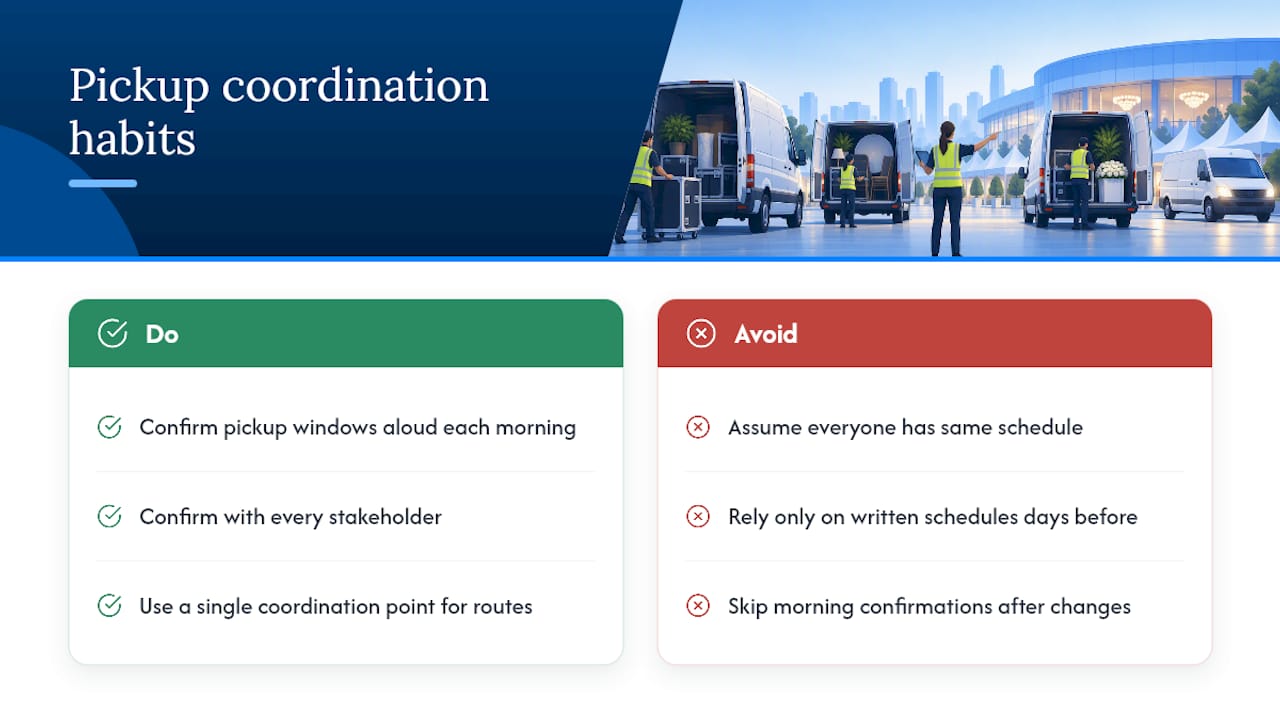
The most common failure I see isn’t a broken vehicle, it’s a coordinator who assumed everyone had the same version of the schedule. A five-minute habit fixes it: confirm pickup windows out loud with every stakeholder the morning of the event, not just in writing days before.
This discipline is often applied on wedding shuttles and corporate routes, where a single coordination point has kept multi-stop pickups on schedule even when a guest list changed the night before.
— Dusty
How Reliant Transportation puts this plan into action
Planning the logistics is half the job. Reliant Transportation handles the other half: wedding shuttles, corporate event transportation, limo buses, and general charter needs, all built around the same centralized coordination and pickup window structure covered above.
- Wedding shuttles with timeline templates already built around real ceremony schedules.
- Corporate event transportation with a single point of contact for multi-site pickups.
- Limo buses and general charter service for groups that need flexible capacity.
| Service | Best fit | Where to start |
|---|---|---|
| Wedding shuttles | Ceremony and reception logistics | Wedding shuttle timeline |
| Corporate events | Multi-site employee or client pickups | Services overview |
| Limo buses | Smaller groups needing flexible routing | Charter bus sizes |
Reliant Transportation serves the Portland metro area, the Willamette Valley wine region, and Hood River. If your event needs coordinated pickups across multiple locations, book a charter bus and get a quote built around your actual stops and timing.
Where to verify the safety and accessibility rules
- FMCSA charter tips: insurance minimums and safety ratings.
- USDOT advisory: loading and tire weight limits.
- FMCSA accessibility guidance: ADA request procedures.
These are the primary sources behind the safety and accessibility guidance in this guide, worth bookmarking before you book any carrier.
Sources
- Tips for chartering a bus | FMCSA
- USDOT issues advisory bulletin reminding motorcoach companies they must follow safety provisions that prevent tire failures | US Department of Transportation
- Accessibility for buses | FMCSA
- Zeelo, CTG and other operators combine in 144-coach operation – Bus & Coach Buyer
FAQ
How far in advance should I plan multiple pickups?
Start your manifest and route planning at least a few weeks before the event, with a hard cutoff for passenger changes around 72 hours out. That gives your coordinator time to finalize pickup windows and confirm any accessibility requests with the carrier.
How many minutes should a pickup window be?
A window of 10 to 15 minutes per stop is generally enough to absorb traffic or slow boarding without pushing later stops off schedule. Fixed fifteen-minute pickups work better for tight event schedules, while rolling loops suit stops that are close together.
What insurance should a charter bus carry?
Vehicles designed for 16 or more passengers should carry $5 million in liability coverage, which is the federal benchmark for interstate charter operations. Ask for proof of coverage and a current safety rating before signing a contract.
How much notice do accessible pickup requests need?
Federal guidance recommends giving carriers 48 hours’ notice or more for accessibility requests whenever possible. Carriers are still expected to try to accommodate requests made with less notice.
What happens if a pickup vehicle breaks down mid-route?
A solid contingency plan names a backup vehicle and driver in advance, along with the exact conditions that trigger the switch. Reliant Transportation builds this into its planning process so a mechanical issue doesn’t turn into a missed pickup.