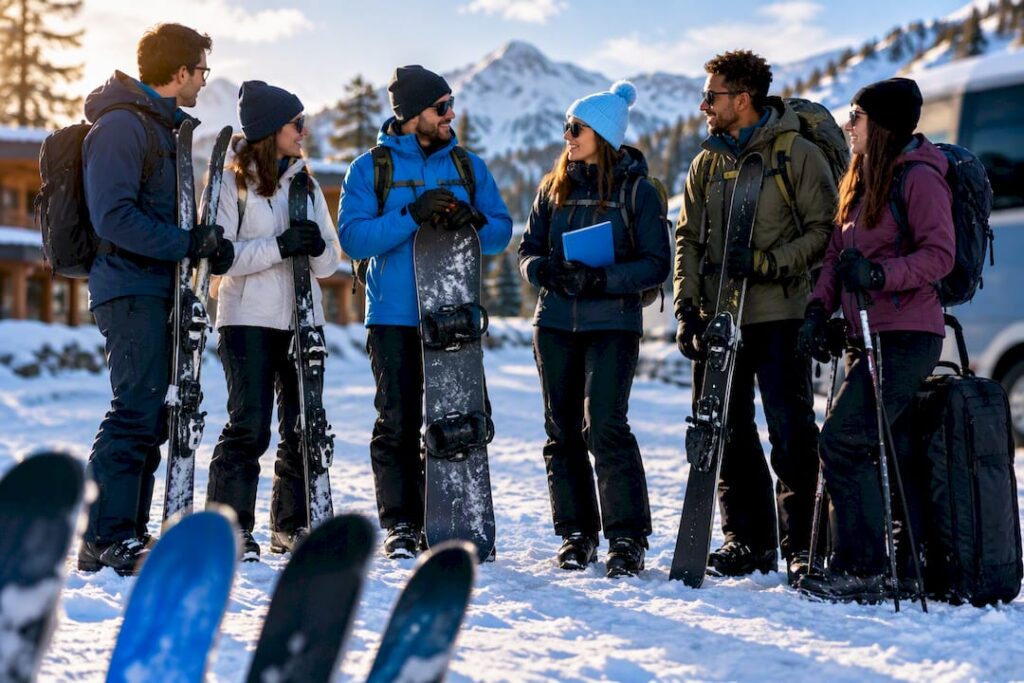
For most solo skiers or couples, a private airport transfer or a scheduled mountain shuttle gets you to the slopes fastest and with the least hassle. Families often do better with a rental car for flexibility, while groups of six or more usually save money and headaches with a charter bus. The right pick depends on your party size, your gear, and how ready you are for mountain roads.
TL;DR:
- Charter buses become the most cost-effective and convenient option for groups of six or more, offering ample luggage space and coordinated arrival.
- Booking a charter bus at least four to six weeks before peak season is essential to secure availability and avoid last-minute issues.
- Shipping skis ahead to the hotel or resort allows travelers to skip baggage handling and arrive with minimal airport stress.
- The safest mountain driving relies on real-time highway condition updates, chain-control awareness, and proper vehicle safety checks before departure.
- For small groups or individuals, shared shuttles or private transfers balance cost and flexibility, while rental cars offer control but may face chain restrictions.
Table of Contents
- Comparing your ski trip transportation options
- When a charter bus makes sense for group ski trips
- Shared shuttle, private transfer, or rental: which one fits your trip?
- Getting your ski gear there in one piece
- Safety and mountain driving rules you need to know
- Booking the right transport: questions, timing, and red flags
- What I’ve learned booking ski trip logistics for groups
- How Reliant Transportation makes ski group travel easier
- Sources
- FAQ
Comparing your ski trip transportation options
Each option trades off cost, convenience, and gear handling a little differently.
- Private transfer: Door-to-door service with room for skis and boards, but it costs more per person than shared options.
- Shared shuttle: Budget-friendly and common at resort towns, though you’re stuck with fixed schedules and sometimes tight gear limits.
- Car rental: Gives you full control over timing, but winter tire and chain rules can complicate things, and many rental contracts restrict chain installation.
- Charter bus: The most practical choice for groups, since one vehicle and one driver handle everyone’s luggage and skis together.
- Train (Amtrak): Many routes let you check skis and snowboards under standard baggage rules, which removes a lot of airport stress. Amtrak permits skis and snowboards when they’re properly bagged and within the airline’s size and weight limits.
- Shipping skis ahead: Sending gear directly to your hotel or a resort-side shop means you skip baggage claim entirely and arrive with just a carry-on.
Once you know your group size and how much gear you’re hauling, the options narrow fast.
When a charter bus makes sense for group ski trips
Once your group hits six or more people, a charter bus usually becomes the most cost-effective and least stressful option. Instead of coordinating three rental cars or splitting up across shuttle runs, everyone travels together, and one driver handles the mountain roads.
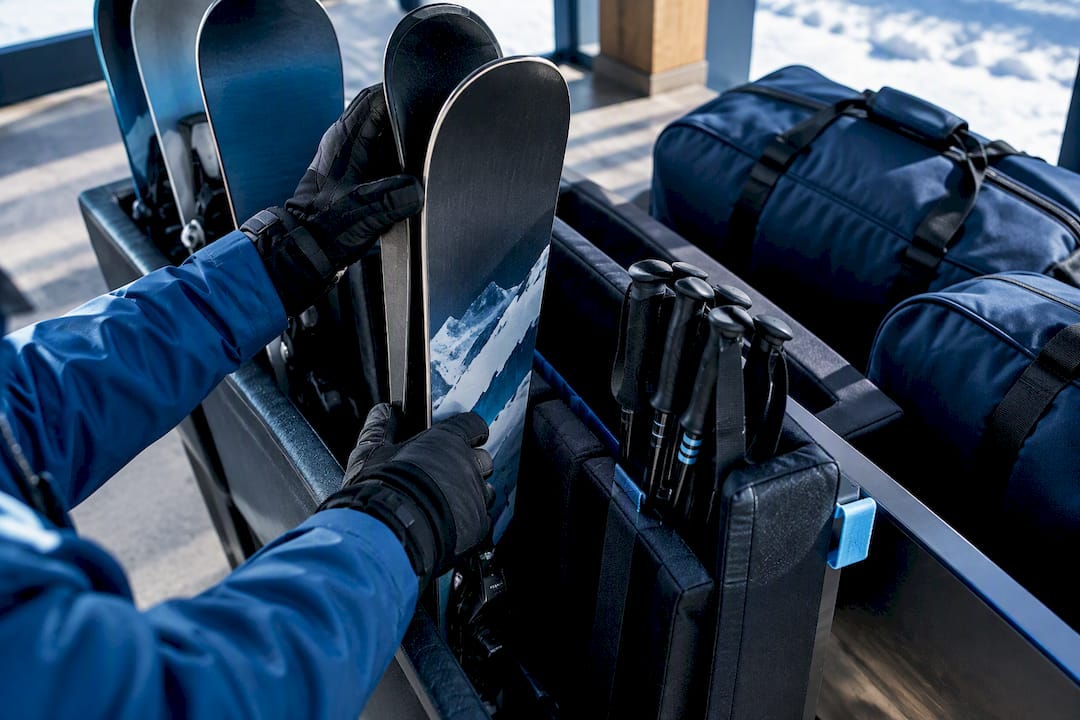
Vehicle size matters here. A minibus works for smaller groups, while larger coaches with underneath luggage bays comfortably fit skis, boards, and boots without cramming gear into the cabin. Some coaches also offer roof-mounted storage for oversized equipment.
- Book charter buses for peak ski season at least four to six weeks ahead, since availability tightens up fast around holidays.
- Ask about luggage bay dimensions before you book, especially if your group has snowboard bags or ski cases longer than standard duffels.
- Request proof of insurance and the carrier’s USDOT number before signing a contract.
Before hiring any motorcoach company, check the carrier’s safety record. The FMCSA’s SaferBus tool and ‘Look Before You Book’ checklist let you confirm active registration and recent compliance reviews before you commit.
Pro Tip: Ask your charter provider how they store skis and boards separately from luggage. It keeps edges from damaging soft-sided bags during the drive.
Shared shuttle, private transfer, or rental: which one fits your trip?
The right airport-to-resort option comes down to your group size and how much you value a fixed schedule versus flexibility.
- Solo travelers or couples: A shared shuttle is usually the cheapest way to get from the airport to the resort, though you’ll wait for scheduled departures rather than leaving on your own timeline.
- Couples wanting more control: A private transfer costs more per person but skips the wait and handles ski bags directly, with tipping typically expected for the driver.
- Families of four to five: A rental car offers the most flexibility for side trips, but factor in chain requirements and rental vehicle restrictions that often prohibit installing chains.
- Groups of six to twenty: A charter bus or larger shuttle van beats splitting into multiple vehicles, since one reservation covers everyone’s gear and everyone arrives together.
Shared shuttles run on fixed schedules, so they’re reliable if you can work around departure times. Private transfers and charters run on demand, which matters more if your flight lands late or gets delayed.
Getting your ski gear there in one piece
Packing and shipping choices make a real difference in how smooth your trip feels once you land.
- Use a padded ski bag or hard case for flights and ground transport. It protects edges and bindings from getting knocked around in cargo holds or luggage bays.
- Check airline and ground transporter size and weight limits before you pack, since oversized bags often trigger extra fees.
- For groups, shipping skis ahead to your hotel or a resort-area ski shop often saves time and cuts down on airport coordination.
- Label every bag with your name and destination the night before you travel, and confirm your pickup or drop-off point matches what your driver or shuttle service has on file.
A little prep here means less scrambling at baggage claim or in a parking lot.
Safety and mountain driving rules you need to know
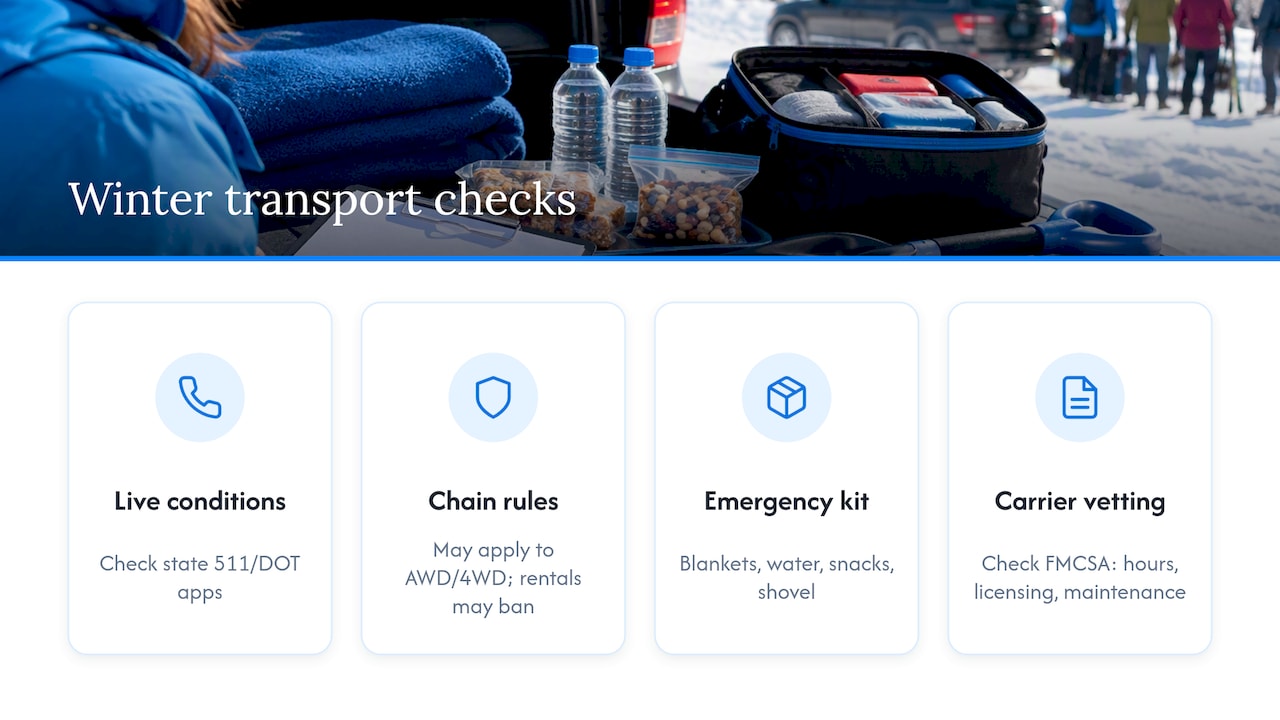
Mountain roads change fast in winter, and a sunny morning can turn into a chain-control afternoon. Before you drive or book ground transport, check your state’s official 511 service or DOT mobile app for live conditions.
Many state DOTs offer free 511 services and mobile apps that provide real-time highway conditions and chain requirements, which are more current than a general weather forecast.
Chain-control levels vary, and all-wheel drive does not always exempt you. The National Park Service warns that chains may still be required for AWD and 4WD vehicles in certain zones, and many rental contracts prohibit installing chains altogether.
Pack an emergency kit with blankets, water, snacks, and a shovel in case you’re stuck waiting out a closure. If you’re hiring a motorcoach, verify the carrier’s safety record through FMCSA before booking, since federal oversight includes checks on driver hours, licensing, and vehicle maintenance.
Booking the right transport: questions, timing, and red flags
A little diligence before you book saves you from surprises on travel day.
- Ask providers exactly how they handle ski and snowboard storage, and whether there’s an extra fee for oversized gear.
- Confirm the cancellation policy and what happens if your flight is delayed or the mountain road closes.
- Book charter buses and popular shuttle routes four to six weeks ahead for peak season, especially around holidays.
- Compare quotes based on distance, vehicle size, and any extra equipment fees, not just the sticker price.
Watch for red flags: a bus company that can’t provide a USDOT number, vague answers about equipment limits, or cancellation terms that seem to shift depending on who you ask. The DOT has issued advisories reminding motorcoach companies to control loading and check tire pressure, so a reputable carrier should have no trouble explaining their safety procedures.
Pro Tip: Get your booking confirmation in writing, including pickup time, location, and gear allowances, so there’s no confusion the morning you leave.
What I’ve learned booking ski trip logistics for groups
Most ski trip transportation problems come down to one thing: nobody planned for the gear. I’ve seen groups solve this by booking a single charter with roomy luggage bays instead of splitting into rental cars, and the difference showed up immediately at pickup, no scrambling to fit ski bags into trunks, no separate cars getting lost on mountain roads. Prioritize safety checks and real luggage capacity over the lowest quote.
— Dusty
How Reliant Transportation makes ski group travel easier
Coordinating gear, pickup times, and mountain routes for a group is exactly what charter buses solve, and it’s what Reliant Transportation handles across Portland, the Willamette Valley wine area, and Hood River.
- Charter buses and limo buses sized for groups of any scale, with luggage bays built for ski and snowboard cases.
- Logistics coordination so your group arrives together instead of split across multiple cars or shuttle runs.
- A single point of contact for scheduling, pickup locations, and gear questions before departure.
If you’re planning a group ski trip, check vehicle sizes and passenger capacities or request a quote to lock in your dates before peak season fills up.
Sources
- Road Weather Impacts and Data (UCAR/NCAR research lab)
- FMCSA briefing on motorcoach safety
- Bring skis and snowboards on Amtrak
FAQ
What are the different ways to transport skis?
Skis can travel with you in padded ski bags on flights, trains, or in a car trunk, or they can be shipped ahead to your hotel or a resort-area shop. Amtrak allows skis and snowboards under standard baggage rules when properly bagged, and many airlines and ground transporters have their own size and weight limits worth checking first.
Where can I find ski transfers?
Ski transfers are typically booked through airport shuttle companies, private transfer services, or charter bus operators serving resort areas. For groups, a charter bus service like Reliant Transportation, which serves the Portland metro area, the Willamette Valley wine region, and Hood River, can coordinate pickup and gear handling in one booking.
Is skiing declining in popularity?
There’s no single figure that settles this, and trends vary by region and season. What’s clear is that group ski trips still require the same core planning, reliable transportation, gear handling, and mountain-road readiness, regardless of broader participation trends.
How much does a ski trip cost per person?
Ski trip costs vary widely based on destination, lodging, lift tickets, and transportation choice, so there’s no single per-person figure that applies across the board. Transportation alone can range from a shared shuttle fare to a private transfer or a per-group charter rate, and getting a quote from your chosen provider is the most accurate way to budget.