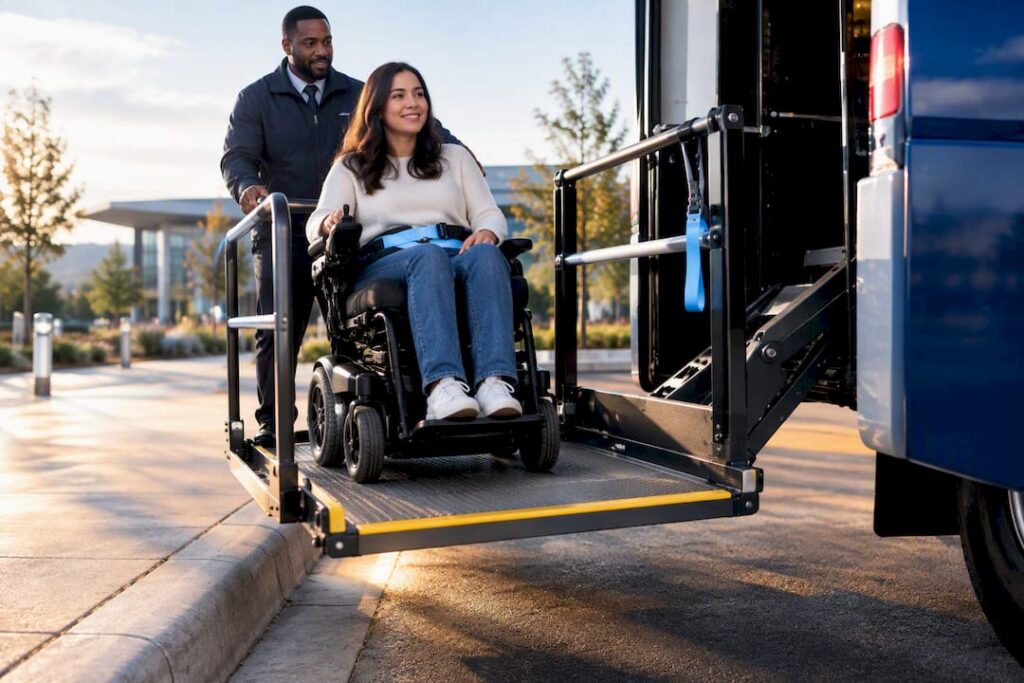
An ADA accessible charter bus is a motorcoach equipped with a lift or ramp and at least one wheelchair securement position that meets federal design standards, usually one to two spaces per coach. Book it by telling the operator you need wheelchair accessibility the moment you first call or request a quote, then get the lift rating, securement count, and vehicle ID confirmed in writing before you sign anything.
TL;DR:
- Operators are required to provide an accessible bus with a lift or ramp rated to handle specific weight capacity, especially for heavier mobility devices.
- Confirm the number of wheelchair securement positions, securement type, and vehicle ID in writing before booking to ensure it meets your group’s needs.
- If the booked accessible bus becomes unavailable, operators can contract another carrier for an equivalent vehicle and must provide a written explanation of the replacement.
- Request information on restroom dimensions, step height, and aisle width during booking, as these features vary widely and can impact rider comfort.
- Book accessible transportation at least 48 hours in advance, and specify all needs early to prevent last-minute issues or misunderstandings.
Table of Contents
- What Accessible Features Should You Expect on a Charter Bus?
- What Do Federal ADA Rules Actually Require?
- How Do You Book an ADA Accessible Charter Bus?
- What If the Accessible Bus You Booked Falls Through?
- How Reliant Transportation Supports Accessible Group Travel
- What Planners Get Wrong About Accessible Booking
- Ready to Book Accessible Charter Transportation?
- Sources
- FAQ
What Accessible Features Should You Expect on a Charter Bus?
Not every coach in a fleet is built the same way, and the differences matter more than most planners realize until the bus shows up.
Lifts vs. ramps. Most full-size motorcoaches use a powered lift platform rather than a fold-out ramp, since the floor height sits well above curb level. Ramps show up more often on shorter shuttle buses and vans. Either way, ask for the lift’s rated capacity in pounds. A standard platform rating won’t cut it for a heavier power chair, and you don’t want to find that out at the curb.
Securement positions. Federal design rules require at least two wheelchair securement locations on vehicles over 22 feet long, and many standard motorcoaches carry one or two positions, as each securement location displaces several regular seats. If your group has three wheelchair users, you likely need a specific vehicle configuration or a larger coach, not just “an accessible bus.”
Here’s what else to confirm before you book:
- Aisle width wide enough for a manual or power chair to navigate to the securement area
- Step height at the door, since some coaches still require a step even with a lift deployed
- Handrails positioned near the entry, aisle, and securement points
- Restroom access, including door width and turning space, which varies widely by coach model
- Service animal policy, which should already be default practice but is worth confirming in writing
- Climate control and audio/visual features that affect comfort for riders with sensory sensitivities
Restroom dimensions in particular trip up a lot of first-time planners. Some coaches marketed as “accessible” have a restroom that a manual wheelchair simply can’t fit into. Check our charter bus bathroom guide for what typical dimensions look like before you assume anything. And if seat removal for securement positions changes your headcount math, our seating chart guide walks through how that works.
What Do Federal ADA Rules Actually Require?
The short version: operators have to provide an accessible vehicle when you ask, but they don’t have to make every bus in their fleet accessible by default.
Under 49 CFR Part 37, demand-responsive over-the-road bus operators, which covers most charter service, must provide an accessible vehicle on request and can require up to 48 hours’ advance notice to do it. That 48-hour window is the legal floor, not a booking strategy. If a company can’t supply an accessible bus from its own fleet for your date, the Northeast ADA Center notes the operator can meet its obligation by contracting with another company to provide equivalent service instead of turning you down.
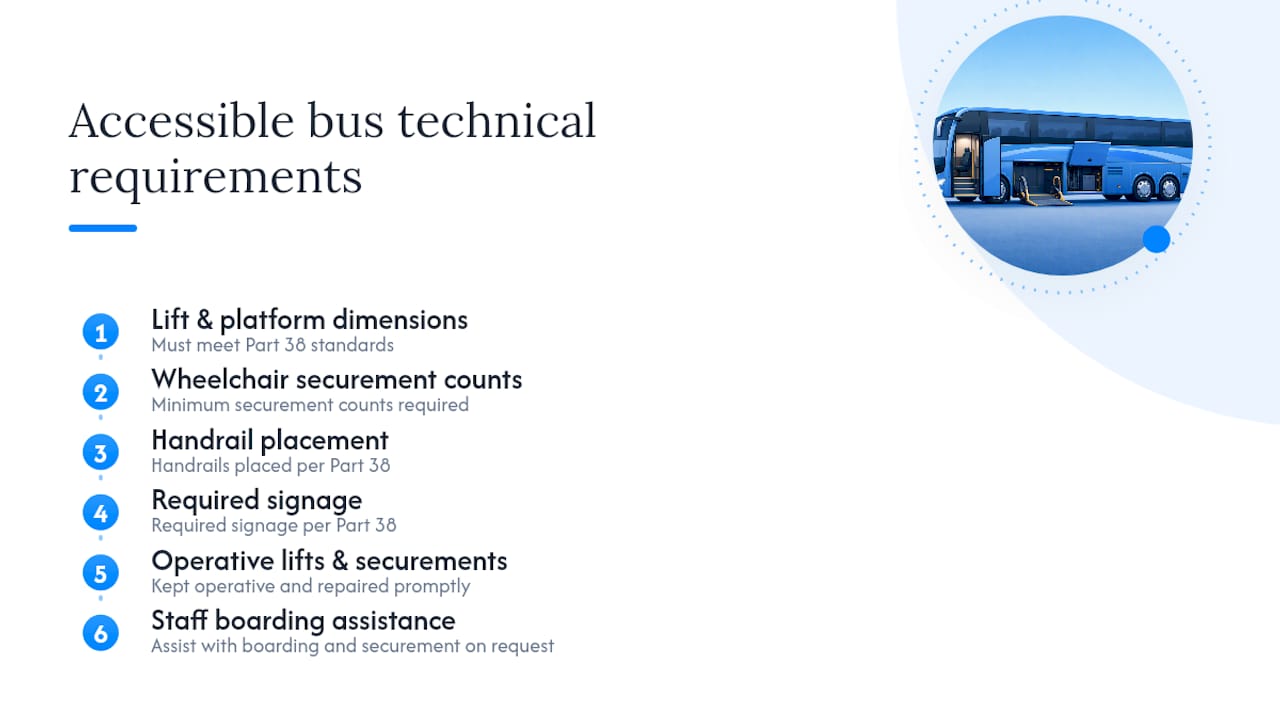
Once a bus is on the road, Part 38 sets the technical standards that define “accessible” in the first place: lift and platform dimensions, minimum securement counts, handrail placement, and required signage. Operators also have to keep lifts and securement systems in operative condition and repair them promptly, and staff must assist passengers with boarding and securement when asked, under Part 37’s service provisions. None of this means every coach shows up accessible by default. It means the accessible one has to meet a real technical bar once you’ve requested it.
How Do You Book an ADA Accessible Charter Bus?
Booking accessible transportation isn’t fundamentally different from booking any charter, but the details you confirm upfront decide whether the day goes smoothly.
- State your accessibility needs at first contact, not after you’ve already picked a date and vehicle class. Mention the number of wheelchair users and the type of mobility device.
- Ask for the lift model and its weight rating, especially if anyone in your group uses a heavier power chair or a nonstandard device. The Northeast ADA Center points out that operators must carry a chair if it can safely board, so confirming the rating in advance avoids a bad surprise on the day.
- Ask for the securement type and count, plus how many total wheelchair positions the specific vehicle offers.
- Request photos or the vehicle ID number in writing so you know exactly which coach you’re getting, not just a category.
- Ask about restroom dimensions, step height, and aisle width if any rider needs those specifics confirmed.
- Confirm the driver’s role in boarding assistance and the company’s service-animal policy.
- Get a written contingency plan for what happens if that specific vehicle becomes unavailable.
Pro Tip: Put the lift rating and securement count directly into your contract or written confirmation, not just in an email thread. A specification line in the agreement is what actually protects you if the wrong vehicle shows up. Our charter bus contract guide has more on what to require in writing.
Accessible vehicles sometimes cost more to book because there are fewer of them in a given fleet and they may require different scheduling. Ask early, and check our charter bus sizes guide once you know your wheelchair position count, since that number often determines which vehicle class actually fits your group.
What If the Accessible Bus You Booked Falls Through?
Equipment breaks, and coaches get pulled for repair. When that happens, the operator’s obligation doesn’t disappear.
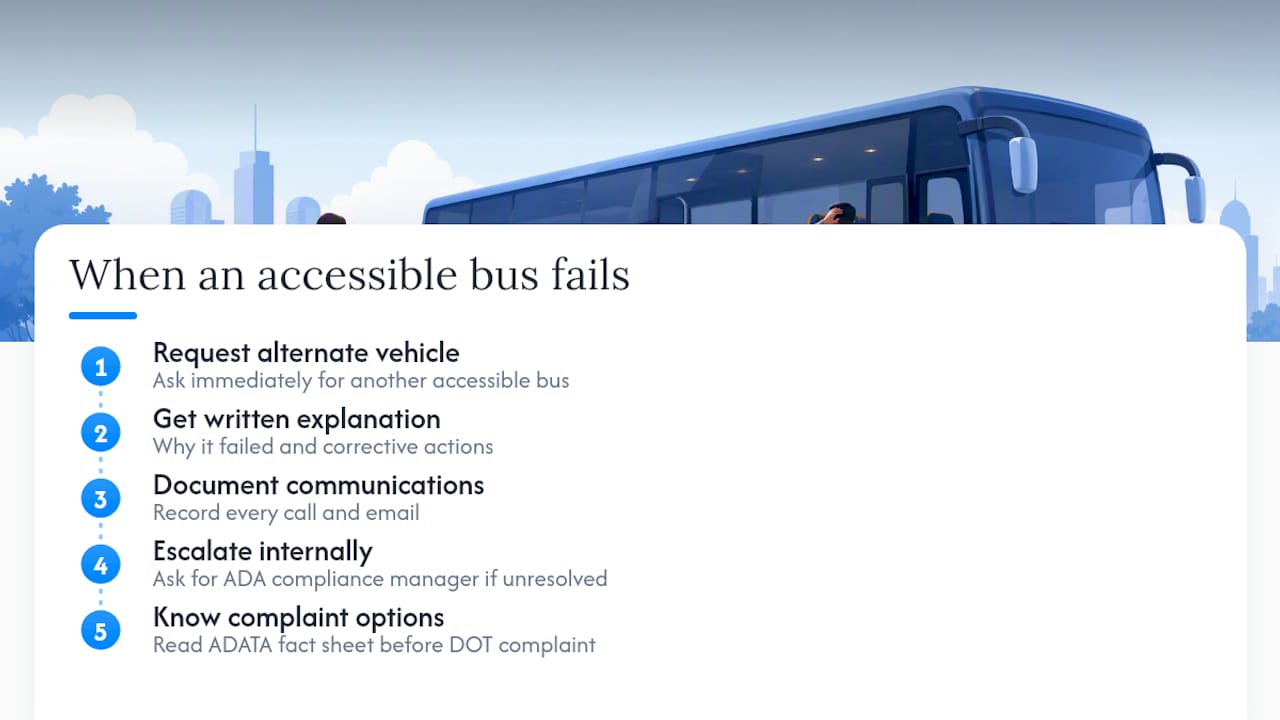
Federal rules allow a company to meet its duty by contracting with another carrier to provide an accessible vehicle if its own fleet can’t, according to the Northeast ADA Center. If a lift or securement system is out of service on the day of your trip, ask immediately for an alternate accessible vehicle, and get a written explanation of what happened and what the company is doing about it. Document every call and email.
If a reservation representative can’t resolve it, ask to escalate to whoever handles ADA compliance internally. The ADATA fact sheet on ground transportation is a useful reference if you need to understand your rights before filing a formal complaint with the Department of Transportation.
How Reliant Transportation Supports Accessible Group Travel
Reliant Transportation coordinates charter service across the Portland metro area, the Willamette Valley wine country, and Hood River, with a focus on well-maintained vehicles and drivers trained to assist riders through boarding and securement. When you request a quote, include your wheelchair count, mobility device type, and event timing so the fleet and logistics team can confirm the right vehicle and put the specifications in writing before your event date.
What Planners Get Wrong About Accessible Booking
The three mistakes I see most often: calling too close to the date, describing accessibility needs vaguely instead of by number and device type, and never asking for the lift’s actual rating. Fix all three with one habit: name your accessibility needs specifically the first time you reach out, and don’t accept a verbal confirmation. Pro Tip: If you only do one thing differently, get the lift rating and securement count in writing before the deposit.
— Dusty
Ready to Book Accessible Charter Transportation?
Reliant Transportation is a direct alternative to piecing together accessible transportation on your own or hoping a generic booking site connects you with the right vehicle. As a transportation operator in the Portland area and nearby regions, the company coordinates itinerary logistics, drivers, and insurance documentation directly with your group, rather than leaving you to chase down specs from an unfamiliar carrier.
When you’re ready to move forward, request a quote and include your wheelchair count, mobility device details, and event date. Reliant’s team will confirm lift rating, securement count, and vehicle details in writing before you commit, whether you’re planning a wedding shuttle, a corporate event, or another group outing covered under Reliant’s services.
Sources
- eCFR :: 49 CFR Part 37 – Transportation Services for Individuals with Disabilities (ADA)
- PART 38—ADA accessibility specifications for transportation vehicles (CFR)
- The ADA and Transportation Providers — Northeast ADA Center
- The ADA and accessible ground transportation | ADATA
FAQ
Are Charter Buses Handicap Accessible?
Some are, but not every bus in a fleet has to be under federal rules. Operators must provide an accessible vehicle when you request one, typically with up to 48 hours’ notice, so always ask specifically when booking.
What Are the ADA Accessibility Guidelines for Transportation Vehicles?
49 CFR Part 38 sets the technical standards, covering lift and platform dimensions, minimum securement locations, handrail placement, and signage. These standards define what actually counts as an accessible vehicle rather than just a bus with a ramp bolted on.
Does an Accessible Charter Bus Cost More To Book?
It can, since accessible vehicles are a smaller share of most fleets and may require different scheduling. Reliant Transportation provides pricing based on your specific vehicle needs and event details, so request a quote directly for current figures on Reliant’s booking page.
What Happens if My Requested Accessible Bus Isn’t Available?
Operators can meet their legal obligation by arranging equivalent service, including contracting with another carrier for an accessible vehicle, according to the Northeast ADA Center. Ask for a written explanation and an alternate vehicle plan if this happens close to your travel date.
How Much Advance Notice Do I Need To Request Accessibility?
Federal rule allows operators to require up to 48 hours’ notice for demand-responsive accessible service, but that’s a legal minimum, not a planning strategy. Request accessibility as early as possible, ideally weeks ahead for weddings or large corporate events, so the operator has time to confirm the right vehicle.