Short answer: yes, you can usually drink on a charter bus, but only if the operator allows it, everyone drinking is 21 or older, and the driver stays completely sober. Federal law clears the biggest legal hurdle for for-hire vehicles under 23 U.S.C. §154, but the real rules come from the operator’s contract and whatever state you’re riding through. Reliant Transportation treats this as a policy question first and a legal question second.
TL;DR:
- Most charter bus operators allow you to bring alcohol if everyone is 21 or older, bottles are in cans or plastic, and the driver remains sober.
- State and local laws can add restrictions, especially regarding sealed bottles, vehicle capacity, and city ordinances, requiring verification at every route stop.
- Operators typically require a written alcohol policy, ID checks at boarding, refundable deposits, and strict zero-tolerance for intoxicated or underage drinking.
- Full alcohol service from a licensed bar onboard usually requires specific licensing, as seen in Oregon, and must be confirmed with proof and insurance.
- Following best practices like proper container use, designated chaperones for minors, and documenting issues helps prevent deposit loss and legal complications.
Table of Contents
- Federal Open-Container Law and What It Means for Charter Buses
- What Charter Companies Commonly Require or Forbid
- Practical Rules for Bringing Alcohol Onboard
- Minors and Chaperone Rules: What Organizers Are Responsible For
- When You Need an Actual Liquor License (the Oregon Example)
- Best Practices Checklist for Planners
- What Happens When Rules Get Broken
- Reliant Transportation’s Policy Checklist for Planners
- Planning a Group Trip With Alcohol? Here’s How Reliant Makes It Easier
- Where to Verify the Legal Details Yourself
- Sources
- FAQ
Federal Open-Container Law and What It Means for Charter Buses
The federal open-container statute that keeps you from cracking a beer in your own car doesn’t apply the same way once you’re a paying passenger on a bus. Under 23 U.S.C. §154, the passenger compartments of vehicles “designed, maintained, and used to transport persons for compensation” are generally exempt from the federal open-container prohibition. That’s the legal foundation letting charter buses, limos, and party buses treat alcohol differently than a regular car does.
Here’s where it gets more complicated. The federal exemption sets a floor, not a ceiling. States adopted their own open-container statutes partly to qualify for federal highway funding, which means enforcement and specific carve-outs vary by state. Oregon’s version, ORS 811.170, mirrors the federal common-carrier exception, but a neighboring state on your route might define “for-hire vehicle” more narrowly or attach extra conditions.
That variation is exactly why you can’t assume a blanket national rule:
- Some states exempt only vehicles above a certain seating capacity.
- A few jurisdictions require the alcohol to be sealed until the vehicle is moving.
- Local ordinances at your pickup or drop-off city can add restrictions the state law doesn’t mention.
If your itinerary crosses city or state lines, check every jurisdiction on the route, not just where you board.
What Charter Companies Commonly Require or Forbid
Legal permission is only half the equation. Charter operators write their own alcohol policies based on liability, cleanup, and past experience, and those policies vary as much as the law does. Most companies fall into a predictable pattern once you know what to ask.
- BYOB is usually allowed, but with limits. Cans and plastic containers are typically fine; kegs and glass bottles are commonly banned outright because of breakage and weight.
- On-board alcohol service without a license is a hard no. If the company isn’t pouring drinks itself, they’re not required to hold a liquor license, but they’ll still restrict what you bring.
- Deposits and cleaning fees are standard. Expect a refundable deposit tied to the condition of the bus at drop-off.
- ID checks happen at boarding. Reputable operators verify age before the bus leaves, not after a problem starts.
- Zero tolerance applies to the driver, always. No exceptions, no “just one.”
Before you sign anything, get the operator’s alcohol policy in writing and ask directly about deposit amounts, banned items, and what happens if a rule gets broken mid-trip. Reviewing a charter bus contract line by line before your event saves you from surprises after the fact.
Pro Tip: Ask your reservation agent to email you the alcohol policy separately from the general contract. A policy buried in fine print is harder to point to later than a dedicated paragraph you can screenshot.
Practical Rules for Bringing Alcohol Onboard
Cans and plastic cups aren’t just a suggestion. They’re the reason most operators say yes to BYOB in the first place. Glass shatters on a moving vehicle and kegs are heavy, hard to secure, and nearly impossible to clean up if they tip. Industry data on charter and party bus operators suggests most allow alcohol with conditions like these built in from the start.
- Bring canned beer, wine in cans or boxes, and pre-mixed cocktails in plastic bottles.
- Skip glass entirely, even for a “nice” bottle of wine for a toast.
- Use a soft cooler with a drain plug or towel underneath to catch condensation.
- Bag your trash as you go instead of letting cans pile up on the floor.
- Bring wristbands or a simple sign-in sheet if your group includes anyone under 21.
None of this is complicated, but skipping it is the fastest way to lose part of your deposit.
Minors and Chaperone Rules: What Organizers Are Responsible For
Mixed-age groups change the equation fast, especially for proms, quinceañeras, or family reunions where some riders are under 21 and others aren’t. Most operators require a designated chaperone for any trip with minors onboard, and that person is expected to actively manage the group, not just ride along.
- Confirm ahead of time whether your trip needs one chaperone or more, based on group size and age range.
- Have chaperones sign a written acknowledgment of their responsibilities before boarding.
- Check IDs at the door and keep a seating plan that separates drinking and non-drinking passengers when practical.
- Plan for the worst case: if a minor is caught drinking, the driver has the authority to end the trip. Know your backup transportation plan before you need it.
Municipal standards in cities that regulate charter and party carriers often spell out these chaperone expectations explicitly, which tells you this isn’t an optional courtesy. It’s baked into how the industry operates.
When You Need an Actual Liquor License (the Oregon Example)
There’s a real difference between passengers bringing their own alcohol and a company serving it to you from a bar cart. BYOB generally doesn’t require the operator to hold a liquor license, since passengers are supplying and consuming their own drinks. The moment a company pours drinks itself, sells alcohol on board, or bundles it into a package price, licensing requirements kick in.
Oregon is a useful example of how rigorous that licensing can get. The Oregon Liquor and Cannabis Commission issues a specific “public passenger carrier” license for full on-premises alcohol service, and it comes with real conditions:
- Applications run through the state’s online CAMP licensing platform.
- Operators must meet food-service requirements tied to the license type.
- Carriers need proof of liquor-liability insurance, commonly cited around $300,000 in coverage, according to OLCC’s licensing page.
If you’re booking a company that advertises on-board bar service, ask to see the license and insurance certificate before you pay a deposit. A legitimate operator will hand it over without hesitation.
Best Practices Checklist for Planners
A little structure before the trip prevents almost every problem people run into mid-ride. Break it into three phases and you’ll cover the parts that actually matter.
- Before the trip: Get the alcohol policy in writing, collect IDs in advance, pay any required deposit, and designate at least one sober chaperone per bus.
- During the trip: Keep drinking away from the driver’s area, stick to cans and plastic, and rotate who’s “on duty” watching the group if the ride runs long.
- After the trip: Help with a quick cleanup sweep, note any damage or disputes in writing immediately, and photograph the bus interior if you’re worried about a deposit disagreement.
Pro Tip: Take photos of the bus interior when you board, not just when you leave. It’s the easiest way to prove pre-existing wear wasn’t your group’s doing.
What Happens When Rules Get Broken
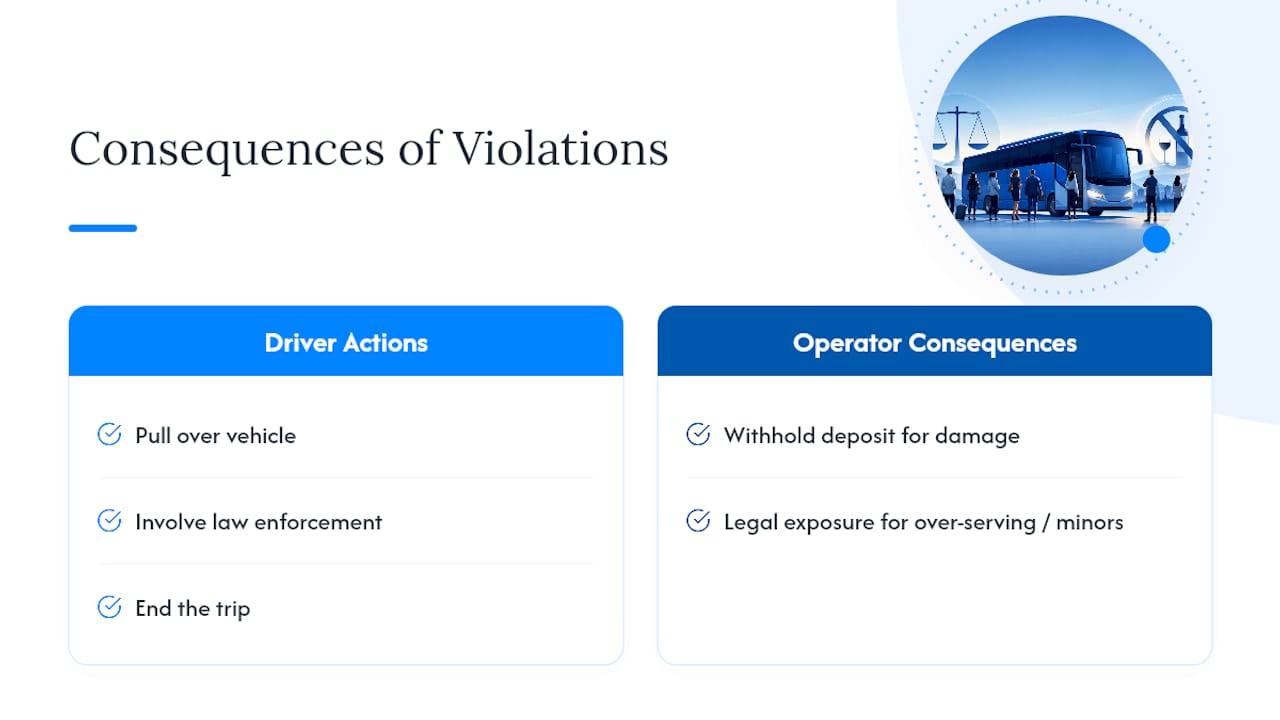
Drivers and operators have real authority here, and they use it more than people expect. A driver can pull over, involve law enforcement, or end the trip entirely if passengers violate the alcohol policy, especially around underage drinking or serving someone who’s clearly intoxicated. Deposits get withheld for damage, and in serious cases, operators face their own legal exposure for over-serving or allowing minors to drink.
If a dispute happens, document it immediately. Take photos, note timestamps, and get names of anyone who witnessed the incident. Most billing disagreements get resolved faster with evidence in hand than with a phone call after the fact.
Reliant Transportation’s Policy Checklist for Planners
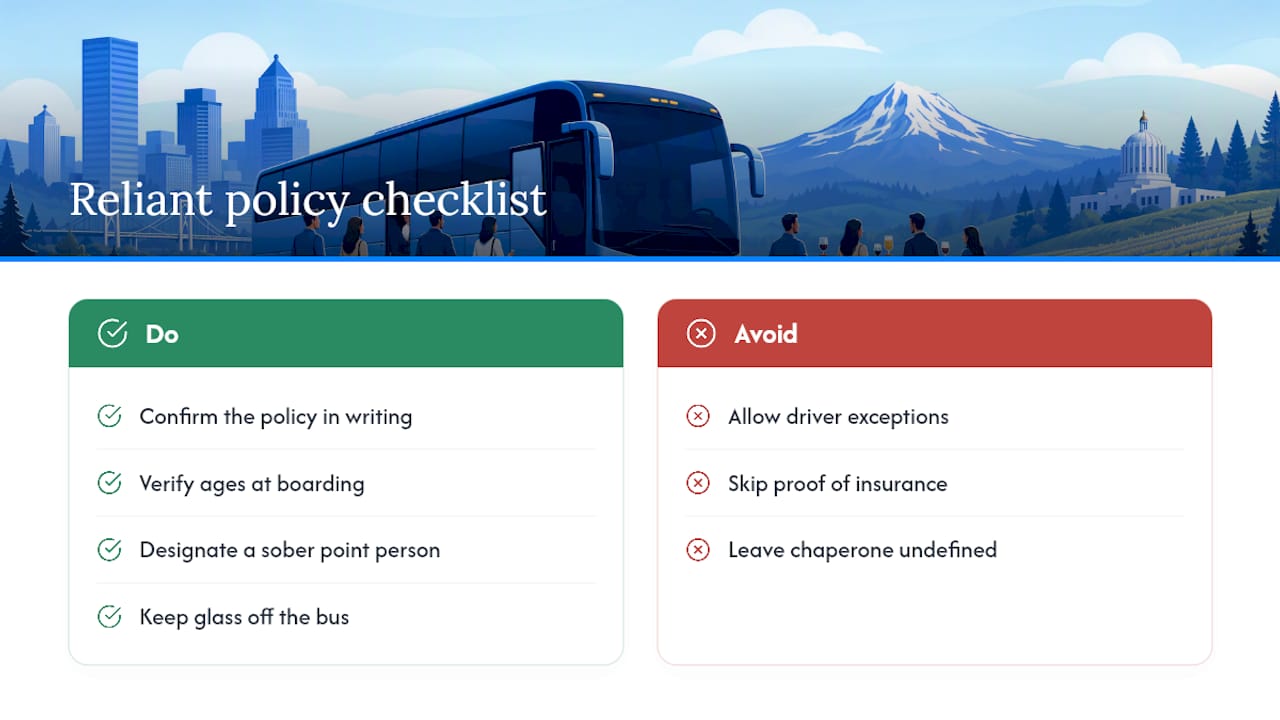
Operators build alcohol policies around one priority: getting everyone home safely without anyone’s night ending in a police report, which varies by vehicle type and operator as explained in this bus wrap cost guide. That means clear contract language up front, proof of insurance available on request, a sober driver with no exceptions, and a defined chaperone process for mixed-age groups.
A workable checklist looks like this: confirm the policy in writing, verify ages at boarding, keep glass off the bus, and designate a sober point person for the group. Reliant Transportation’s charter bus sizes guide can help you match vehicle type to group size before you even get to the alcohol conversation.
— Dusty
Planning a Group Trip With Alcohol? Here’s How Reliant Makes It Easier
Reliant Transportation is the alternative to guessing your way through vague policy pages or calling five companies to find out who actually allows BYOB. As a charter bus service in the Portland area, Reliant provides clear alcohol policy terms, proof of insurance documentation, and credentialed drivers as part of every booking conversation, not as an afterthought you have to dig for.
Whether you’re organizing a wedding shuttle, a corporate outing, or a wine tour through the valley, Reliant’s team walks you through what’s allowed before you book, so there are no surprises on the day of your event. Explore the full range of Reliant’s services for various charter needs, or head straight to book a charter bus and get a written quote with your alcohol policy questions answered upfront.
Where to Verify the Legal Details Yourself
For the federal baseline, read 23 U.S.C. §154 directly. Oregon organizers should check the OLCC public passenger carrier licensing page, and always confirm local ordinances for every stop on a multi-city itinerary.
Sources
- §154. Open container requirements — U.S. Code Title 23
- Oregon Liquor and Cannabis Commission: Full on-premises, public passenger carrier
- Can You Drink Alcohol or Smoke on a Bus? — BusRates
- Alcohol policy on charter buses — Buslane
FAQ
What Is the 2 2 2 Rule for Alcohol?
The “2 2 2 rule” isn’t a standard legal or industry framework tied to charter bus travel, and definitions of it vary widely depending on the source. If you’ve seen it referenced somewhere specific, treat it as informal advice rather than an established regulation, and rely on your operator’s written policy and state law instead.
Is It Allowed to Drink Alcohol on a Bus?
Yes, on most charter and party buses, because federal law exempts for-hire passenger vehicles from the open-container prohibition that applies to regular cars. Whether it’s actually allowed on your specific trip depends on the operator’s own policy and the laws in every state or city your route passes through.
Can I Bring My Own Drink on the Bus?
In most cases, yes, as long as the operator permits BYOB and everyone drinking is 21 or older. Canned and plastic containers are typically welcome, while glass bottles and kegs are commonly banned due to breakage and cleanup concerns, so confirm container rules with your operator before you shop.
Can I Drink If I’m in the Passenger Seat?
That depends entirely on the vehicle type, not just your seat. The open-container exemption applies to the passenger compartment of for-hire vehicles like charter buses, not to a regular car where an ordinary passenger seat still falls under standard state open-container laws.