
For 8 to 14 people with standard luggage, book a Mercedes Sprinter or similar 14-passenger van. For 24 to 35 travelers, move up to a minibus. For larger groups, you need a full-size charter bus. Whatever the headcount, request a quote today, send your flight manifest, and confirm the operator offers meet-and-greet service with live flight tracking.
TL;DR:
- Booking a vehicle that fits luggage capacity is critical; a 14-passenger van often can’t handle two checked bags per person comfortably.
- For groups of 14 to 24, a mid-size minibus provides a balance of space and cost, while larger groups of 24 to 35 require a small coach or full-size bus.
- Reserve your transportation at least 2 weeks for medium groups and 4 to 8 weeks during peak seasons to guarantee vehicle availability.
- Building a detailed transfer brief with passenger and luggage details, flight info, and contact points reduces day-of confusion and delays.
- Confirm staging zones, flight monitoring, and meet-and-greet plans beforehand to avoid curbside miscommunications and timing issues.
Table of Contents
- What Vehicle Size Do You Need for an Airport Group Pickup?
- How Far Ahead Should You Book Group Airport Transportation?
- What Happens at the Curb: Staging, Meet-and-Greet, and Timing
- What Drives the Cost of a Group Airport Pickup
- What to Ask and Confirm Before You Book
- How Reliant Transportation Handles Group Airport Pickups
- A Planner’s One-Page Transfer Brief Template
- Book Reliant Transportation for Your Group Airport Pickup
- Sources
- FAQ
What Vehicle Size Do You Need for an Airport Group Pickup?
Picking the wrong vehicle class is the single most common mistake event planners make when arranging an airport group pickup, and it almost always comes down to counting heads without counting bags. A 14-seat van technically fits 14 adults, but not 14 adults with two checked bags, a carry-on, and a golf club case each. Large-group transfer guidance makes this point directly: purpose-built vehicles matter because rideshare apps cap out around six seats and fall apart fast once you add luggage to a group of seven or more.
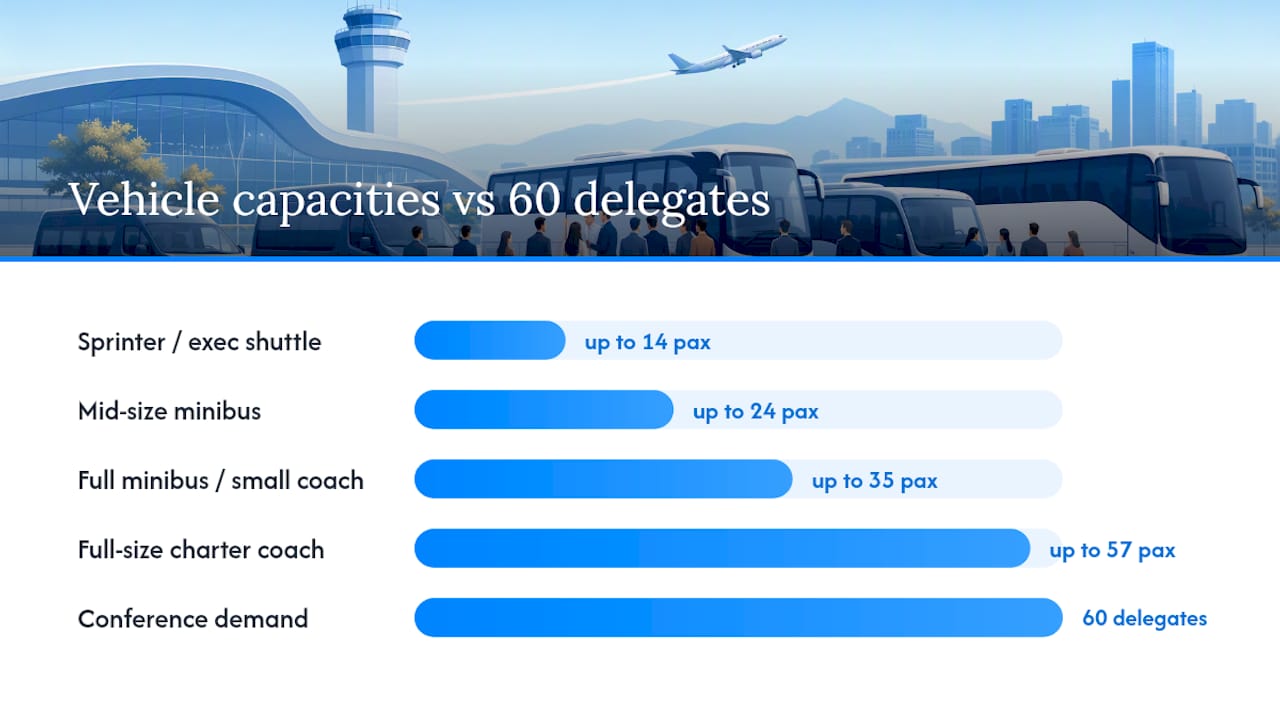
Here’s how the capacity bands typically break down for group airport transportation:
- 8 to 14 passengers: A Sprinter van or similar executive shuttle, ideal for small wedding parties, board delegations, or a single-family reunion group.
- 14 to 24 passengers: A mid-size minibus, the sweet spot for bridal parties plus family, small corporate teams, or tour subgroups.
- 24 to 35 passengers: A full minibus or small coach, common for larger wedding guest lists and conference delegations arriving on one flight bank.
- 40 to 57 passengers: A full-size charter bus, built for large conference groups, school trips, and multi-flight tour arrivals.
The rule of thumb that saves planners the most grief: if your headcount is within two or three seats of a vehicle’s max, size up rather than squeeze in. Count bag types separately, too. Checked bags, carry-ons, and oversize items like garment bags or musical instruments all eat into underneath storage differently, and luggage capacity needs to be verified rather than assumed. A wedding party of 20 with garment bags and gift boxes needs more cargo room than 20 business travelers with roller bags.
Some groups need more than one vehicle no matter how you slice the math. A conference with 60 delegates landing across three flights within an hour often does better with two mid-size shuttles running staggered pickups than one overloaded coach waiting on the last connection. If you’re transporting AV equipment, wine cases for a Willamette Valley tasting tour, or oversized gear, ask about a trailer option before assuming a bigger bus solves the problem. Our charter bus sizing guide breaks down seat counts and underneath storage by model if you want exact specs before you call anyone.
How Far Ahead Should You Book Group Airport Transportation?
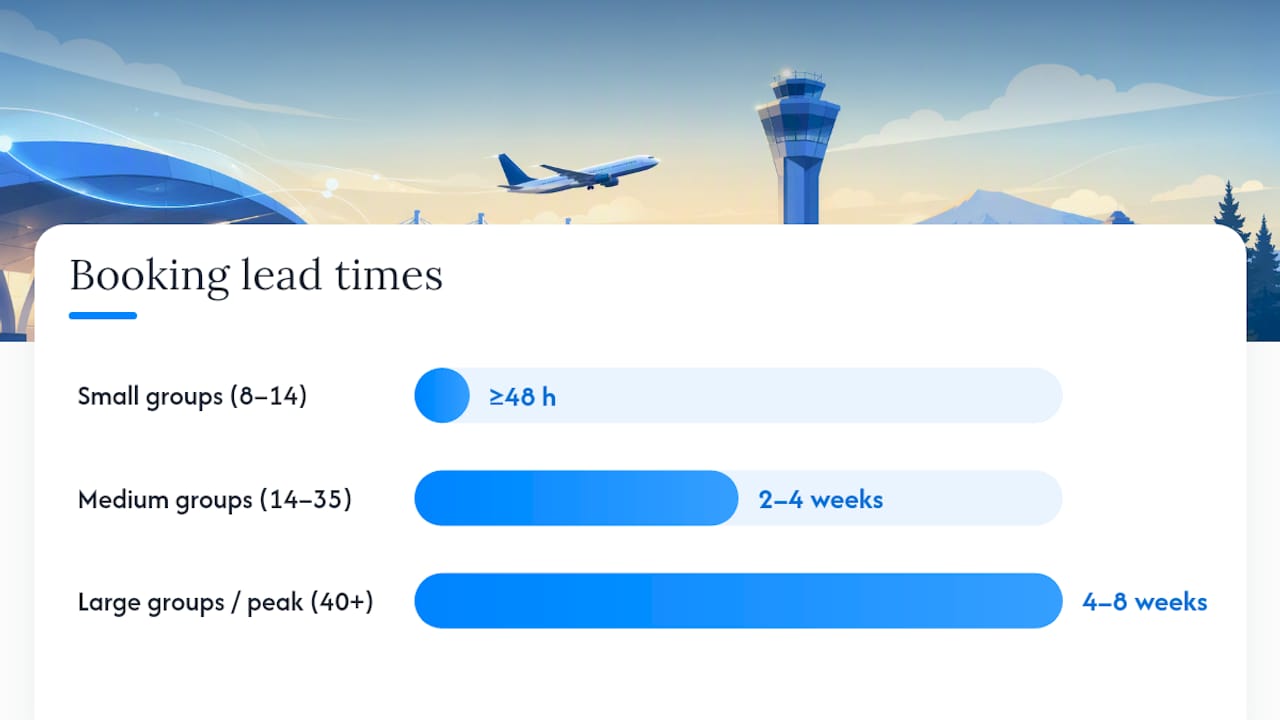
Lead time isn’t just a courtesy to your operator. It’s what determines whether the right vehicle is even available when your flight lands. Booking timelines scale with group size and how competitive the calendar is:
- Small groups (8 to 14 people): Book at least 48 hours ahead for a standard weekday transfer, longer if you’re arriving during a local event or holiday weekend.
- Medium groups (14 to 35 people): Give yourself 2 to 4 weeks. This is enough runway for the operator to confirm the right vehicle class and assign a driver familiar with your specific airport’s staging setup.
- Large groups or peak season (40+ people, or any group arriving during wine country harvest season or wedding high season): Plan 4 to 8 weeks out, since minibuses and coaches book up fast during peak periods and last-minute availability shrinks accordingly.
Once you’ve locked in a date, the real work is building what planners call a transfer brief. This is the single document that keeps your pickup from turning into a scavenger hunt. A solid brief includes:
- Full passenger names and headcount
- Flight numbers, arrival times, and terminals for every arriving party
- Exact luggage counts by type (checked, carry-on, oversize)
- Any special needs (wheelchair access, car seats, temperature-sensitive items)
- One designated contact person and their phone number
Flight tracking is where a lot of the day-of stress gets absorbed before it ever reaches you. A professional operator monitors your flight in real time, which matters more than people realize when a connection runs late or gets rerouted. If your group is landing on a single flight, one pickup works fine. If you’ve got a wedding party arriving on four flights across a three-hour window, staggered pickups, timed to each landing rather than one vehicle idling for hours, keep costs down and guests from standing around a terminal.
Close the loop 24 hours before arrival with a reconfirmation call, and make sure your driver’s direct contact number is in the hands of your day-of point person. That single phone number often prevents the “where is everyone” text chain that ruins first impressions.
What Happens at the Curb: Staging, Meet-and-Greet, and Timing
Charter buses and minibuses don’t pull up to the same curb your rideshare uses. Commercial vehicles operate out of designated staging or loading zones, separate from standard passenger pickup, and every airport numbers or names these zones differently. Confirm the exact zone with your provider before travel day and pass that information directly to your group, because sending 30 people to the rideshare lot when your bus is parked at Zone 4 is the fastest way to lose 20 minutes you didn’t budget for.
Meet-and-greet service solves most of this before it becomes a problem. A trained representative waits inside baggage claim holding a sign with a name your group will recognize, not just “Reliant Transportation,” but something specific like “Martinez Wedding Party.” Best practice looks like this:
- Use a landmark-based meeting phrase (“Meet at baggage carousel 3, near the Starbucks”) rather than a vague “meet outside.”
- Print a sign large enough to read from 30 feet away, with the group name in bold letters.
- Text a photo of the sign and the driver to your group chat before wheels-down so nobody is searching blindly.
Timing expectations matter here too. Domestic arrivals typically clear baggage claim in 15 to 25 minutes after touchdown. International arrivals, especially with customs and immigration, can take 45 minutes to over an hour. Build that difference into your pickup window instead of assuming every flight behaves the same way once it lands.
Pro Tip: Assign one person in your group, not the driver, not you personally if you’re managing five other things, as the single point of contact for “where do we go.” One coordinator with one phone number cuts confusion dramatically compared to everyone texting the driver individually.
What Drives the Cost of a Group Airport Pickup
Charter and minibus pricing usually runs on one of two models: hourly rates or flat job minimums, and most operators default to whichever protects them against a short trip that still requires a driver, fuel, and staging fees for an hour or more. Distance from the airport, wait time built into your window, after-hours or overnight service, and airport staging fees all factor into a quote, and multiple vehicles multiply every one of those line items.
Group size actually works in your favor on a per-person basis. Cost-per-person tends to drop as group size increases, since you’re splitting one vehicle’s operating cost across more travelers.
| Group size | Vehicle type | Approximate cost per person (short transfer) |
|---|---|---|
| 8 to 14 | Sprinter van | Higher per-person, fewer people splitting the job minimum |
| 24 to 35 | Minibus charter | Roughly $12 to $20 per person |
| 40+ | Full charter bus | Lower per-person than multiple vans or rideshares |
Staggered pickups for multiple flight arrivals typically cost more than a single coordinated pickup, since you’re paying for extra wait time or a second vehicle run. If your budget is tight and your group is landing across a wide window, compare the cost of splitting into two smaller vehicles against paying one larger vehicle to wait. Sometimes splitting wins; sometimes it doesn’t. Ask your operator to run both numbers before you decide.
What to Ask and Confirm Before You Book
Treat this like a pre-flight checklist. A rushed phone call now costs you far less than a confused group standing at the wrong curb later.
Contract items to confirm:
- Exact vehicle make, model, or seat class, in writing
- Insured passenger capacity (not just seat count)
- Cancellation policy and any job minimum charges
- What’s included in the quoted price versus billed as an add-on
Operational items to confirm:
- Meet-and-greet details and exact staging zone number
- Direct driver contact for day-of communication
- Luggage policy by bag type and count
- Built-in wait time buffer for delayed flights
Watch for red flags: an operator who can’t tell you a specific staging zone, gives vague luggage allowances instead of hard numbers, or doesn’t mention flight monitoring at all. Those gaps tend to surface at the worst possible moment. Our charter bus contract guide walks through exactly what to require in writing before you sign.
How Reliant Transportation Handles Group Airport Pickups
Reliant Transportation builds its process around the same discipline this guide has walked through, because that discipline is what prevents day-of chaos. Every group booking starts with itinerary coordination specific to your event, matched to a fleet sized for your actual headcount and luggage load, not a generic estimate.
What a typical booking looks like:
- You submit a transfer brief with passenger count, flight details, and luggage information.
- Reliant monitors your flight status leading into arrival.
- A driver or representative executes meet-and-greet at your confirmed pickup point.
- Luggage gets reconciled against your brief before departure from the airport.
Drivers carry the credentials and insurance documentation Reliant provides as part of its standard compliance process, and every contract spells out capacity and coverage details up front rather than leaving them to a phone call the week of your event. Reliant serves the Portland metro area, the Willamette Valley wine region, and the Hood River area, and every group job runs through that same coordination process regardless of whether it’s a wedding shuttle or a conference transfer.
A Planner’s One-Page Transfer Brief Template
Copy this into a single page: passenger count, flight numbers and terminals, luggage totals by type, special needs, and one contact name with a cell number. Assign two roles before travel day. A communications lead handles all pickup questions from the group so the driver isn’t fielding ten separate texts, and a baggage captain does a headcount-to-bag-count check before the vehicle pulls away. Give your group a windowed ETA (“pickup between 2:15 and 2:45”) instead of a fixed time, since flights rarely land exactly on schedule. One channel, one brief, one point of contact. That combination is what keeps a complicated arrival bank from turning into a scramble.
Book Reliant Transportation for Your Group Airport Pickup
A local charter bus company provides an alternative to piecing together multiple rideshares or gambling on a shuttle service not built for weddings, conferences, and large group logistics. If you’re coordinating a wedding party landing across several flights, a corporate delegation, or a wine country group heading into the Willamette Valley, this provider handles the vehicle sizing, the flight monitoring, and the meet-and-greet coordination to simplify your experience at baggage claim.

Start on the services page to see which vehicle class and service type fits your event, whether that’s a wedding, corporate transfer, or general charter need. When you’re ready, send your transfer brief, passenger count, flight numbers, luggage counts, and special needs, through the quote request page. Reliant typically responds with vehicle availability and a clear quote, then confirms details as your travel date approaches. Request your custom quote today and get a specific answer instead of a guess.
Sources
- How to arrange transport for large groups to & from airports | My Private Transfers
- SeaTac group transport: Bus, shuttle or rideshare | Buslane
FAQ
What Is an Airport Pickup?
An airport pickup is a scheduled ground transportation service that picks up passengers directly from an airport terminal after their flight lands. For groups, this typically means a dedicated vehicle, van, minibus, or charter bus, sized to the headcount, with a driver who meets travelers at a designated point rather than a shared curbside line.
How Much Should You Budget for a Shuttle Service?
Cost depends heavily on group size and vehicle type. A minibus charter for 24 to 35 people can run roughly $12 to $20 per person for a short transfer, while smaller vans carry a higher per-person cost since fewer people split the job minimum.
What’s the Cheapest Way to Move a Large Group From the Airport?
For groups of seven or more, a single charter vehicle almost always beats booking multiple rideshares, since rideshare apps aren’t built for groups past six passengers and splitting into several cars adds cost and coordination risk. A minibus or coach spreads the cost across the group and keeps everyone together.
What Should You Look for in a Group Airport Transfer Provider?
Look for verified driver credentials and insurance coverage, real-time flight tracking, meet-and-greet service, and clear pricing with a defined cancellation policy. Some charter bus providers include itinerary coordination and credentialed drivers as standard parts of their group charter process for events across the Portland metro area, the Willamette Valley, and Hood River.
How Far in Advance Should You Book a Group Airport Pickup?
Book at least 48 hours ahead for small groups, 2 to 4 weeks for medium-size groups, and 4 to 8 weeks for large groups or peak travel periods. Booking earlier secures the right vehicle class before availability tightens closer to your date.