Federal law requires lap and shoulder belts on new over-the-road motorcoaches and other new large buses above a set weight threshold, effective since November 2016. Small buses under 10,000 pounds already needed three-point belts. Large school buses are the exception: federal rules rely on a different safety design instead, though several states now require belts on those too. When installed and worn, lap/shoulder belts meaningfully cut the odds of dying or suffering a serious injury in a crash.
TL;DR:
- Seat belts are federally required on large motorcoaches over a weight threshold since 2016, but not on large school buses due to design safety standards.
- Many states have enacted laws requiring seat belts on school buses, but enforcement and installation mandates vary, with some only applying to new buses.
- Crash data shows belts reduce fatalities by around 44% and injuries by 45%, yet their effectiveness depends heavily on proper use.
- Retrofitting older buses with belts is costly, and operational concerns such as evacuation delays and enforcement often hinder widespread adoption.
- In buses without belts, sitting in forward-facing seats away from doors or windows offers slightly better crash protection, especially on longer highway trips.
Table of Contents
- Seat Belts on Buses: What Federal Law Actually Requires
- Why School Buses Play by Different Rules
- What the Crash Data Actually Shows
- Why So Many Buses Still Don’t Have Belts
- What to Do When You’re Actually on a Bus
- How Reliant Transportation Thinks About Seat Belts
- Where These Rules Come From
- An Editorial Take on the Seat Belt Debate
- Sources
- FAQ
Seat Belts on Buses: What Federal Law Actually Requires
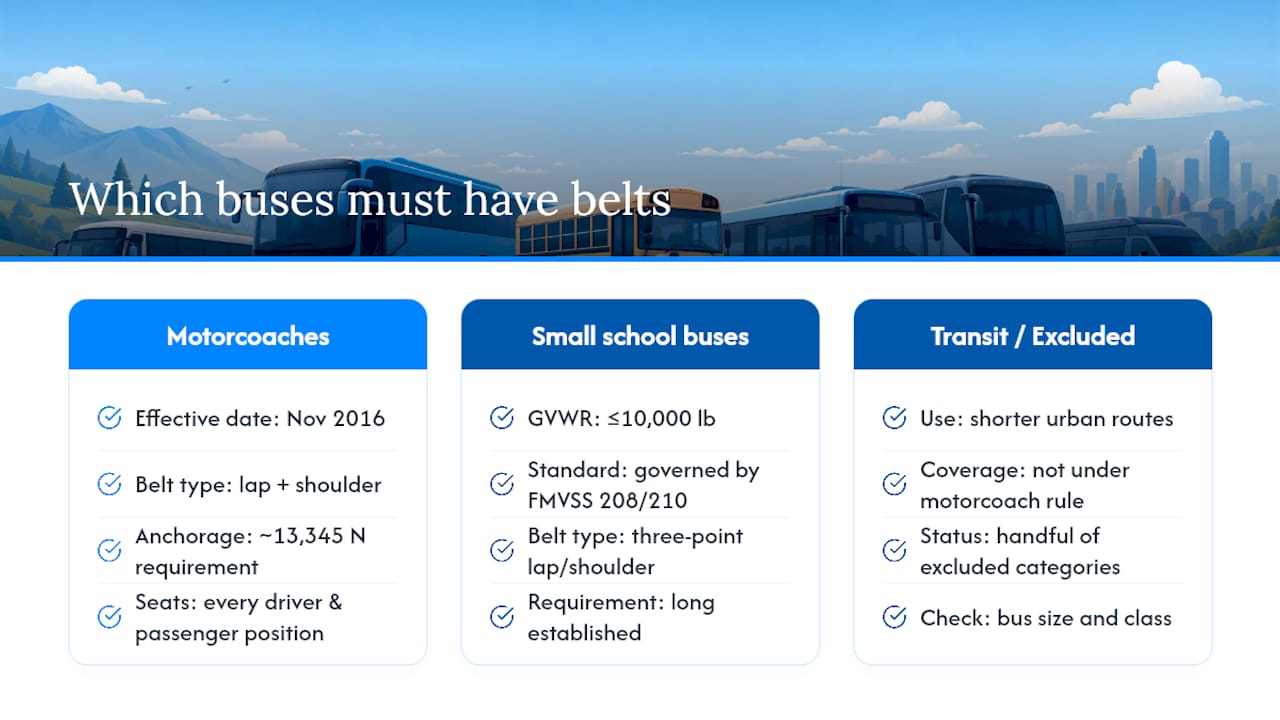
The rule everyone’s asking about traces back to a single NHTSA final rule that took effect for newly manufactured motorcoaches and other large buses starting in November 2016. It requires lap and shoulder belts at every passenger and driver seating position on covered vehicles, and NHTSA projects that the requirement could significantly reduce fatalities and moderate-to-severe injuries when belts are worn.
The weight threshold matters here. Buses above a certain gross vehicle weight rating (GVWR) fall under this motorcoach rule, while smaller buses were already governed by older standards. Federal Motor Vehicle Safety Standard (FMVSS) No. 210 covers seat belt anchorages, meaning how securely the belt attaches to the bus frame, while FMVSS No. 208 governs occupant crash protection, spelling out which seats need belts and what type. Small school buses, those at or under 10,000 pounds GVWR, have long been required to carry three-point lap/shoulder belts under these same standards.
The Federal Register rulemaking record also set the technical bar for those belts: anchorages have to withstand roughly 13,345 newtons of force, and belts need to lock properly and fit passengers ranging from small children to 95th-percentile adults. Transit buses used for shorter urban routes, along with a handful of other excluded categories, don’t fall under this motorcoach mandate. If you’re trying to figure out whether a specific charter vehicle qualifies, checking the bus size and class is a useful first step, since GVWR often tracks closely with vehicle category.
Why School Buses Play by Different Rules
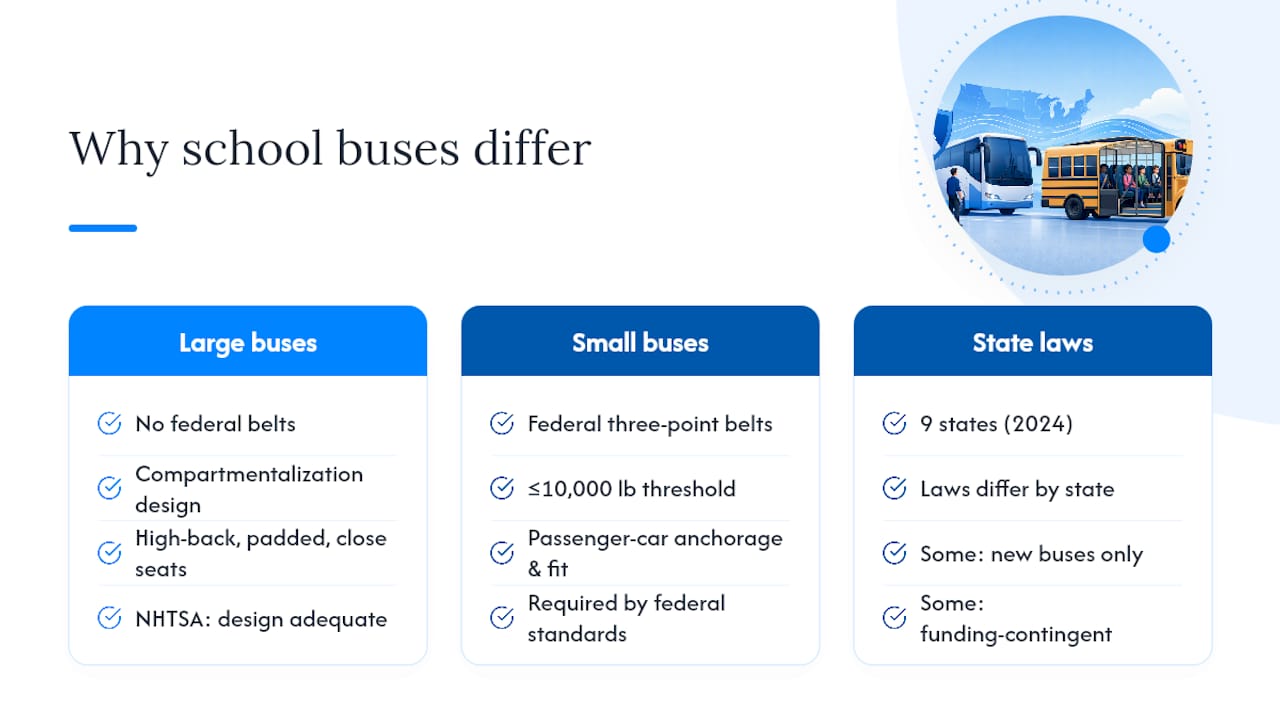
Large school buses don’t get the same federal seat belt mandate, and the reasoning goes back decades. Under FMVSS No. 222, large school buses use a design principle called compartmentalization instead: high-backed, heavily padded, closely spaced seats that create a protective shell around each child during a crash. NHTSA’s own interpretation holds that this design already delivers strong crash protection, and that mandating belts nationwide could carry unintended costs without a proportional safety gain.
Small school buses are treated differently again. Because they weigh 10,000 pounds or less, federal standards require them to have the same three-point lap/shoulder belts as passenger vehicles, with the same anchorage and fit certifications.
States haven’t waited for Washington to settle the debate. As of 2024, nine states, Arkansas, California, Florida, Iowa, Louisiana, Nevada, New Jersey, New York, and Texas, have passed laws requiring seat belts on school buses, according to the National Conference of State Legislatures (NCSL). None of these laws look identical. Some mandate installation only on newly purchased buses going forward. Others tie the requirement to state appropriations, meaning a school district might not have to comply until funding actually arrives, a caveat documented in a Connecticut legislative report on the topic. Florida requires the belts; whether they’re required to be worn, and by whom, is a separate enforcement question districts handle locally.
What the Crash Data Actually Shows
The 44% fatality reduction and 45% injury reduction figures from NHTSA’s motorcoach rulemaking aren’t abstract projections pulled from a lab. They come from crash reconstruction and occupant-protection modeling built around how motorcoach passengers actually get hurt: ejection through windows during rollovers, and being thrown into seatbacks or the aisle during frontal collisions.
NHTSA’s rulemaking record estimates that lap/shoulder belts prevent several deaths annually on covered buses, according to a GAO review of the rule, with per-vehicle costs running above $2,000 in the agency’s historical estimates.
Rollovers are where belts do the most work. A passenger thrown against a window or ejected entirely faces dramatically worse outcomes than one held in place by a lap/shoulder combination. Side and frontal-impact data tell a similar story, though the benefit only shows up when the belt is actually buckled.
That’s the catch nobody likes talking about. A belt sitting unused in a motorcoach seatback delivers zero protection, and no federal standard can force a passenger’s hand to buckle it.
Why So Many Buses Still Don’t Have Belts
Cost is the obvious barrier. Retrofitting anchorages into an existing fleet, or paying the premium for belts on a new order, adds real dollars per vehicle, and operators running tight margins sometimes choose to extend the life of an older, unbelted bus rather than replace it early.
Operational friction plays a role too. Evacuating a bus full of belted passengers during an emergency takes longer than clearing an unbelted one, particularly with children who need help releasing a buckle. Enforcement is its own headache: a driver already responsible for the route, the schedule, and rider behavior now also has to police whether every seat belt is fastened, especially on a school run with dozens of kids.
There’s also a policy trade-off worth naming honestly. Some safety advocates argue that a fixed pool of transportation dollars produces more lives saved when it goes toward driver training, crossing guard programs, or vehicle maintenance rather than universal belt retrofits, particularly on large school buses where compartmentalization already provides a documented safety floor.
What to Do When You’re Actually on a Bus
If your bus has lap/shoulder belts, use them the way you would in a car: the lap portion sits low across the hips, not the stomach, and the shoulder strap crosses the collarbone rather than the neck. For a young child needing a car seat or booster, check that the belt locks properly. Most factory-installed bus belts have a locking mechanism designed for exactly this.
If the bus has no belts at all, forward-facing seats away from the very front and very back offer somewhat better protection in a frontal impact. For long highway trips or wine country routes with higher speeds, belted motorcoaches are worth requesting specifically when you book.
- Ask the operator directly whether the vehicle has lap/shoulder belts at every seat.
- Confirm the bus model and year, since belt requirements changed in 2016, and consider reading What Is a Digital Driver ID? A Passenger Guide for tips on verifying operator credentials.
- Request written confirmation of recent anchorage and belt maintenance checks.
- Report any loose, frayed, or non-locking belt to the operator immediately, and put it in writing.
Pro Tip: If you’re booking group transportation for a wedding party or a wine tour with several stops, ask to see the seating chart before the trip. It’s the easiest way to confirm belt placement and legroom before anyone boards.
How Reliant Transportation Thinks About Seat Belts
When we spec out or retrofit vehicles in our fleet, seat belts aren’t an afterthought bolted on to satisfy a checklist. Charter operators weigh belt availability against seating capacity, route length, and how a vehicle will actually be used, since a shuttle running short hotel transfers has different needs than a coach headed up the Columbia Gorge to Hood River.
Safety specifications are part of every conversation with a client before a trip gets booked. If seat belts matter to your group, ask the operator directly to confirm what’s available on the vehicle assigned to your date.
Before you lock in any charter, a short checklist helps: ask about seat belt availability, request a passenger safety briefing for the driver to deliver, and confirm the vehicle’s last maintenance check. You can get a clear quote and reserve online once you know what you need.
Where These Rules Come From
The core facts here trace to four primary sources: the NHTSA final rule on motorcoach seat belts, the Federal Register rulemaking record detailing technical standards, FMCSA’s summary of which vehicle classes are covered, and the NCSL state-by-state tracker on school bus seat belt laws.
An Editorial Take on the Seat Belt Debate
The federal rule on motorcoaches got this right: above a certain weight, with passengers exposed to highway speeds for hours, belts save lives, and NHTSA’s own numbers back that up convincingly. Where the conversation goes wrong is when people assume the same logic should automatically extend to every yellow school bus in the country.
Compartmentalization isn’t an excuse, it’s an actual engineering approach with decades of crash data behind it, and large school buses remain among the safest vehicles on the road by any fatality-per-mile measure. The real gap isn’t belts versus no belts. It’s usage. A motorcoach belt nobody buckles protects nobody, and that’s a training and habit problem, not a hardware problem.
If you’re a parent, planner, or passenger, spend less energy debating whether belts should exist and more energy checking whether the ones already installed get used correctly. That’s the lever within your control, and it’s the one most guides skip past.
— Dusty
Sources
- NHTSA Announces Final Rule Requiring Seat Belts on Motorcoaches | US Department of Transportation
- Seat belt requirements and other occupant protection standards for buses | FMCSA
- Federal Register: FMVSS amendments re occupant crash protection for certain buses (final rule)
FAQ
What States Require Seat Belts on Buses?
Nine states, Arkansas, California, Florida, Iowa, Louisiana, Nevada, New Jersey, New York, and Texas, require seat belts on school buses as of 2024, according to NCSL, though installation timelines and funding rules vary by state.
Why Are There No Seat Belts on Buses?
Large school buses rely on compartmentalization, high, padded, closely spaced seats, rather than belts, based on NHTSA’s long-standing safety interpretation. Motorcoaches and large buses built since November 2016, by contrast, are federally required to have lap/shoulder belts.
Do Pennsylvania School Buses Have Seat Belts?
Pennsylvania is not currently among the nine states with a school bus seat belt mandate identified by NCSL, meaning large school buses there follow the federal compartmentalization standard rather than a belt requirement.
Does Florida Require Seat Belts on School Buses?
Yes. Florida is one of the nine states that requires seat belts on school buses, per NCSL’s state tracking, though enforcement of actually wearing the belt is typically handled at the district level.