
If your trip includes shared, nonrefundable costs and 5 to 10 or more travelers, group travel insurance is usually the most efficient way to protect everyone at once, and often the cheapest per person. Start your shortlist with named insurers like Faye, Travelex, Seven Corners, AXA Assistance USA, and Allianz Global Assistance. Buy inside the pre-existing condition waiver window, generally 14 to 21 days after your first trip payment, and add Cancel For Any Reason coverage if your group’s plans could still change.
TL;DR:
- Most group travel insurance policies are suitable for groups of around 10 travelers, with some plans available for as few as 5, but confirmation is necessary.
- Buying insurance within 14 to 21 days of the first trip payment locks in pre-existing condition waivers and allows the addition of Cancel For Any Reason coverage.
- Group policies typically cover trip cancellation, medical emergencies, evacuation, baggage, and delay, with individual certificates issued for each traveler to file claims separately.
- Shipping accurate trip and traveler details upfront helps obtain comparable quotes quickly and avoids delays in the insurance process.
- For shared transportation costs, providing proper documentation such as a signed contract and passenger list speeds up claims for supplier bankruptcy or cancellation.
Table of Contents
- Which Group Travel Insurance Provider Fits Your Trip?
- What Does Group Travel Insurance Actually Cover?
- Group Policy, Individual Plans, or a Hybrid?
- How Do You Compare and Choose a Group Policy?
- When Should You Buy, and What Will It Cost?
- Insuring the Bus, Not Just the Bus Riders
- Quick Recommendations by Trip Type
- Let Reliant Transportation Take the Logistics Off Your Plate
- Where to Get Quotes and Verify the Details
- Sources
- FAQ
Which Group Travel Insurance Provider Fits Your Trip?
Not every insurer on this list is built for the same kind of group. A 40 person wedding party has different needs than a 12 student research trip to Costa Rica, and the right policy depends on group size, destination, and how much flexibility you want to pay for.
Here’s a quick read on each option before you start requesting quotes:
- Faye shows up frequently in comparison searches as a quote first option, meaning you can get pricing quickly without a long intake call, which suits leisure group organizers who just need numbers to compare.
- Travelex offers group-capable plans with some of the more straightforward Cancel For Any Reason options on the market, when that upgrade is available in your state.
- Seven Corners has built its reputation on international and group medical coverage, making it a natural fit for student groups and adventure trips headed outside the country.
- Nationwide brings the reassurance of a large, recognizable insurer with integrated customer service, which some organizers prefer over a niche travel-only brand.
- Tin Leg functions more like a distribution platform, letting you compare multiple carriers’ group plans in one place rather than committing to a single insurer upfront.
- AXA Assistance USA issues each traveler an individual certificate of coverage under one group travel insurance policy, and backs it with 24/7 global assistance, which matters if someone in your group needs an evacuation at 2 a.m. in a country where nobody speaks English.
- Allianz Global Assistance offers broad distribution and a claims process most travelers have already encountered, since it insures both individual and group trips at scale.
| Provider | Best For | Min. Group Size | CFAR Available | Typical Price/Savings | Medical/Evacuation Limit | Pre-Existing Waiver |
|---|---|---|---|---|---|---|
| Faye | General group quotes, leisure groups | Varies by quote | Sometimes | Competitive, quote-based | Varies by plan | Standard early-purchase window |
| Travelex | Straightforward CFAR when offered | Varies by quote | Yes, where offered | Mid-range | Varies by plan | Standard early-purchase window |
| Seven Corners | International/student and adventure trips | Varies by quote | Sometimes | Mid-range | Higher medical limits common | Standard early-purchase window |
| Nationwide | Familiar insurer, integrated service | Varies by quote | Sometimes | Mid-range | Varies by plan | Standard early-purchase window |
| Tin Leg | Multi-carrier comparison shopping | Varies by carrier | Depends on carrier | Varies by carrier | Varies by carrier | Depends on carrier |
| AXA Assistance USA | Emergency medical/evacuation, global assistance | 10 typical (some accept fewer) | Available on select plans | 10 to 30% savings vs. individual plans | Structured per certificate | Time sensitive, confirm at quote |
| Allianz Global Assistance | Broad distribution, familiar claims process | Varies by quote | Sometimes | Mid-range | Varies by plan | Standard early-purchase window |
Most insurers set a minimum group size around 10 travelers, though a handful will write policies for groups as small as 5. If your headcount sits right at that line, call before you assume you qualify.
Pro Tip: Ask specifically for a dedicated group-quote desk rather than the general customer service line. Group underwriters want your total trip cost and deposit schedule upfront, and they can usually turn around a quote faster than a standard individual policy request.
What Does Group Travel Insurance Actually Cover?
A group policy bundles the same core protections you’d find in an individual plan, but spreads the paperwork and often the cost across everyone traveling together. Understanding each category matters because “covered” doesn’t mean covered for everything, and the fine print is where organizers get burned.
Trip cancellation and interruption reimburses nonrefundable costs when a covered reason forces you to cancel or cut a trip short, things like a documented illness, a family emergency, or a natural disaster at your destination. Standard cancellation only pays out for reasons the policy lists. If someone just changes their mind, that’s where Cancel For Any Reason coverage comes in, and it’s a separate, more expensive add-on with its own rules.
Emergency medical and evacuation coverage is where group policies earn their keep on international trips. A broken leg on a ski trip or a medical evacuation from a remote hiking route can run tens of thousands of dollars without insurance, and this is the benefit category AXA and similar insurers build their group travel insurance for groups products around. This includes baggage, delay, and 24/7 assistance.
Baggage loss or delay and travel delay coverage work on a per-person basis even under a group policy, meaning one traveler’s lost suitcase doesn’t affect anyone else’s claim. Delay benefits typically kick in after a set number of hours and reimburse essentials like a change of clothes or a hotel room if your connecting flight gets scrubbed.
The 24/7 assistance line deserves more attention than most organizers give it. When something goes wrong mid-trip, whether that’s a medical crisis or a lost passport, that hotline is often the fastest route to a solution, and it works the same way for a group of 30 as it does for a solo traveler.
Common add-ons worth knowing about:
- Cancel For Any Reason (CFAR), which lets you walk away from a trip for reasons standard cancellation won’t cover.
- Sports and activity riders, needed if your group is skiing, scuba diving, or doing anything an insurer classifies as higher risk.
- Supplier bankruptcy coverage, which protects your deposit if a tour operator, hotel, or transportation company goes out of business before your trip.
Group policies consistently list the same core benefit set: trip cancellation, interruption, emergency medical, evacuation, baggage, and travel delay, all issued under individual certificates so each traveler can file a claim independently even though the policy was purchased as one unit.
Group Policy, Individual Plans, or a Hybrid?
The honest answer is that it depends on how uniform your group’s needs actually are, and for most real trips, a hybrid approach beats an all-or-nothing choice.
A single group policy simplifies life for the organizer. One master policy means one point of contact, one set of paperwork, and one payment to track instead of chasing down twelve separate confirmation emails. But administration gets easier, not lighter on responsibility. You’re the one who has to distribute documents, answer questions about what’s covered, and keep records straight if something goes wrong.
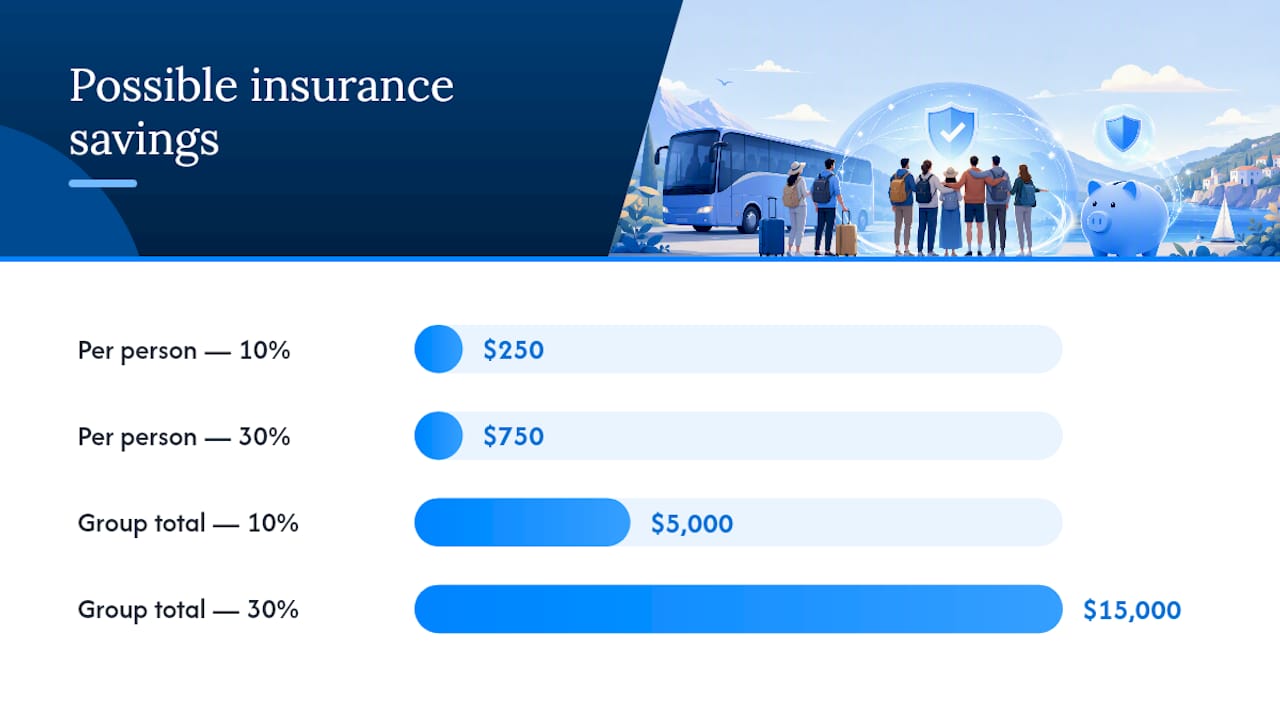
Cost is where group coverage usually wins. Buying as a group commonly saves 10 to 30% per person compared to everyone purchasing individual policies separately. On a group of 20 people spending $2,500 each on a trip, that percentage range can mean real money back in everyone’s pocket.
The catch is coverage uniformity. A group policy applies the same terms to everyone, which works fine until you have a 68 year old traveler with a heart condition next to a 24 year old going skydiving on a free day. Age caps and activity exclusions don’t bend for individual circumstances under most group plans.
Here’s how to think through it:
- Map your group’s risk variance. If everyone is roughly the same age doing the same low-risk activities, a straight group policy is often enough.
- Flag outliers early. Older travelers, anyone with a pre-existing condition, or anyone doing something the group plan excludes should look at supplemental individual coverage.
- Insure the shared costs as a group. Nonrefundable deposits for hotels, tour operators, and transportation belong under the master policy since everyone shares that financial risk equally.
- Let individuals top up personally. Higher medical limits or coverage for expensive personal gear is often cheaper and more accurate purchased separately.
Pro Tip: Insure your shared, nonrefundable supplier costs, the hotel block, the bus deposit, the venue payment, under the group policy, and let travelers with unique medical needs or high-value belongings buy their own supplemental coverage. It’s the approach most experienced organizers land on once they’ve run a trip or two.
How Do You Compare and Choose a Group Policy?
Vetting insurers gets a lot faster once you know exactly what to ask and what details to have ready before you call.
Before requesting any quote, gather:
- Total number of travelers and a rough age range
- Exact trip dates, including any pre-trip or post-trip extensions
- Total trip cost per person and the deposit payment schedule
- Planned activities, especially anything adventurous or sports related
- Destination country or countries
Insurer group desks specifically want trip dates, total trip cost, deposit schedule, a passenger list with ages, and planned activities before they’ll issue an accurate quote, so having this ready in one document saves you multiple rounds of back and forth.
Once you’re on the phone or filling out a quote form, ask these questions directly:
- What are the exact CFAR terms, including the reimbursement percentage and the purchase deadline?
- When does the pre-existing condition waiver window close relative to my first trip payment?
- What are the emergency medical and evacuation limits per traveler?
- How does the claims process work, does each traveler file individually or does the organizer handle it centrally?
- Is supplier bankruptcy coverage included or available as an add-on?
Watch for a few red flags that should send you to a different provider. An insurer that can’t clearly state its pre-existing waiver window doesn’t know its own product well enough to sell it to a group. Vague answers about evacuation limits, or a refusal to put coverage limits in writing before you pay, are both reasons to walk. And if a company pressures you to buy before you’ve compared at least two other quotes, that pressure itself is worth noting.
A simple checklist you can copy into your own quote request emails:
Group size: ___ Trip dates: ___ Total cost per person: ___ Deposit schedule: ___ Ages: ___ Activities: ___ Destination: ___
Sending that block of information upfront, every time, is the single fastest way to get comparable quotes from Faye, Travelex, Seven Corners, Nationwide, Tin Leg, AXA Assistance USA, and Allianz Global Assistance without repeating yourself five times.
When Should You Buy, and What Will It Cost?
Timing changes what you’re eligible for, and it’s one of the few levers organizers fully control. Buy your policy within roughly 14 to 21 days of your first trip payment to lock in a pre-existing condition waiver, which means an existing health condition won’t automatically disqualify a claim tied to that condition. Miss that window, and you may lose the waiver entirely, along with the option to add Cancel For Any Reason coverage, since CFAR almost always has to be purchased within a set number of days of that first payment too.
CFAR itself typically reimburses 50 to 75% of your nonrefundable trip costs if you cancel for a reason standard coverage won’t touch, say, a change of heart or a scheduling conflict that isn’t a covered event. It’s not full reimbursement, and some plans cap the maximum insurable trip cost eligible for CFAR, so confirm that ceiling if your trip runs on the expensive side.
Most travel insurance, group or individual, runs roughly 4 to 8% of total trip cost, though CFAR and higher medical limits push that number up. Build the estimate into your per-person invoice from the start rather than presenting it as a surprise add-on later. Organizers who list insurance as a line item alongside the deposit and final payment see far less pushback than those who spring it on the group two weeks before departure.
Insuring the Bus, Not Just the Bus Riders
Group trips almost always include a shared transportation cost, and that deposit is exactly the kind of nonrefundable expense a group policy should cover. Insurers writing supplier bankruptcy or default coverage need the insured item labeled clearly, along with a vendor contract or receipt on file to validate a claim if that supplier cancels or goes under.
At Reliant Transportation, we’ve watched organizers get their claims processed faster simply because they kept clean paperwork from day one: a signed charter bus contract with cancellation terms spelled out, a deposit receipt, and a finalized passenger list. Hand those three documents to your insurer when you request a quote for supplier bankruptcy coverage, and you’ll avoid the back and forth that slows claims down when something actually goes wrong.
Quick Recommendations by Trip Type
Wedding groups usually do best with a group policy plus Cancel For Any Reason, or at minimum higher cancellation limits, since wedding plans have a way of shifting right up until the big day.
Student and educational tours should prioritize medical and evacuation limits above almost everything else, along with supplier bankruptcy coverage if the trip involves a tour operator or study-abroad program.
Corporate retreats often benefit from a hybrid setup, since employees rarely have identical health situations or personal coverage needs.
Leisure tour groups can typically get by with a straight group policy, as long as every planned activity is actually listed and covered under the plan you buy.
None of these are hard rules. They’re starting points based on how these trip types tend to differ in risk and flexibility, and your specific group might land somewhere else on the spectrum.
— Dusty
Let Reliant Transportation Take the Logistics Off Your Plate
Booking one charter provider instead of juggling multiple transportation vendors gives your insurer exactly what it wants: one contract, one deposit receipt, one passenger manifest, instead of a scattered paper trail across three different companies like those featured by Movable’s group coach services.

We serve organizers in the Portland metro area, the Willamette Valley wine region, and Hood River, and build documentation into the booking process from the start. Our charter bus contract template gives you clean cancellation terms your insurer can actually read, and our seating chart tool helps you produce the passenger list most group policies require before they’ll issue a certificate. If you’re planning a wedding, see how a charter bus simplifies your big day logistics before you lock in your insurance quote. Ready to centralize your group’s transportation and get documentation your insurer will actually accept? Book your charter bus and request a quote today.
Where to Get Quotes and Verify the Details
Comparison platforms and insurer group pages are the fastest way to line up multiple quotes without repeating your details five separate times.
- Squaremouth lets you compare group plans and CFAR terms across carriers in one search.
- AXA’s group travel insurance page outlines standard group benefits and certificate structure directly from the insurer.
- Contact a dedicated group-quote desk at Faye, Travelex, Seven Corners, Nationwide, Tin Leg, AXA Assistance USA, or Allianz Global Assistance for a custom quote tailored to your exact headcount and itinerary.
Confirm pre-existing waiver timing and CFAR availability directly with whichever insurer you’re leaning toward, since both vary by state and by plan.
Sources
- Cancel For Any Reason — Squaremouth
- Group travel insurance — AXA Travel Protection
FAQ
Can You Buy Travel Insurance for a Group?
Yes. Most insurers write dedicated group policies, though minimum group size is typically around 10 travelers, with some accepting groups as small as 5.
What Is the Best Multi-Trip Travel Insurance for Groups?
There’s no single best option since the right fit depends on destination and risk profile, but Seven Corners tends to suit international and student groups, while AXA Assistance USA stands out for groups that need strong emergency medical and evacuation support with structured group certificates.
How Much Is Travel Insurance for a $10,000 Trip?
Expect to pay roughly $400 to $800 per person at a typical 4 to 8% of trip cost, with the final number rising if you add Cancel For Any Reason coverage or higher medical limits.
Does AAA or AARP Offer Travel Insurance?
Both organizations offer travel insurance products to their members, though neither is a primary group-travel insurer in the way Faye, Travelex, or AXA Assistance USA are; check current member benefits directly with AAA or AARP for group eligibility.
Do I Need Group Insurance If Everyone Already Has Personal Coverage?
Not always, but a group policy usually covers shared nonrefundable costs, like a transportation deposit or hotel block, more efficiently than asking every traveler to insure the same shared expense individually.