
Charter buses are generally a safe way to move a group, but that safety depends entirely on the carrier you pick. Before you book, confirm the company’s USDOT authorization, verify it carries the required minimum liability insurance for vehicles seating 16 or more, and pull its current FMCSA safety rating. If any of those three checks comes back wrong, walk away.
TL;DR:
- Verify that the charter carrier has an active USDOT number, proper liability insurance of at least $5 million, and a “Satisfactory” safety rating before booking.
- Confirm drivers hold a passenger endorsement, current medical certificates, and participate in random drug testing, especially for long or multiday trips.
- Check recent maintenance and inspection logs, and inspect safety features like emergency exits, fire extinguishers, functioning lights, and tire condition before departure.
- Request accessibility accommodations at least 48 hours in advance in writing and verify the lift and securement systems are operational on the day of the trip.
- Use FMCSA’s safety search tool with the USDOT number to confirm active authorization, safety ratings, and BASIC performance categories; avoid carriers flagged with high risk scores.
Table of Contents
- How Do You Verify Charter Bus Safety Before Booking?
- What Driver Rules Protect You on a Charter Trip?
- What Vehicle Checks Matter Most for Safety?
- How Far Ahead Do You Need to Request Accessibility?
- How Do You Use FMCSA’s Bus Safety Search Tool?
- What Should You Do About Unsafe Charter Bus Conditions?
- How Do Professional Operators Apply These Standards?
- Why Safety Should Beat the Lowest Bid Every Time
- Get Documentation and Book With Reliant Transportation
- Sources
How Do You Verify Charter Bus Safety Before Booking?
Every legitimate carrier operating across state lines has to register with the Federal Motor Carrier Safety Administration and carry a USDOT number. That number is your key to everything else. Ask for it before you ask about pricing.
Once you have it, here’s what to confirm:
- USDOT number and active operating authority. Request the number directly and cross check it against FMCSA’s own records rather than trusting a website badge.
- Insurance coverage. Any vehicle designed to carry 16 or more passengers must carry a minimum $5 million in liability coverage, and the FMCSA’s guidance for chartering a bus explains exactly how to confirm that figure through the carrier’s licensing and insurance filing.
- Safety rating and BASICs. Look for “Satisfactory,” and treat “Conditional” or “Unsatisfactory” as a hard stop until you get an explanation.
- Driver qualifications. Ask whether drivers hold a commercial license with a passenger endorsement, current medical certificates, and participate in random drug and alcohol testing.
- Maintenance records. Request recent inspection documentation, not a verbal assurance that “the fleet is well maintained.”
Red flags include a carrier that can’t produce a USDOT number quickly, dodges questions about insurance limits, or quotes a price so far below competitors that it can’t possibly cover proper maintenance and driver pay.
Pro Tip: Ask for the USDOT number in writing over email, not on a phone call. A carrier that hesitates to put it in text is telling you something.
What Driver Rules Protect You on a Charter Trip?
Fatigue is one of the biggest hidden risks in group travel, and federal hours-of-service rules exist specifically to limit it. Passenger carrier drivers face strict limits on how many hours they can drive before a mandatory rest period, which is why a reputable operator plans multi-day trips with relief drivers or overnight stops built in rather than pushing one person through a 14-hour haul.
Beyond hours, confirm the basics of driver qualification:
- A commercial driver’s license with a passenger (P) endorsement
- A current DOT medical certificate on file
- Participation in a random drug and alcohol testing program
- Use of an electronic logging device (ELD) to track hours objectively rather than on paper
If your trip spans long distances or multiple days, ask directly whether the carrier uses split teams or a single driver for the whole route. That answer tells you a lot about how seriously they take fatigue management.
What Vehicle Checks Matter Most for Safety?
A bus can have a spotless safety rating on paper and still show wear that matters on the day of your trip. Ask to see recent inspection and repair logs, and don’t be shy about requesting the vehicle’s DOT inspection history if it isn’t offered upfront.
On board, confirm these items before departure:
- Marked and unobstructed emergency exits
- A charged fire extinguisher and stocked first-aid kit
- Working seat belts where the vehicle is fitted with them
- Functioning headlights, brake lights, and turn signals
- Tires with adequate tread and no visible sidewall damage
If you’re coordinating a photo walk-around before a wedding or conference shuttle, our amenities checklist is a useful reference for what a well-equipped coach should include. Any carrier that resists a quick walk-around before a multi-hour trip is giving you a reason to look elsewhere.
How Far Ahead Do You Need to Request Accessibility?
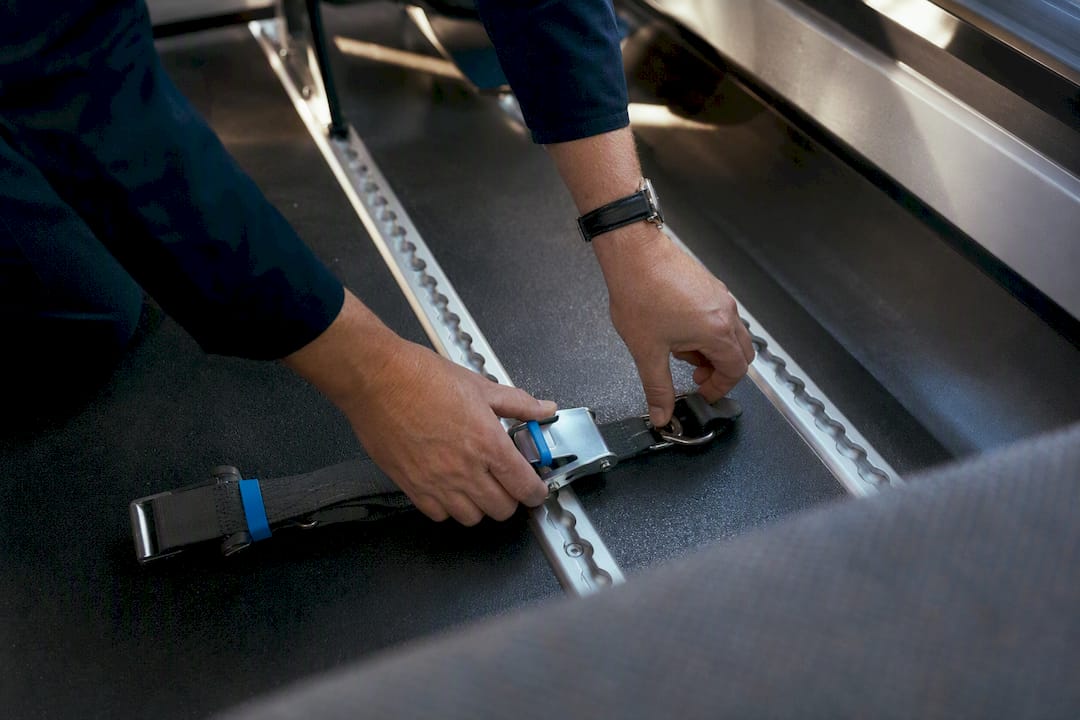
Federal rules require charter and tour operators to provide accessible service, including wheelchair lifts and proper securement systems, when given at least 48 hours’ advance notice. Put that request in writing in your booking confirmation, not just a phone call, so there’s a paper trail if something gets missed.
On the day of the trip, confirm the lift is operational, the securement points are used correctly, and staff have actually been trained on the equipment rather than improvising.
How Do You Use FMCSA’s Bus Safety Search Tool?
Always search by USDOT number instead of company name. Similar business names are common in this industry, and name collisions have caused more than a few planners to accidentally vet the wrong carrier entirely.
- Go to FMCSA’s Bus Safety Search tool and enter the carrier’s USDOT number.
- Review the safety rating: Satisfactory, Conditional, or Unsatisfactory.
- Open the BASICs, which break performance into categories like unsafe driving, hours-of-service compliance, vehicle maintenance, controlled substances, and driver fitness, as FMCSA’s own research guidance explains.
- Check the licensing and insurance section to confirm active authority and coverage on file.
A carrier flagged with high percentiles in multiple BASIC categories deserves a direct conversation, not a shrug. If the answers don’t satisfy you, or the rating shows Unsatisfactory, document what you found and move to another operator.
What Should You Do About Unsafe Charter Bus Conditions?
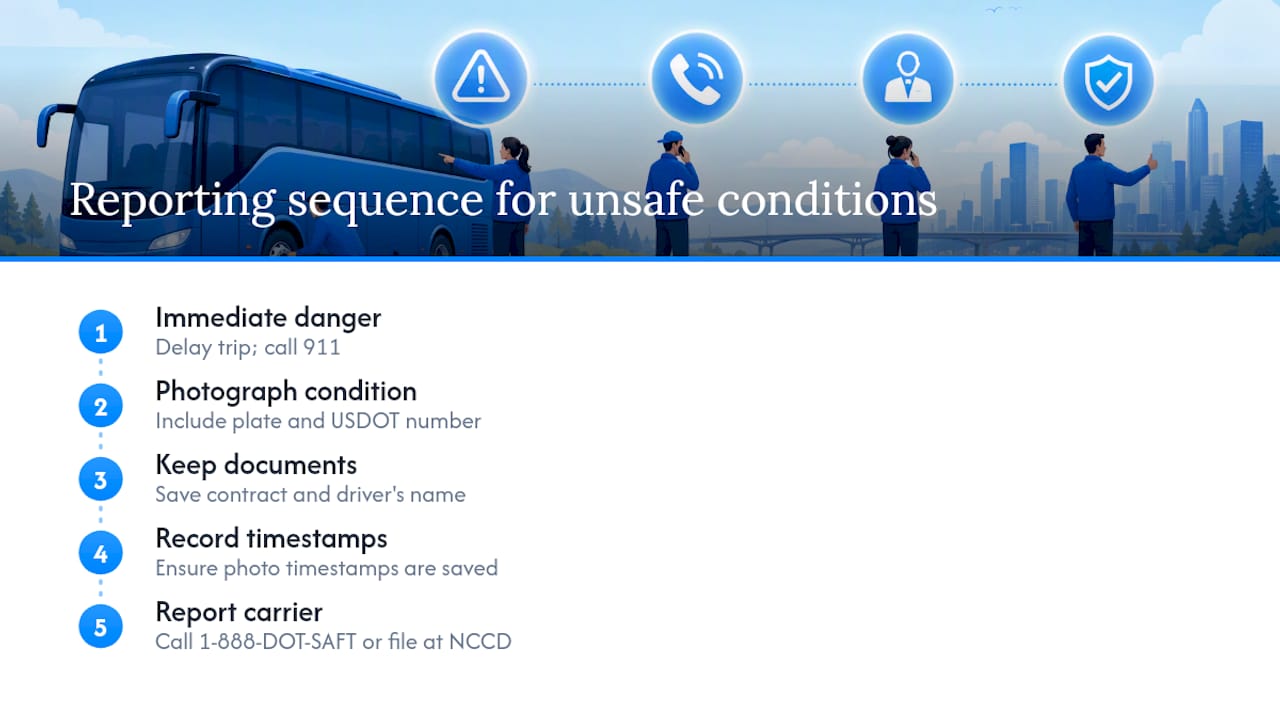
If you spot a problem before departure, delay the trip until it’s resolved. Call 911 immediately if there’s imminent danger, and photograph the issue along with the vehicle’s plate and USDOT number visible in frame.
To report a carrier formally, use FMCSA’s hotline at 1-888-DOT-SAFT or file through the National Consumer Complaint Database. Keep copies of your contract, the driver’s name, photos, and timestamps in case you need them after the trip.
How Do Professional Operators Apply These Standards?
A charter company that takes safety seriously builds documentation into its normal booking process instead of scrambling to produce it when asked. That means driver schedules planned around hours-of-service limits, maintenance logs kept current rather than reconstructed after the fact, and ADA accommodations recorded in the contract the moment a group requests one.
Planners who request a seating chart or amenities rundown before the trip aren’t being difficult. They’re doing exactly what FMCSA’s own guidance recommends: documenting expectations before departure day, not during it.
Our seating chart template is one example of the kind of planning document that helps both sides stay accountable to what was promised.
Pro Tip: Save every confirmation email that mentions accessibility needs, driver assignments, or insurance proof. If a question comes up later, that paper trail is your best friend.
Why Safety Should Beat the Lowest Bid Every Time
The cheapest quote on your list is rarely the safest one, and event planners under budget pressure are the group most likely to skip the verification steps that actually matter. I’d rather see a planner pay a little more for a documented, insured, well-rated carrier than save a few hundred dollars and gamble on one that won’t produce a USDOT number without prodding.
A few tactics make a real difference: stage pickups at a single, clearly marked spot instead of scattering guests across a parking lot, assign a chaperone or point person for each vehicle on school and youth trips, and get credentials in writing before you sign anything. If your group includes a guest who needs a wheelchair lift, build in that 48 hour notice from day one. Missing that window is the single most avoidable mistake planners make.
— Dusty
Get Documentation and Book With Reliant Transportation
Reliable charter bus operators offer direct, documented options for group travel in your region. Rather than chasing down a carrier’s USDOT number and insurance proof after you’ve already committed to a date, request that documentation upfront, along with accessibility accommodations arranged with proper notice.
If you’re planning a wedding shuttle, a corporate event, or a school trip anywhere in our service area, the simplest next step is to request a quote and ask for our USDOT number and insurance documentation in the same email. For couples specifically planning wedding-day logistics, our wedding transportation page walks through how a charter shuttle fits into your timeline. Either way, you’ll have the paperwork in hand before you finalize anything, exactly as it should be.