
A working charter bus emergency plan puts passenger safety first, names the driver as the on-scene decision authority, lists required safety equipment and inspection cadence, and requires a pre-trip safety briefing before the wheels ever move. It also needs a short, ordered checklist for the first minutes after any incident, backed by FMCSA rules and 49 CFR standards, so nobody has to improvise when it counts.
TL;DR:
- Ensuring the on-scene decision-maker is clearly identified and equipped with laminated checklists helps guide immediate actions during an emergency.
- Carrying inspected safety devices like fire extinguishers, warning triangles, and maintained emergency exits is mandatory before each trip.
- The pre-trip safety briefing must occur after boarding and before departure, emphasizing exits, fire safety, and following the driver’s instructions.
- The driver is responsible for deciding evacuation timing and method based on the type of threat, whether a controlled exit or rapid evacuation.
- Regular driver training and vehicle maintenance records, including inspection logs, are crucial to ensure ongoing emergency preparedness and legal compliance.
Table of Contents
- What should you do in the first 10 minutes of a charter bus emergency?
- What safety equipment and inspection records should the plan require?
- What should the pre-trip safety briefing say, and when should it happen?
- Who decides when to evacuate, and how should it happen?
- How should a breakdown differ from an accident or fire response?
- How should carriers train drivers and maintain records?
- What should you communicate and document after an incident?
- How Reliant Transportation builds preparedness into every charter
- Book a Carrier That Treats Your Emergency Plan as Non-Negotiable
- Keep These Sources on File
- Sources
What should you do in the first 10 minutes of a charter bus emergency?
The first ten minutes decide whether an incident stays a close call or becomes a crisis. Follow this order:
- Secure the vehicle. Move off active traffic lanes or rail crossings if it’s safe to do so; the driver assesses immediate danger like fire, smoke, or oncoming traffic.
- Activate hazard lights and set reflective triangles or fusees per federal spacing guidance.
- Call 911, then notify dispatch. The driver or a designated staff member handles this, never a bystander guessing at the address.
- Assign a passenger-accounting lead. One person, usually the group organizer, starts a head count immediately.
- Decide on evacuation. The driver weighs outside risk against inside risk, then directs passengers to wait at least 100 feet from the vehicle if evacuation is warranted.
- Document everything. Time, location, witness names, and photos, before memories fade or evidence moves.
Pro Tip: Give your on-site lead a laminated card with these six steps in order. Panic erases memory, but a card in someone’s hand doesn’t need to be recalled from scratch.
What safety equipment and inspection records should the plan require?
Federal rules set the floor, not the ceiling, for what should ride on every motorcoach. Any charter bus emergency plan worth using should require carriers to confirm the following before departure:
- A fire extinguisher with a visible charge gauge, plus spare fuses, both required under 49 CFR §393.95.
- Warning devices: three bidirectional reflective triangles or at least six fusees, also specified in that same regulation.
- Emergency exit labeling that meets 49 CFR §393.62 and FMVSS No. 217, including “DO NOT BLOCK” signage and instructions within six inches of the release mechanism.
- Written proof of a maintenance cycle.
Federal rules require push-out windows, emergency doors, and marking lights to be inspected at least every 90 days, with records kept on file. Ask your carrier for that inspection log before you sign anything. A carrier that can’t produce one on request is telling you something about how it runs its fleet.
What should the pre-trip safety briefing say, and when should it happen?
Timing matters as much as content here. FMCSA guidance requires the briefing to happen after passengers board and before the bus moves, never as an afterthought once the trip is underway.
A solid briefing covers:
- The main door as the primary exit, plus the location of every emergency exit.
- The fire extinguisher’s location and the restroom emergency alarm, if the bus has one.
- A direct instruction to follow the driver’s direction in any emergency and to call 911 if the driver is incapacitated.
For groups with many passengers or trips with non-English speakers, print a one-page visual version and post it near the door. Here’s a script you can copy: “Before we get moving, quick safety rundown. The main door up front is our primary exit. There’s a second exit in the back, and it works exactly like this. Fire extinguisher is mounted right here. If anything happens, stay calm, follow the driver’s instructions, and let us handle 911. Thanks, let’s get going.”
Pro Tip: Have your event lead confirm out loud, “Briefing done,” before the driver pulls out. It takes two seconds and closes a gap that plenty of trip leaders never think to check.
Who decides when to evacuate, and how should it happen?
The driver decides. NHTSA and FMCSA guidance treat the driver as the primary decision-maker, weighing outside hazards like traffic or fire against the relative safety of staying inside the bus.
There are three basic patterns, and knowing the difference matters:
- Controlled disembarkation. No immediate danger. Passengers exit calmly through the main door, row by row, starting from the front.
- Rapid emergency evacuation. Immediate danger like fire or smoke. The driver may open both front and rear exits simultaneously and direct able-bodied passengers to help others.
- Assisted evacuation. For mobility-impaired or elderly passengers, assign helpers in advance. Note wheelchair and mobility-device locations on your seating chart so helpers know exactly who needs support and where.
Windows and roof hatches are last resorts, used only when standard exits are blocked. Once everyone is off, the group moves at least 100 feet away and stays clear until responders arrive. A seating chart that flags mobility needs ahead of time turns this from guesswork into a plan.
How should a breakdown differ from an accident or fire response?
A mechanical breakdown and a fire call for different urgency levels, and mixing them up wastes precious time. For a non-fire breakdown:
- Pull off safely, activate hazards, and place reflective triangles within 10 minutes, spaced according to federal guidance.
- Keep passengers on board unless there’s a specific reason not to. The bus is usually safer than the shoulder of a highway.
For fire, a stalled position on railroad tracks, or any life-threatening hazard, evacuate immediately, move everyone to a safe distance, and call 911 before doing anything else. Only trained staff should attempt to use the onboard extinguisher, and only if it’s genuinely safe to do so. Once the scene is stable, record what happened for the incident report, since first responders will ask for exactly this kind of detail.
How should carriers train drivers and maintain records?
Preparedness that only exists on paper the day of the event isn’t preparedness. Look for a carrier that treats training and maintenance as ongoing commitments:
- Drivers should complete evacuation and passenger-assistance training on a recurring basis, not just once at hire.
- Vehicles need push-out windows, emergency doors, and marking lights inspected on the federally required 90-day cycle, with logs showing date, inspector, and findings.
- Organizers running a large or recurring event can run a short evacuation drill themselves, timing how long it takes to clear the bus and checking headcount accuracy afterward.
Pro Tip: Ask for training certificates and maintenance logs as contract deliverables, not as a favor. A carrier confident in its own records will hand them over without hesitation.
What should you communicate and document after an incident?
Speed and accuracy both matter once the immediate danger has passed. When calling 911, give the exact location, number of people involved, and any hazards still present. Notify dispatch right after, and log the time, GPS coordinates, and any evacuation status.
- Run a headcount against your passenger roster before anyone leaves the scene.
- Photograph the vehicle, surroundings, and any visible damage.
- Collect witness names and contact information on the spot.
- Store everything in one incident log so insurers and investigators get a consistent record.
How Reliant Transportation builds preparedness into every charter
Some charter companies run documented inspection logs, scripted pre-trip briefings, and trained drivers for their charters. Planners working with any carrier should ask for the same three things: proof of inspection, confirmation the briefing script gets delivered, and a copy of driver training records. Those aren’t extras. They’re the difference between a plan on paper and a plan that works when it matters.
— Dusty
Book a Carrier That Treats Your Emergency Plan as Non-Negotiable
Plenty of charter companies will quote you a price. Fewer will hand you an inspection log without you having to ask twice. Some charter companies serving the Portland metro area, the Willamette Valley wine region, and Hood River provide documented 90-day inspection records, a scripted pre-trip briefing, and drivers trained on evacuation procedures, not just defensive driving.

If you’re planning a wedding shuttle, corporate retreat, or wine country trip, ask us directly for inspection proof and a sample briefing script before you commit. Check our charter bus seating chart templates to flag mobility needs ahead of time, then get a clear quote and reserve your dates through Book a Charter Bus. The sooner you lock in your date, the more flexibility you’ll have to build these safety details into the plan from day one.
Keep These Sources on File
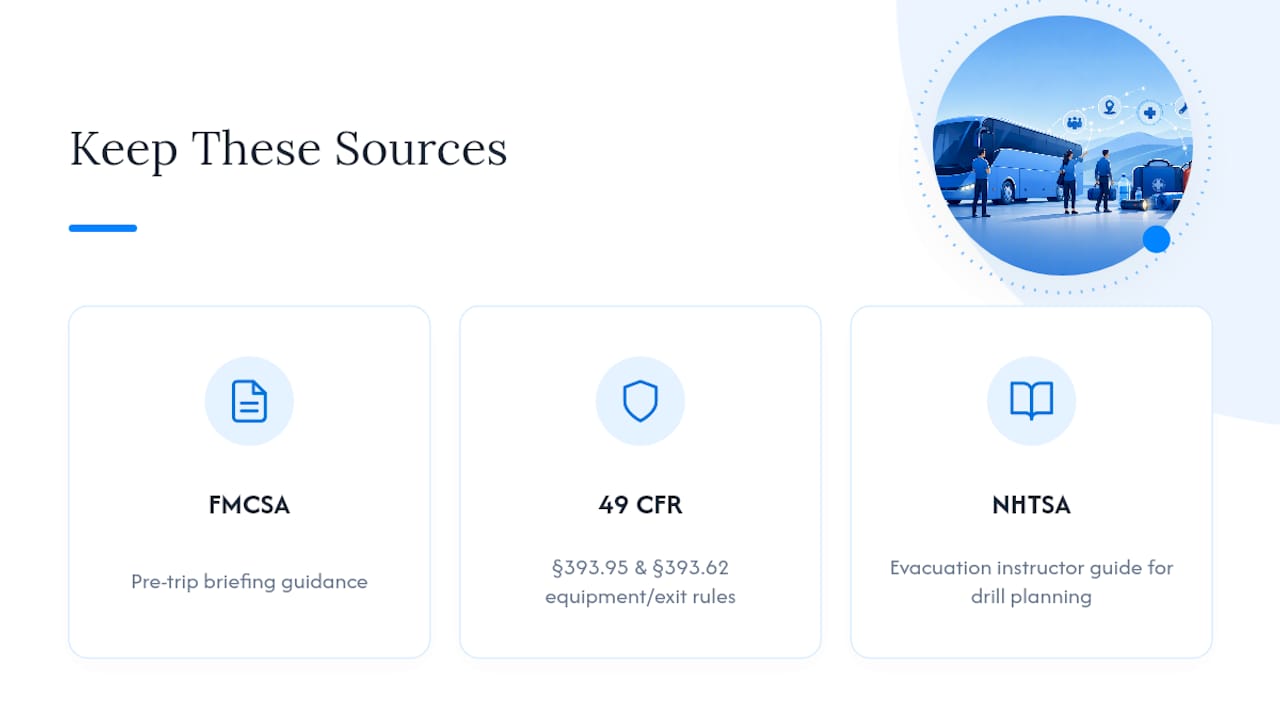
Retain the FMCSA pre-trip briefing guidance, 49 CFR §393.95 and §393.62 for equipment and exit rules, and the NHTSA evacuation instructor guide for drill planning.
Sources
- 49 CFR § 393.95 – Vehicles transporting passengers; emergency equipment. | Cornell Law
- Inspection, repair, and maintenance for motor carriers of passengers – Part 396 | FMCSA