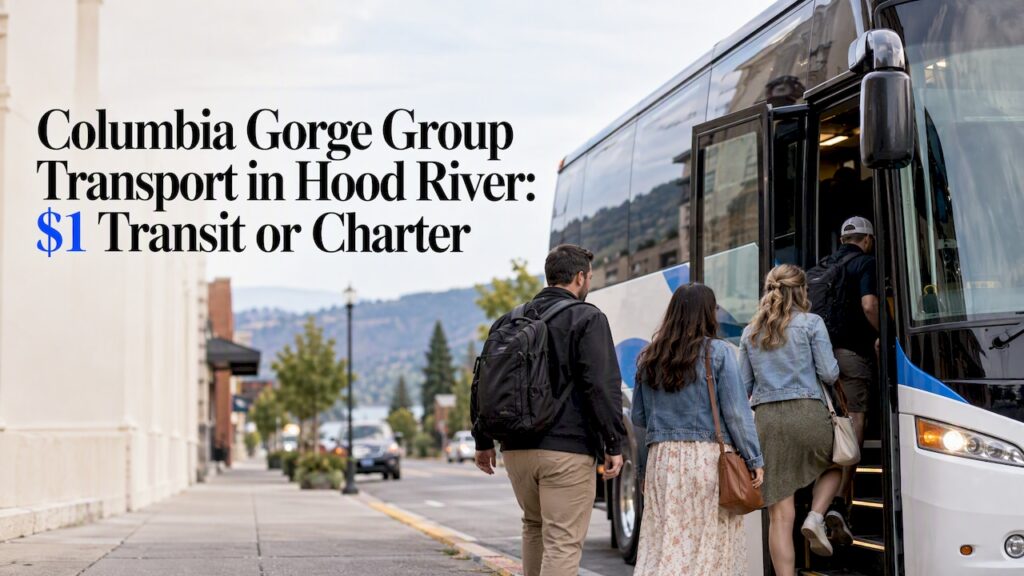
Small car-free groups can rely on Columbia Area Transit and the Columbia Gorge Express to see the main Gorge highlights without driving. For weddings, corporate outings, and larger parties, a private charter gets you guaranteed seats, a locked schedule, and someone else handling the logistics; many hosts find stunning indoor and outdoor ceremony spaces ideal for such events. The right pick depends on group size, timing needs, and how much you want to leave to chance.
TL;DR:
- CAT local rides cost about $1 each way, while the Columbia Gorge Express costs about $10; use transit only when timing is flexible.
- Groups larger than 15, fixed event schedules, custom stops, or guaranteed late returns favor a private charter over scheduled routes or casual shuttles.
- Multnomah Falls requires timed entry reservations May 22 through September 7, from 9:00 AM to 6:00 PM, plus a $2 online transaction fee.
- Book summer weekends months ahead, add 15 to 30 minutes per busy stop, and confirm bike capacity, wheelchair access, insurance, and cancellation terms in writing.
Table of Contents
- Public transit and scheduled shuttle options from Hood River
- Local paid shuttles and tour providers serving Hood River
- When a private charter makes sense for your group
- Step-by-step planning checklist for Gorge group transport
- Why local charter experience matters for Hood River groups
- What actually matters when planning Gorge group transport
- Get a quote for your Gorge group trip
- FAQ
- Sources
Public transit and scheduled shuttle options from Hood River
Columbia Area Transit, known locally as CAT, runs the backbone of car-free travel in Hood River County. CAT operates four kinds of service: fixed-route buses around town, deviated fixed-route service that can detour slightly for riders who need it, Dial-A-Ride for on-demand trips, and the intercity Columbia Gorge Express, which connects Hood River to Cascade Locks, Multnomah Falls, and Portland’s Gateway Transit Center seven days a week with multiple daily departures in both directions.
Fares follow a simple split. Local fixed-route rides typically run $1 each way, while the intercity Columbia Gorge Express costs closer to $10 one way, and a Gorge Pass offers unlimited local rides for $40 a year for adults or $20 for youth. Payment is usually exact change or a digital pass, so groups should plan ahead rather than assume a card reader will be on board.
A few practical limits matter for planners:
- Bike capacity on buses is limited to a set number of racks per vehicle, so bike-heavy groups may need to split up or book a separate shuttle.
- ADA-accessible seating is available but limited in quantity per trip, and advance notice helps secure it.
- Multnomah Falls draws heavy crowds in summer, and transit stops there can shift or get skipped during peak congestion, so build in buffer time.
For a party of a few people with flexible timing, this is the cheapest way to see the Gorge. For a larger wedding party needing to be at a venue at a specific hour, it is not a reliable foundation.
Local paid shuttles and tour providers serving Hood River
Beyond CAT, a handful of commercial operators run paid shuttles and guided tours through the Gorge. These generally fall into a few categories: small-group van tours built around waterfalls and wineries, dedicated winery shuttles for the Hood River Valley, and private shuttle services booked for a single event or outing.
Before booking any of these, confirm a few things in writing:
- Group rates and whether pricing is per seat or per vehicle.
- Bike storage capacity if your group is arriving with bikes.
- ADA accommodations, since not every van is wheelchair accessible.
- Pickup and dropoff flexibility, especially if your group spans multiple hotels or wineries.
Lead times matter more than people expect. Summer weekends book out operators fast, and a last-minute request in July often means a smaller vehicle or no availability at all. Ask for a written confirmation that includes a passenger manifest and proof of insurance, which protects you if a venue requires it.
Pro Tip: If your group includes several cyclists or anyone using a wheelchair, call ahead and get the vehicle’s exact bike rack and lift specs before you commit, since “shuttle” can mean very different things between operators.
When a private charter makes sense for your group
Public transit and small shuttles work well for casual sightseeing, but certain situations call for a private charter instead. Here is how to think through the decision:
- Group size over fifteen. Once you are coordinating more than a handful of people, a dedicated vehicle removes the risk of someone missing a bus or a shuttle running out of seats.
- Fixed event timing. Weddings, corporate retreats, and conference shuttles need a vehicle that shows up on your schedule, not the transit authority’s.
- Return-trip certainty. A charter guarantees the ride back, which matters more than people realize after an evening wedding reception when ride-hailing options in the Gorge thin out fast.
- Multiple stops or a custom route. A charter can build in stops at a winery, a trailhead, and a venue in one trip, something no fixed transit route offers.
- Permit-sensitive locations. Trips involving National Forest land or high-visitation sites may require coordination that a scheduled public route simply isn’t built to handle.
Charter pricing typically scales with vehicle size, hours booked, and mileage, so a wedding shuttle running a few hours between a hotel and a venue costs differently than an all-day winery tour. For larger parties, the per-person cost often lines up close to or below piecing together multiple rideshares, with far less risk of someone getting left behind.
Step-by-step planning checklist for Gorge group transport
Booking group transportation for the Gorge goes smoother with a clear sequence. Follow these steps in order:
- Size your vehicle first. Our Charter Bus Sizes guide can help you match group count to the right bus or limo before you start requesting quotes.
- Book early for summer weekends. Peak-season demand on regional routes is well documented in the Hood River County transit master plan, and the same crunch hits private operators, so lock your date months ahead.
- Build in buffer time. Plan on 15 to 30 minutes of extra time per stop at high-traffic sites during summer weekends to absorb pedestrian congestion and schedule shifts.
- Check Multnomah Falls timed-entry rules. The Forest Service requires reservations at Multnomah Falls from May 22 through September 7 between 9:00 am and 6:00 pm, with a $2 online transaction fee, so confirm whether your group needs one before you finalize a stop there.
- Confirm the operational details. Ask about loading zones, restroom stops, bike capacity, insurance documentation, and the cancellation policy before you sign anything.
- Prepare a manifest. Share passenger counts, contact numbers, and on-site staging details with your driver well before pickup day.
One reservation window, one fee, zero guesswork: knowing the Multnomah Falls timed-entry requirement up front means your group never gets turned away at the trailhead.
Why local charter experience matters for Hood River groups
Running group transportation through the Gorge takes more than a van and a map. Peak-season crowding at waterfalls, shifting transit stops, and venues scattered across wineries and trailheads all add friction that a scheduled bus route was never built to absorb.
Reliant Transportation has handled charter transportation out of the Portland area for weddings, corporate events, and limo bus trips for over a decade, with a long track record of positive customer feedback. We build manifests for every trip, carry insurance documentation, and stagger pickups around high-traffic sites like Multnomah Falls so your group never gets stuck waiting in a crowd.
A few things we handle as a matter of course:
- Coordinating multi-stop itineraries across wineries, trailheads, and venues in one booking.
- Providing certificates of liability when a venue or permit requires one.
- Adjusting pickup timing around known congestion points in the Gorge.
A charter that shows up on your schedule, with your group’s names on a manifest, removes the single biggest risk in Gorge logistics: someone getting left behind.
What actually matters when planning Gorge group transport
The conventional advice on this topic leans too hard on cost comparisons between a $1 bus fare and a charter quote, as if the decision were purely financial. It rarely is. The real variable is tolerance for uncertainty. A solo traveler or a couple can absorb a missed stop or a packed bus; a wedding party cannot.
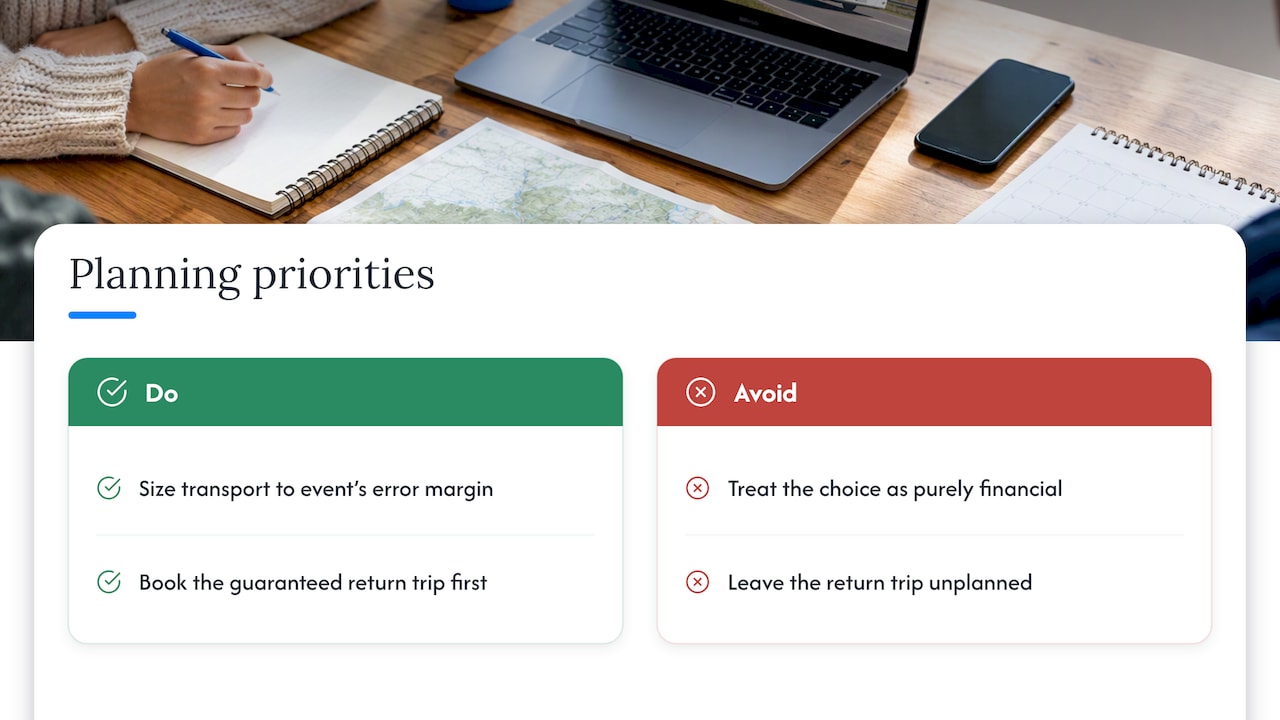
What gets underrated is the return trip. Planners spend weeks picking the perfect pickup spot and almost no time thinking about how forty guests get back to their hotels after a reception ends at 10 p.m. in a town with limited late-night options. That is where public transit and casual shuttle arrangements fall apart fastest.
Our take: size the decision to the event’s margin for error, not its budget line. If a missed connection just means a longer wait, transit is fine. If it means a stranded wedding party or a corporate group missing a flight, book the vehicle that guarantees the return trip before you book anything else.
— Dusty
Get a quote for your Gorge group trip
Once you know your headcount and rough schedule, getting a quote from us takes just a few details. Include your date, pickup and dropoff points, group size, any wheelchair or bike storage needs, and your desired return time.
From there, we match you with the right vehicle from our fleet and walk through logistics together. A few things that speed up the process:
- Your event date and approximate headcount.
- Pickup and drop off addresses, including any venue restrictions.
- Any accessibility or bike storage requirements.
Browse our services page for the full range of charter options, or go straight to book a charter bus to request a quote. We can also send over our on-site shuttle coordinator checklist so your day-of contact has everything staged and ready.
FAQ
How much does the Columbia Gorge Express cost?
A one-way ride on the Columbia Gorge Express typically costs around $10, compared to about $1 for a local CAT fixed-route fare. A Gorge Pass offering unlimited local rides runs $40 a year for adults and $20 for youth.
How do you get around Hood River without a car?
CAT’s fixed-route service connects downtown Hood River, shopping areas, and key local destinations seven days a week. For trips farther into the Gorge, the Columbia Gorge Express links Hood River with Cascade Locks, Multnomah Falls, and Portland.
Is there a shuttle to the Columbia River Gorge?
Yes, the Columbia Gorge Express runs daily service between Portland, Hood River, Cascade Locks, and Multnomah Falls. Private charter and tour shuttles also serve the Gorge for groups that need a dedicated vehicle and custom schedule.
Can you use Uber in Hood River, Oregon?
Rideshare apps operate in Hood River but availability can be limited, especially at night or after events. For groups needing a guaranteed return trip, a reserved charter removes that uncertainty entirely.
When is a timed-entry reservation required at Multnomah Falls?
The Forest Service requires timed-entry reservations at Multnomah Falls from May 22 through September 7, between 9:00 am and 6:00 pm, with a $2 online reservation fee. Groups visiting during this window should reserve ahead regardless of how they arrive.
Sources
- Columbia Gorge Express – Columbia Area Transit
- Multnomah Falls – Columbia River Gorge National Scenic Area (US Forest Service)