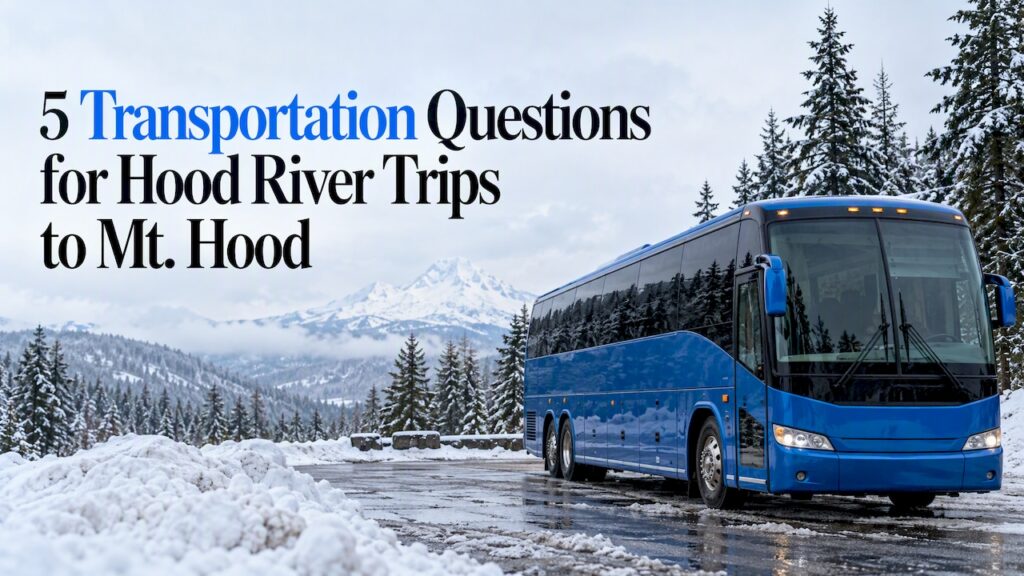
For most Hood River groups, public seasonal shuttles like the Gorge-To-Mountain Express are the low-cost way to reach Mt. Hood. When you need guaranteed timing, gear handling, or a fixed group schedule, a private charter like Reliant Transportation is the practical choice. Both public operators suspend service seasonally, so check their pages before you lock in a date.
TL;DR:
- CAT’s Hood River route is seasonal and may pause as snowpack or funding changes, so confirm its schedule during the week of travel.
- Groups of ten or more may exceed public seating on busy Saturdays, while shared routes limit gear space and cannot guarantee seats or arrival times.
- Reserve a private charter two to three weeks before a standard winter weekend, earlier for holidays, and provide passenger, gear, accessibility, and pickup details.
- Designated winter lots require permits, mountain roads may require chains or traction tires, and cell coverage can fail; download a map and check TripCheck.
Table of Contents
- Options at a Glance: Shuttles, Buses, and Ride Coordination
- When to Pick Public Transit vs. a Private Charter
- Booking Checklist and Timeline for Your Mt. Hood Trip
- Winter and Forest Logistics Every Group Needs to Plan For
- How a Local Charter Solves Common Group-Planning Gaps
- A Local Organizer’s Take on the Practical Default
- Reliant Transportation: How to Book a Charter for Your Hood River Group
- FAQ
- Sources
Options at a Glance: Shuttles, Buses, and Ride Coordination
Hood River groups headed to Mt. Hood have four real categories of transportation, and each fits a different kind of trip.
- Public transit: Columbia Area Transit’s Gorge-To-Mountain Express connects Hood River, Odell, Parkdale, Teacup Sno Park, and Mt. Hood Meadows on a published seasonal schedule, with Gorge Pass fare options that keep per-trip cost low.
- Mt. Hood Express: this route runs the Highway 26 corridor from Sandy toward Timberline and other mountain stops, which suits travelers coming up from the Portland side rather than straight out of Hood River.
- Private shuttle and limo operators: category services similar to those Travel Oregon lists typically require advance reservations, run winterized vehicles with chains or snow tires, and handle ski and snowboard gear as part of the booking.
- Charter buses: a charter makes sense when your group needs a fixed pickup time, one vehicle for everyone, and a driver who already knows the itinerary; be ready to share your date, headcount, and pickup location when you request a quote.
- Ride-share coordination: community tools like Get There Oregon can fill small gaps for last-mile connections but aren’t built for moving a full group at once.
Matching the option to your trip type, rather than defaulting to whatever is most familiar, is the fastest way to avoid a scramble the morning of.
When to Pick Public Transit vs. a Private Charter
The right call usually comes down to five practical questions, answered in order:
- How many people are traveling? A couple of riders fit easily on CAT or Mt. Hood Express; a group of ten or more starts to strain a public route’s seating on a busy Saturday.
- Do you need a fixed arrival time? Public schedules run on fixed departures, but they don’t guarantee you a seat or an exact arrival window.
- How much gear are you bringing? Skis, boards, and boot bags for a group add up fast, and a shared bus has limited rack space.
- Do you want to skip parking and lot congestion? A charter drops your group at the door; public riders still need a plan for the first and last mile.
- What’s your budget per person? Public fares are cheaper per rider, but a charter’s per-seat cost can even out once you count everyone who would otherwise need their own car.
On peak powder days, scheduled routes can fill up, and seasonal service on routes like Gorge-To-Mountain can pause entirely depending on snowpack and funding. A charter removes that uncertainty because the vehicle is reserved for your group alone.
Pro Tip: If your group needs guaranteed ski storage and an on-time return for a dinner reservation or event afterward, book a dedicated vehicle rather than counting on a shared route’s last run.
Booking Checklist and Timeline for Your Mt. Hood Trip
Give yourself more lead time than you think you need, especially for winter weekends.
- Private charters: reserve at least two to three weeks ahead for a standard weekend, and earlier around holidays, when vehicles book up fast.
- Public transit: you can typically plan closer to your travel date, but still confirm the schedule the week of your trip since seasonal routes shift.
- What to have ready when you book: your date and time, passenger count, gear counts (skis, boards, luggage), exact pickup and drop-off coordinates, and any accessibility needs.
- Where to confirm day-of status: check the CAT schedule page, Mt. Hood Express updates, ODOT TripCheck, and Forest Service notices before you leave.
- Day-of logistics: build in a 15 to 20 minute arrival buffer, bring a downloaded or printed map since cell service is unreliable in the forest, and confirm your meeting point and an emergency contact with everyone traveling.
A little prep on the front end saves you from standing in a parking lot wondering where your ride actually is.
Winter and Forest Logistics Every Group Needs to Plan For
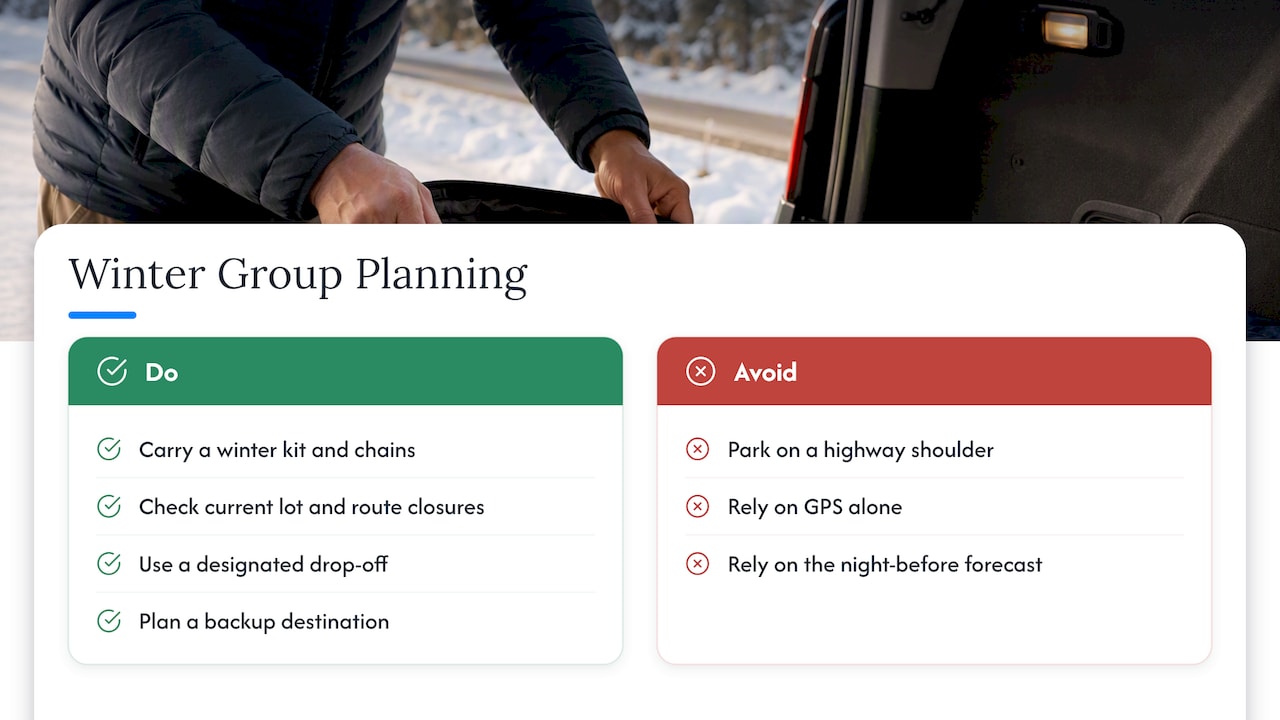
Mt. Hood National Forest doesn’t behave like a city grid, and winter changes the rules fast. The U.S. Forest Service warns that cell coverage and live mapping can be unreliable in parts of the forest, which means a GPS app alone isn’t a safe plan. Download the official Motor Vehicle Use Map (MVUM) as a PDF or pick up a paper copy before you go.
Sno-Park permits are required at designated winter lots, and chains or traction tires are often mandatory on mountain highways once snow starts falling. Check ODOT TripCheck the morning of travel for current road conditions rather than relying on a forecast from the night before.
Parking is its own problem on busy weekends. When Sno-Park lots fill up, parking illegally on a highway shoulder is both unsafe and ticketable, which is one reason a charter that drops your group directly at the lodge or a designated lot can matter more than it sounds. Every group should carry a basic winter kit, chains, and a backup plan in case your first-choice lot or route is closed.
How a Local Charter Solves Common Group-Planning Gaps
A charter closes the gaps that public transit, by design, can’t:
- Fixed pickup time and location, so your group isn’t waiting on a shared schedule.
- One dedicated vehicle, which keeps everyone together instead of splitting across cars or seats on a public run.
- On-board storage for skis, boards, and luggage, handled as part of the booking rather than squeezed into a shared rack.
- Itinerary coordination, including return timing if your day includes a dinner or event after the mountain.
We build itinerary coordination and manifest planning into how we run group trips, which is the kind of logistical control a shared public route isn’t set up to offer. Before booking any charter, ask for insurance documentation, driver credentials, the vehicle’s inspection policy, and the cancellation and weather rules in writing.
Pro Tip: Get your charter’s weather and cancellation policy in writing before you pay a deposit, since mountain conditions change faster than a verbal agreement can account for.
A Local Organizer’s Take on the Practical Default
For a weekend ski day with a small, flexible group, I default to public transit. It’s cheap, it runs on a published schedule, and nobody minds a little wait when the plan is loose. For a multi-stop corporate outing, a wedding shuttle, or anything with a fixed schedule everyone else is built around, I default to a charter every time.
On execution day, three things matter most: confirm your pickup point with the driver or dispatcher the morning of, assign one point person to count heads before departure, and build a buffer into your return time so one slow lift line doesn’t blow up the rest of the evening.
— Dusty
Reliant Transportation: How to Book a Charter for Your Hood River Group
We run group and event charters in the region, and a Mt. Hood trip is the kind of outing our vehicles and drivers can support. 
When you’re ready to request a quote, have these details ready:
- Your travel date and preferred pickup time.
- Passenger count and any accessibility needs.
- Gear counts, including skis, boards, and luggage.
- Exact pickup and drop-off locations.
For winter weekends, we recommend reaching out two to three weeks ahead, earlier around holidays, so your vehicle and driver are locked in well before snow conditions start affecting everyone’s plans at once. Visit our services page to see our charter options for weddings, corporate events, and general group outings, or start your request through our charter booking page.
If your group is also booking lodging for the weekend, verified hotels with in-room jacuzzis in Hood River are worth checking alongside your transportation plan.
FAQ
Is there public transportation from Hood River to Mt. Hood?
Yes. Columbia Area Transit’s Gorge-To-Mountain Express connects Hood River to Mt. Hood Meadows and Teacup Sno Park on a seasonal schedule. Service and fares can change year to year, so confirm current details on CAT’s route page before you travel.
What is the difference between Mt. Hood Express and the Gorge-To-Mountain Express?
Mt. Hood Express runs the Highway 26 corridor from Sandy toward Timberline, which suits travelers coming from the Portland side. Gorge-To-Mountain Express departs from Hood River and serves Mt. Hood Meadows and nearby Gorge communities instead.
How much does a private charter to Mt. Hood cost for a group?
Pricing depends on your group size, vehicle type, and trip length, and we quote it directly based on those details rather than a flat rate. Request a quote through our services page with your date, headcount, and pickup location for an exact figure.
How far in advance should I book group transportation to Mt. Hood?
For a private charter, book two to three weeks ahead for a standard weekend and earlier around holidays. Public transit schedules can usually be confirmed closer to your travel date, but seasonal service changes make it worth checking the week before you go.
Do I need a Sno-Park permit to drive to Mt. Hood in winter?
Yes, designated winter parking lots near Mt. Hood require a Sno-Park permit, and chains or traction tires are often mandatory on mountain routes. Check ODOT TripCheck for current road conditions before you leave.
Sources
- Gorge-To-Mountain Express – Columbia Area Transit
- Car-Free Transportation to Mt. Hood – Travel Oregon
- Mt. Hood maps & mobile devices – USFS
- CAT meeting materials and fare proposals