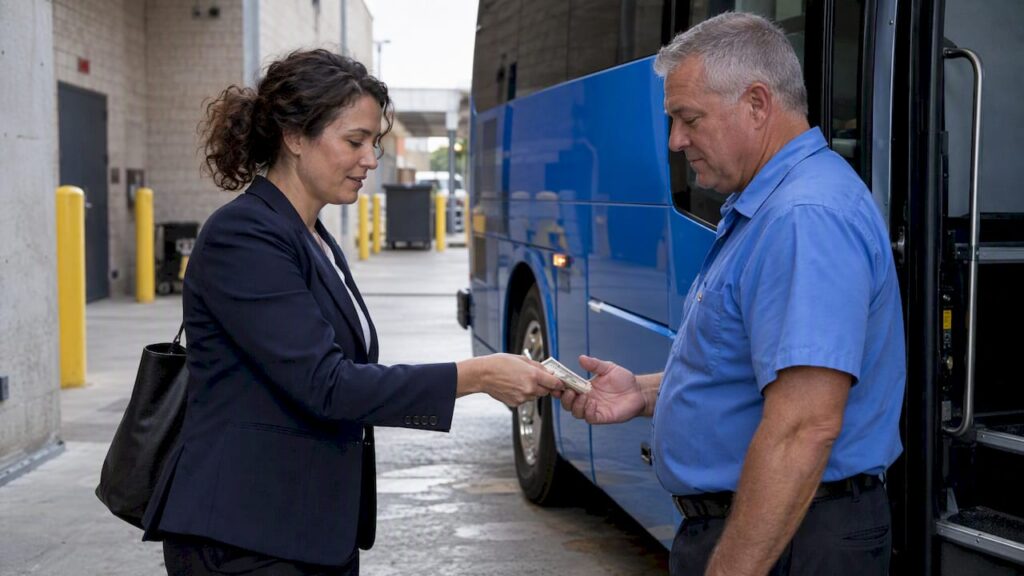
The standard rule is $2 to $4 per person per day for solid, reliable service, and $5 to $10 per person per day when the driver goes above and beyond. The group organizer usually collects the tip in advance and presents it at the trip’s final stop.
TL;DR:
- Tips for standard service range from $2 to $4 per person per day, with higher amounts of $5 to $10 for exceptional or stressful conditions.
- Collecting tips in advance in a labeled envelope simplifies accounting and ensures everyone contributes before the final stop.
- Longer trips, overnight duties, or additional responsibilities like luggage handling justify increasing the tip amount for drivers.
- When multiple drivers are involved, each should be tipped individually based on their actual days or hours worked.
- Tipping norms differ between private charters and scheduled carriers, with scheduled services like Greyhound generally not expecting tips.
Table of Contents
- Recommended amounts and worked examples
- Who pays the tip and how to split it fairly
- Factors that should change your tip amount
- When and how to present the tip
- Special situations and rules to know
- Regulatory context and what the numbers mean
- An organizer’s quick checklist
- How Reliant Transportation makes tipping easier to plan
- FAQ
- Sources
Recommended amounts and worked examples
Once you know the trip length and group size, the math gets simple. Use these ranges as your starting point, then adjust based on what you read in the next section about workload and duties.
For a single-day trip like a wedding shuttle or corporate outing, $2 to $4 per person covers standard service: the driver showed up on time, handled the route smoothly, and kept everyone comfortable. Bump that to $5 to $10 per person when the driver handled a tight schedule, extra stops, or a stressful day without complaint. For multi-day trips, figure the same per-person daily range multiplied by the number of days, since the driver is putting in long hours and often extra responsibilities each one of them.
If per-person math feels like too much tracking, a flat percentage of the total rental cost is a fair substitute. A lower double-digit percentage is appropriate for straightforward trips; a higher double-digit percentage fits longer or more demanding charters. This works especially well for smaller groups where per-person totals would be awkwardly small.
Here are three worked examples organizers can copy directly:
Examples include:
- A wedding shuttle with a modest group for one day receiving standard service; calculate a moderate per-person amount times the group size.
- A multi-day group tour with a larger number of passengers and exceptional service; multiply the elevated per-person daily amount by the number of passengers and days.
- A corporate event with a small group and a half-day charter; applying a clean percentage of the rental cost simplifies tip calculation.
Who pays the tip and how to split it fairly
Someone has to collect the money, and the organizer collecting it in advance almost always works better than passing a hat at the last stop.
- Organizer collects in advance: cleaner presentation, no last-minute scrambling, but it puts the accounting burden on one person.
- Individual contributions on the day: spreads the effort, but often leaves gaps if some passengers forget cash.
- Multiple buses or drivers: tip each driver separately based on the days or hours that driver actually worked, never a single pooled amount split blindly.
- Partial contributions or no-shows: adjust the total honestly rather than padding it from the organizer’s own pocket, and note any shortfall for future trips.
Label the envelope by driver name or bus number if there’s more than one, and keep a simple running tally so nothing gets lost in the shuffle.
Factors that should change your tip amount
Not every trip calls for the same tip, and a few situational details should push your number up or down.
- Trip length and overnight duties: multi-day charters often mean the driver is responsible for the vehicle overnight, which adds to the job beyond just driving.
- Extra duties: luggage handling, crowd control at stops, or acting as an informal guide all justify a higher tip.
- Weather and schedule changes: a driver who reroutes around a storm or reworks a timeline without complaint earned more than the baseline.
- Contract terms: check whether gratuity is already built into your quote before tipping on top of it. The charter bus contract guide walks through exactly what to look for before signing.
Pro Tip: When a driver doubles as a tour guide on a longer trip, tipping guidance suggests a separate amount for that role, often an added $5 to $10 on top of the standard driving tip.
When and how to present the tip
Timing matters almost as much as the amount. Present the tip at the final stop, right before the driver departs, so it reads as a clear thank-you rather than an afterthought.
- Choose the moment: the last stop of the trip, or a scheduled farewell if the itinerary includes one.
- Pick a presentation method: a pooled envelope handed over by the organizer, individual envelopes from each passenger, or a signed group card alongside the cash.
- If collecting in advance, track who contributed, keep the cash in a labeled envelope, and give a quick verbal accounting to the group so nobody wonders where the money went.
- Tipping at check-in versus trip’s end: tipping early can feel generous but removes the incentive tied to performance, while tipping at the end rewards the actual service delivered.
Special situations and rules to know
A few edge cases come up often enough to plan for ahead of time.
- Multiple or relief drivers: tip each one separately for the days they actually worked rather than guessing at a split.
- Private charters versus scheduled carriers: tipping norms differ sharply. A scheduled-line carrier like Greyhound generally does not expect tips the way a private charter driver does.
- Poor service: etiquette guidance recommends leaving the customary tip anyway and reporting the issue to the company or manager afterward, rather than withholding the tip as a form of protest.
- Gratuity included in the contract: confirm who actually receives that money before deciding whether an additional tip is needed on top of it.
Regulatory context and what the numbers mean
Driver fatigue rules shape how demanding a trip really is, which should factor into your tip.
Passenger-carrying drivers may drive a maximum of 10 hours after 8 consecutive hours off duty, and may not drive after 15 hours on duty following that rest period.
That’s the federal hours-of-service limit for passenger-carrying drivers, and it’s a big reason long charters often use relief drivers, each of whom should be tipped for their own days worked. These federal limits line up with common tour-operator guidance recommending a few dollars per person per day, which tracks closely with the ranges above. Reliant Transportation’s planning resources and amenities checklist can help you map out passenger counts and service expectations before you finalize a tipping budget.
An organizer’s quick checklist
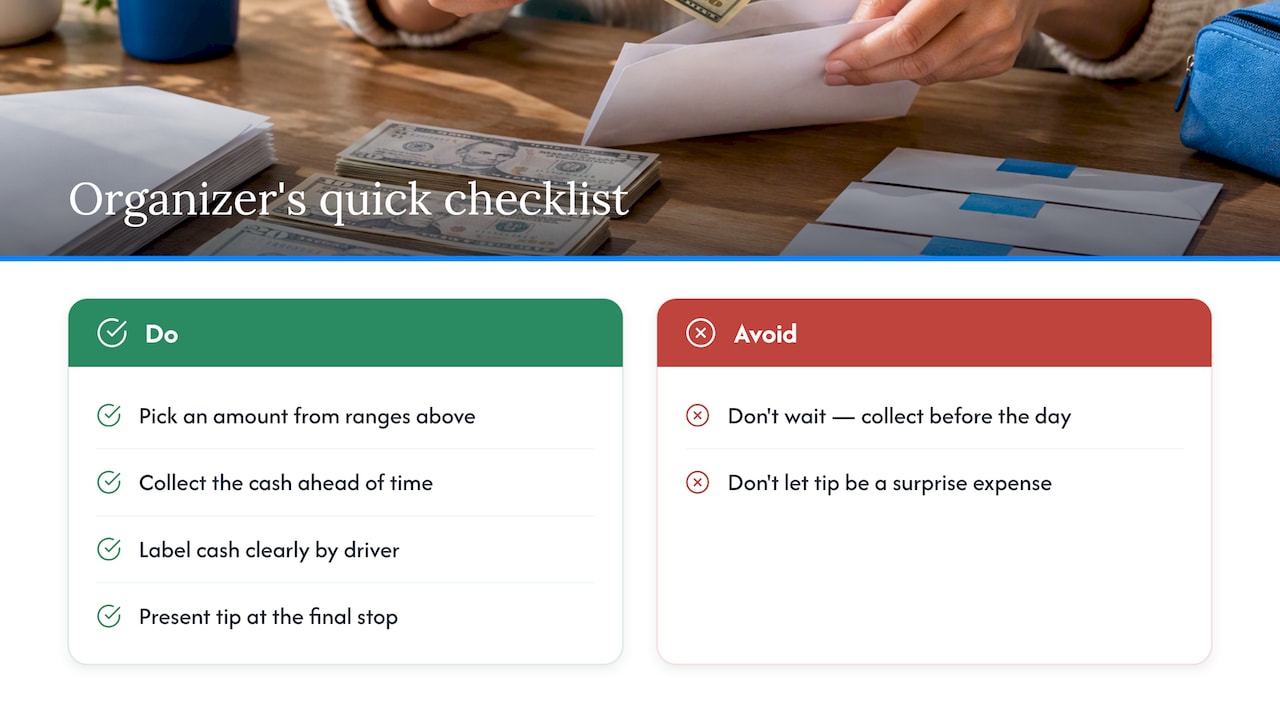
Here’s the short version I’d run through myself before any trip: pick your amount using the ranges above, collect the cash ahead of time, label it clearly by driver, present it at the final stop, and jot down who gave what for your own records.
A simple script works fine: “Thank you for getting us here safely, this is from all of us.” Build the tip into your event budget early so it’s not a surprise expense on the day.
— Dusty
How Reliant Transportation makes tipping easier to plan
Charter bus services in the Portland, Oregon metro area, the Willamette Valley wine region, and Hood River offer clear upfront quotes to make it easier to budget a fair tip alongside the rest of your transportation costs.

- Our team supports itinerary coordination so you know driver duties and schedules well before the trip.
- The seating chart planning guide helps you lock in passenger counts for accurate per-person tip math.
- Organizers who want logistics handled can book a charter bus and get a quote that makes tip budgeting straightforward from the start.
FAQ
How much should I tip a tour bus driver per day?
A common range is $2 to $4 per person per day for standard service, rising to $5 to $10 per person per day for exceptional service. Tour operators like EF Tours and Go Ahead Tours recommend amounts in a similar range for multi-day trips.
Is it rude to not thank the bus driver?
A verbal thank-you costs nothing and is always appropriate, but skipping a tip isn’t considered rude the way it might be in other service industries. Etiquette guidance still favors leaving the customary tip even when service was merely adequate, since it’s the standard practice for private charters.
How many hours a day can a charter bus driver drive?
Under federal hours-of-service rules, passenger-carrying drivers can drive up to 10 hours after 8 consecutive hours off duty and may not drive after being on duty for 15 hours following that rest period. These limits often mean long charters use relief drivers, each of whom should get their own tip.
Are you supposed to tip a Greyhound bus driver?
No, scheduled-line carriers like Greyhound don’t follow the same tipping norms as private charters, and drivers on fixed-route services generally aren’t tipped. That practice is specific to private charter and tour bus drivers.
Sources
- Hours of Service for Motor Carriers of Passengers | FMCSA
- Tipping etiquette: a guide for travelers (NBC News)