
For moving a wedding party, conference crowd, or corporate group reliably, a private charter or shuttle service beats every other option on the table. It is the closest thing to guaranteed on-time arrivals you can buy. There are local options serving the Portland metro, the Willamette Valley wine country, and Hood River for your transportation needs. Before you request a single quote, confirm your real headcount and lock your itinerary.
TL;DR:
- Confirm the transportation provider has proper operating authority, insurance, and safety records before booking to avoid service failures on the event day.
- Match vehicle size to the actual group size, accounting for luggage, accessibility needs, and adding a 5-10% buffer to prevent costly last-minute changes.
- Obtain a detailed written quote that clearly states included services, potential extra charges, and cancellation and substitution policies to avoid surprises.
- Book transportation 30 to 90 days in advance during peak seasons to secure qualified providers and finalize all details without rush.
- Assign a dedicated on-site contact, verify real-time tracking options, and prepare contingency plans for day-of logistics to ensure smooth execution.
Table of Contents
- What Is the Best Event Planning Software for Booking Group Transportation?
- Which Vehicle Type Fits Your Event?
- How Do You Compare Quotes and Contracts Fairly?
- What’s the Right Timeline for Booking Event Transportation?
- How Do You Handle Day-of Transportation Logistics?
- What Features Should a Transportation Planning Tool Actually Have?
- How Do Top Planning Approaches Compare for Managing Transportation?
- How Does Transportation Coordination Connect to Your Other Planning Tools?
- How Steep Is the Learning Curve for Coordinating Group Transportation?
- What Does Transportation Actually Cost, Beyond the Base Quote?
- What Kind of Support Should You Expect From a Transportation Provider?
- An Editorial Take on Why “Software” Isn’t the Real Answer Here
- Get a Clear Quote From a Local Charter Provider
- Sources
- FAQ
What Is the Best Event Planning Software for Booking Group Transportation?
The phrase “event planning software” gets used loosely, but when you are staring down a wedding shuttle schedule or a 200-person conference transfer, the real question isn’t which app to download. It’s which transportation provider can actually execute the plan you build. Think of this less as software shopping and more as vendor vetting, because a beautiful spreadsheet doesn’t matter if the bus doesn’t show up.
Start by asking every charter company for its operating authority number and a certificate of insurance. Legitimate carriers register with the Federal Motor Carrier Safety Administration and can produce a USDOT number on request. If a sales rep hesitates or can’t produce documentation quickly, that’s your answer. Vetting operating authority, insurance, driver screening, and maintenance records is necessary to avoid service failures that ruin an otherwise well-planned event.
From there, dig into the operational details:
- Ask to see the driver screening process, including commercial driver’s license verification and ongoing safety training.
- Request the vehicle maintenance schedule and inspection frequency, not just a promise that the fleet is “well maintained.”
- Confirm who handles your account day-to-day. You want one single-point contact, not a rotating call center.
- Ask exactly how they manage passenger manifests. Digital tracking beats a printed list every time.
Red flags show up early if you know where to look. A vendor who won’t put a scope of work in writing, who dodges questions about backup vehicles, or who quotes a price without asking your pickup addresses is not someone you want holding your event’s transportation on the day it matters most.
Pro Tip: Call the provider’s office directly instead of only emailing. How fast and how clearly they answer basic questions on the phone tells you almost everything about how they’ll handle a 6 a.m. crisis call on your event day.
Which Vehicle Type Fits Your Event?
Matching vehicle class to group size sounds obvious until you’re staring at forty confirmed guests and a vendor pushing you toward whatever’s sitting empty in the yard. Choosing the right vehicle depends on passenger count, luggage volume, trip distance, and accessibility, not on which bus happens to be available that weekend.
- Motorcoach: best for large groups, long distances, and heavy luggage. Wedding parties bussing guests between a Willamette Valley venue and downtown Portland hotels often land here.
- Minibus: ideal for shuttle loops and medium groups, think corporate retreat attendees moving between a Hood River hotel and a conference venue every hour.
- Sprinter van or sedan: right for small VIP moves, like getting the wedding couple or executive leadership team from point A to point B without excess space.
Take your realistic headcount and add a 5 to 10% buffer for vendors, chaperones, and the cousin who confirms three days before the wedding. Undersizing is the single most common planning error, and it’s an expensive one to fix last minute.
Beyond capacity, confirm the amenities that actually affect guest comfort: restroom availability on longer routes, wheelchair-accessible lifts if any guest needs one, working HVAC, and a seating layout that fits your group’s dynamic. Reliant Transportation’s charter bus sizes guide breaks down capacity ranges if you’re not sure where your group falls.
How Do You Compare Quotes and Contracts Fairly?
Two quotes that look similar on price can hide wildly different terms. Pricing differences commonly come down to what’s included, not what’s charged per hour.
Typical cost components include:
- Base hourly or mileage rate
- Parking fees and toll charges
- Driver lodging for overnight or multi-day trips
- Fuel surcharges during high-demand periods
- Gratuities, which some quotes bundle in and others leave for you to add
Before you sign anything, insist on a written proposal. It should spell out exactly what’s included, what triggers an extra charge, the cancellation policy, overtime rates if your event runs long, and the vehicle-substitution policy if your assigned coach breaks down. Reliable providers present written proposals that identify inclusions, exclusions, and contingency procedures as a matter of course, not something you have to fight for.
If one quote comes in noticeably lower than the rest, don’t assume you found a bargain. Ask what’s excluded. A cheap hourly rate that doesn’t include gratuity, tolls, or overtime can end up costing more than the “expensive” quote that included everything upfront. Reliant Transportation’s charter bus contract guide lays out the specific language worth requiring before you sign.
What’s the Right Timeline for Booking Event Transportation?
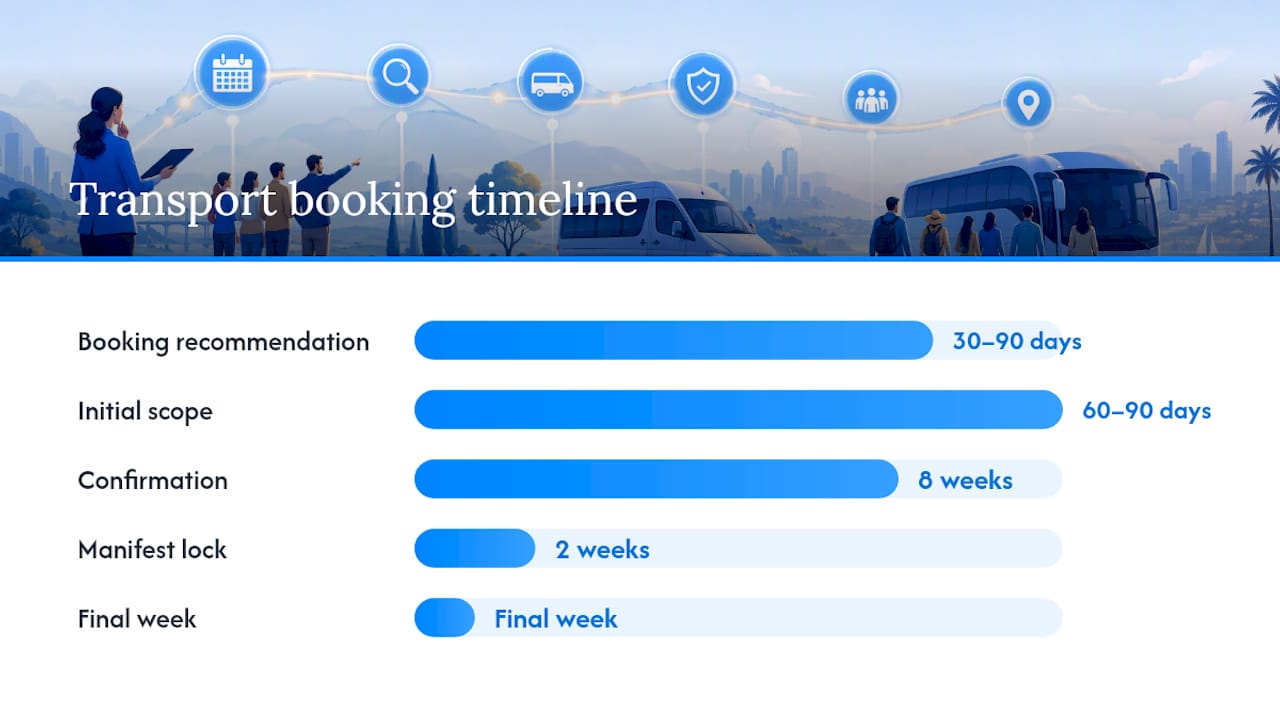
Charter companies fill their calendars fast during wedding season and conference season alike. Industry guidance recommends booking 30 to 90 days ahead during peak periods to secure a qualified provider instead of scrambling for whoever still has a bus available.
- Initial scope (60 to 90 days out): Nail down your realistic headcount, pickup and drop-off locations, and general timing. Booking a bus before you know your real passenger count is one of the most common planning mistakes, and it leads straight to over or under capacity.
- Confirmation (8 weeks out): Lock the vehicle type, confirm pricing in writing, and finalize pickup windows.
- Manifest lock (2 weeks out): Submit your final passenger list with exact addresses, which side of the building to stage at, and any accessibility notes.
- Final week: Confirm driver assignment, verify the exact vehicle, and do a last check on any venue access restrictions.
Manifest quality matters more than most planners expect. Include exact street addresses, not just venue names, note which entrance guests should use, flag any VIPs or vendors with special timing needs, and mention accessibility requirements clearly. If your venue has a specific loading zone or restricts staging times, get that in writing and pass it to your driver ahead of time. A quick site visit before the event catches problems no phone call ever will.
Pro Tip: Build your manifest in a shared document your transportation contact can access directly, rather than emailing updated versions back and forth. Late changes get lost in email threads far more often than in a live shared file.
How Do You Handle Day-of Transportation Logistics?
The plan you built weeks ago only matters if someone executes it in real time. Assign one on-site transportation contact, ideally someone not also managing catering or the ceremony timeline, who has a direct two-way line to your driver or dispatcher. Manifest management, a single point of contact, and real-time tracking measurably reduce day-of confusion compared to informal coordination.
Build contingency plans before you need them:
- Know your provider’s process for a replacement vehicle if one breaks down mid-route.
- Ask whether relief drivers are available for multi-day events or long shift windows.
- Get a clear escalation path in writing: who do you call, and how fast do they respond?
For guest communication, keep it simple. SMS updates with realistic ETAs cut down on the “where’s the bus” texts you’ll otherwise field all day. Clear signage at pickup points and a quick verbal reminder of boarding rules keep shuttle loops moving instead of stalling while people find seats. Technology like GPS tracking and SMS notifications is now a baseline expectation for event transportation, not a premium add-on.
What Features Should a Transportation Planning Tool Actually Have?
Whatever system you use to run logistics, whether that’s a shared spreadsheet, a project board, or dedicated coordination software, it needs to handle a few things well or it isn’t worth your time. Task management should let you assign deadlines to specific people: who confirms the manifest, who calls the venue about loading zones, who follows up on the signed contract. Budgeting features matter just as much. You need a place to track quoted costs against what actually gets billed, since overtime charges and fuel surcharges often show up after the initial quote.
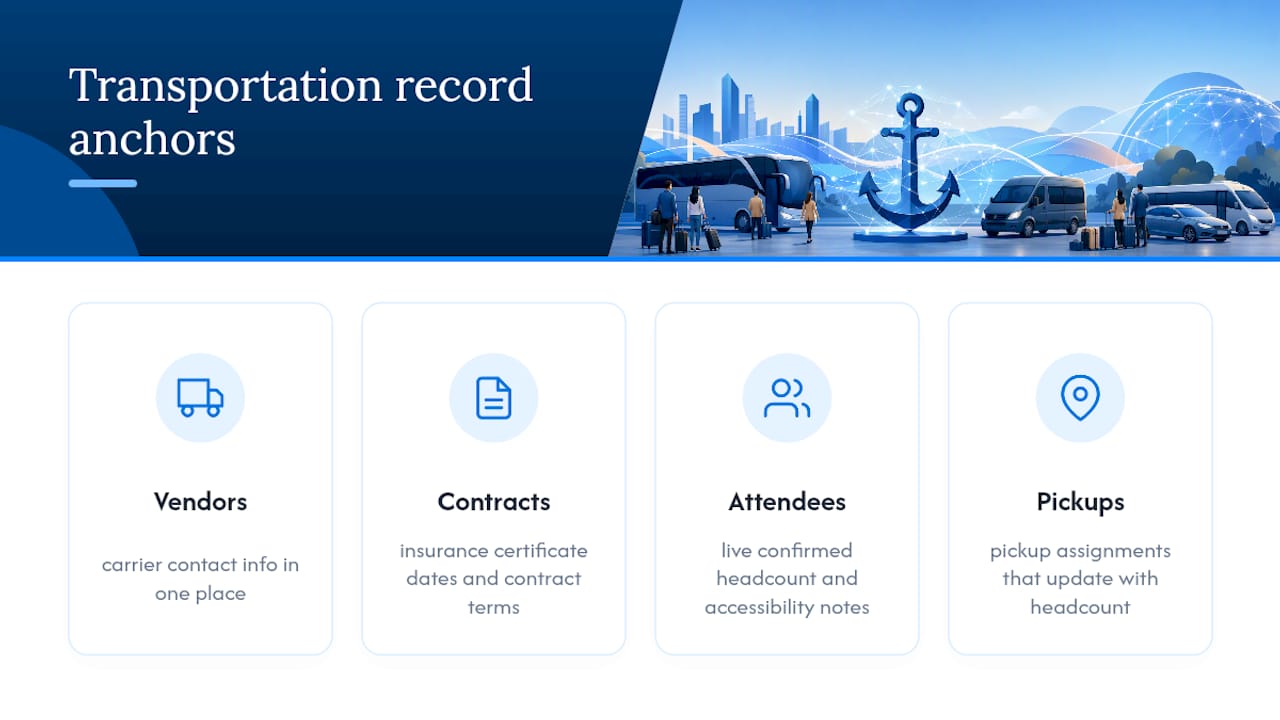
Vendor management is where most tools fall short for transportation specifically. You need a way to log carrier contact info, insurance certificate dates, and contract terms in one place you can find fast, not buried in an email from six weeks ago. Attendee tracking rounds it out: a live count of confirmed passengers, dietary or accessibility notes, and pickup assignments that update as your headcount shifts.
The best setup treats transportation the same way you’d treat catering or venue booking: a line item with its own deadlines, its own contract, and its own point of contact. If your current planning tool doesn’t let you flag “confirm final headcount by [date]” as a task tied to a specific vendor, you’re patching gaps with memory instead of a system.
How Do Top Planning Approaches Compare for Managing Transportation?
Different planning methods carry real trade-offs when transportation is the piece you’re managing.
Spreadsheet-based tracking costs nothing and works for smaller events. The downside shows up fast once you’re juggling manifests, driver contact info, and payment status across multiple vendors. Nothing updates automatically, and version control turns messy the moment two people edit at once.
Dedicated event management platforms offer stronger vendor and budget tracking with automated reminders. They tend to have a real learning curve, and most were built with venues and catering in mind first, so transportation-specific fields like manifest management or driver ETAs often need workaround fields.
Direct vendor coordination, working straight with your transportation provider’s own booking and communication process, cuts out a layer of software entirely. Providers who offer digital manifests and real-time tracking as part of their service give you much of what a planning platform promises, without an extra subscription to manage.
None of these is universally right. A 300-guest wedding with six vendor categories probably needs a dedicated platform. A single shuttle loop for a 40-person corporate retreat usually doesn’t.
How Does Transportation Coordination Connect to Your Other Planning Tools?
Whatever system tracks your budget, calendar, and vendor contracts should talk to your transportation plan, not sit in a separate folder. If your event calendar lives in Google Calendar or Outlook, sync your pickup and drop-off windows into it directly rather than keeping them in a separate document nobody checks on event day.
Payment tracking matters more than planners expect. If your transportation deposit and final balance run through a different payment gateway than your other vendor payments, note the due dates somewhere central. Missed final payments are a common reason quotes get renegotiated or vehicles get reassigned at the last minute.
If you’re managing repeat events, whether that’s an annual conference or a company with regular offsite meetings, a simple CRM-style contact log for your transportation provider saves real time. Track who your account contact was, what vehicle you used last time, and what worked or didn’t. Some transportation providers assign a consistent point of contact for repeat clients, which removes the need to re-explain your event’s quirks every single booking.
How Steep Is the Learning Curve for Coordinating Group Transportation?
Coordinating charter transportation isn’t technically difficult, but it punishes disorganization more than most other event categories. A caterer can often adjust on the fly. A charter bus stuck in the wrong pickup location cannot.
The steepest part of the learning curve is manifest management, not vehicle selection. First-time planners often underestimate how much detail a driver needs: exact addresses, which building entrance to use, and specific timing for staggered pickups. Get that wrong and you get a bus circling a parking lot while guests wait on the wrong side of a venue.
The good news is that this gets dramatically easier with a good provider on the other end. A carrier that assigns you a single-point contact and handles digital manifest updates absorbs most of the coordination complexity for you. Reliant Transportation’s charter bus seating chart guide gives first-time planners a template to work from instead of building a manifest format from scratch. Once you’ve run one event through a clear process, the second one takes a fraction of the time.
What Does Transportation Actually Cost, Beyond the Base Quote?
The base hourly or mileage rate is rarely the full cost of the service, and treating it as the total is the fastest way to blow a transportation budget. Fuel surcharges fluctuate seasonally. Driver lodging applies to overnight or multi-day trips. Gratuity, typically 15 to 20% of the base fare, is sometimes included in a quote and sometimes added as a separate line, and you need to ask which before you compare two numbers side by side.
Add-on costs show up around scheduling flexibility too. Overtime rates kick in if your event runs past the contracted window, and those rates are usually higher than the base hourly charge, sometimes significantly. Vehicle substitution, if your original coach becomes unavailable, shouldn’t cost you extra if it’s spelled out correctly in the contract, but plenty of vendors leave that clause vague on purpose.
The total cost of ownership for event transportation isn’t just the invoice you pay. It’s the invoice plus the hours you spend chasing clarification on what wasn’t included. A vendor who gives you a complete written breakdown upfront, even if the number is a little higher, usually costs less in total than one whose low quote turns into three follow-up emails and a surprise overtime charge.
What Kind of Support Should You Expect From a Transportation Provider?
Support quality separates a provider you can trust with your event from one you’re gambling on. At minimum, you should get a direct phone line to a human, not just a contact form, for both the booking process and the day of your event itself.
Ask what happens if something goes wrong at 5 a.m. on event day. A provider with a real answer, a named backup contact, an emergency dispatch line, a documented escalation process, is telling you they’ve handled this before. One who shrugs or says “that hasn’t happened” hasn’t thought it through.
Training resources matter less here than in software categories, since you’re not learning an interface. What matters instead is documentation: a written contract you can reference, a manifest template you can reuse, and a point of contact who remembers your event’s specifics without you re-explaining everything. That’s the real support infrastructure for group transportation, and it’s worth asking about directly before you sign.
An Editorial Take on Why “Software” Isn’t the Real Answer Here
Some transportation companies have spent over a decade serving weddings, corporate events, and group outings across regional areas, building a fleet and a client history that back up what this guide recommends. The pattern worth noticing: planners who treat transportation as a software problem end up with excellent spreadsheets and unreliable buses. Planners who treat it as a vendor relationship end up with the opposite.
The less obvious checks are the ones that catch people off guard. Confirm which exact vehicle gets assigned to your event, not just the class you booked. Ask for a driver arrival window, not a vague “morning of” promise. And if your route runs long, verify restroom availability directly rather than assuming every coach has one. Reliant’s amenities checklist and bathroom guide cover exactly these gaps.
— Dusty
Get a Clear Quote From a Local Charter Provider
Using a local transportation provider can be a direct alternative to juggling planning apps and unverified vendors for event transportation in regional areas. Instead of piecing together spreadsheets, vendor calls, and guesswork about which bus fits your group, you get one local point of contact, a well-maintained fleet, and a written proposal before you commit to anything.
Some providers handle wedding shuttles, corporate event travel, conference transfers, and group outings with fleet options ranging from sprinter vans to full motorcoaches. Bookings may include a dedicated contact to manage your manifest directly, reducing communication layers. If you’re planning a wedding, the wedding charter bus guide covers vehicle timing specific to ceremony and reception logistics.
Confirm your headcount, pin down your pickup locations, and request a quote through Reliant’s booking page to see fleet availability for your date.
Sources
- What event planners should look for in a group transportation provider – AZ Big Media
- Group event transport explained: reliable solutions for US events
FAQ
What Is the Best Event Planning Software for Charter Bus Logistics?
There’s no single app that replaces vendor vetting. The most reliable approach combines a simple task tracker with a transportation provider that manages manifests and communication directly.
How Far in Advance Should I Book Event Transportation?
Book 30 to 90 days ahead for peak seasons, since qualified providers fill their calendars fast during wedding and conference season.
What Vehicle Size Do I Need for a 50-Guest Event?
A minibus typically fits medium groups comfortably, but confirm your exact headcount plus a 5 to 10% buffer before booking, since undersizing based on an unconfirmed count is a common planning error.
What Should Be in a Charter Bus Contract?
Insist on inclusions and exclusions, cancellation fees, overtime rates, and a vehicle-substitution policy in writing, since these terms are the strongest safeguard against last-minute cost surprises.
Does Reliant Transportation Serve Weddings and Corporate Events?
Yes. Reliant Transportation provides charter bus and shuttle service for weddings, corporate events, conferences, and group outings across the Portland metro, the Willamette Valley wine region, and Hood River.