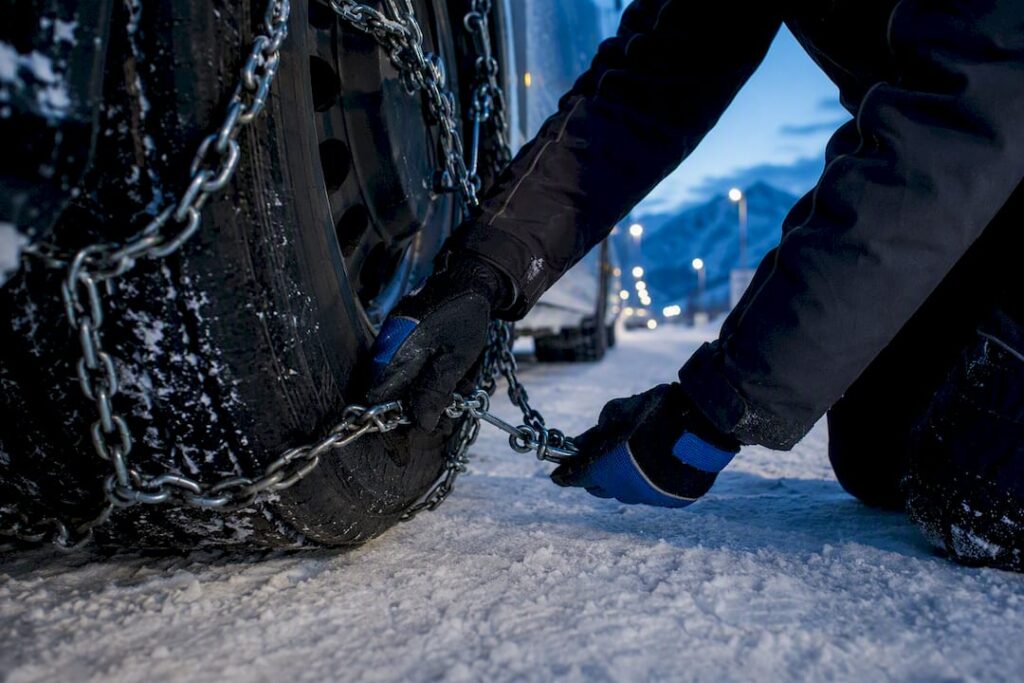
Whether your charter bus rolls with snow chains depends on posted road requirements and the operator’s own policy, not guesswork on the day of travel. Responsible operators fit chains when law or conditions demand it, and many run traction tires that satisfy the rule without chains at all. Before you book, confirm the vehicle’s weight class, the company’s chain policy in writing, and whether the driver has documented winter training.
TL;DR:
- Most operators can confirm whether their buses carry chains, who installs them, and how long the process takes on a route.
- Vehicle weight class and axle configuration determine the number and placement of chains required by law, with specific rules for different axle setups.
- Traction or mud-and-snow tires can sometimes substitute for chains legally, but conditional closures can override exemptions, requiring chains regardless.
- Operators practicing winter safety develop layered strategies, including driver training, route monitoring, planned staging, and built-in schedule buffers.
- Confirming written chain policies, driver winter training, and contingency plans before booking significantly improves winter travel preparedness.
Table of Contents
- Will My Charter Bus Have Snow Chains? What to Ask the Operator
- How Do Chain Laws and Exemptions Actually Work?
- What Winter-Safety Measures Do Operators Use Beyond Chains?
- Your Booking Timeline: What to Confirm and When
- What a Professional Charter Operator Looks Like in Winter
- Ready to Book a Winter-Ready Charter?
- Sources
Will My Charter Bus Have Snow Chains? What to Ask the Operator
Getting a straight answer here separates a prepared operator from one that’s guessing along with you. Ask these questions in order, and don’t accept a vague “we’ll figure it out” as a substitute for a real policy.
- Does the assigned bus carry chains, and who installs them? Find out if the driver chains up solo, if a second crew member assists, or if the company stages a chaining stop with support staff. Ask how long the process typically takes on that route.
- What’s the vehicle’s GVW and axle configuration? This determines exactly how many chains go on and where. A single-drive axle bus and a tandem-drive axle bus have different placement requirements, and an operator who can’t answer this quickly is a red flag.
- Are traction tires or mud-and-snow tires in use? Some vehicles satisfy chain requirements with the right tire rating alone. Ask whether the operator claims any legal exemption, and whether that exemption holds up under a full closure.
- Can you provide proof of driver winter-training or a written winter policy? A company with real winter operations will have this ready. One that doesn’t usually hasn’t thought past “we’ll see how it goes.”
- What’s the contingency plan if conditions worsen mid-route? Reroute, delay, or wait it out. Get specifics, not reassurance.
Watch for vague answers, refusal to put anything in writing, or no clear day-of contact you can reach if weather turns. Those are the signs of an operator managing your trip by hope rather than plan.
Pro Tip: Ask for the winter policy by email before you sign anything. If the operator hesitates or says “it varies,” that’s your answer about how prepared they really are.
How Do Chain Laws and Exemptions Actually Work?
Chain requirements aren’t a blanket rule that applies the same way everywhere, and understanding the baseline helps you know what your operator is legally required to do versus what’s just good practice.
Most western states, including Oregon, post chain requirements at specific locations when conditions call for it, and once those signs go up, compliance isn’t optional. Oregon’s Division 17 administrative rule sets minimum chain placement for medium-duty vehicles like buses, and the rule ties placement directly to axle configuration.
- A bus with a single-drive axle typically needs one chain per side on that axle.
- A tandem-drive axle configuration can require two chains per side, depending on the specific setup.
- TripCheck’s chain placement guidance walks through these placements by vehicle class, and it’s worth having your operator confirm which category their bus falls under.
Here’s where it gets more nuanced than most planners expect: some buses carry an exemption tied to accessibility modifications that raise the vehicle’s GVW. That exemption sounds like a permanent pass, but it isn’t. According to ODOT’s chain and traction tire guidance, conditional closures can override standard exemptions entirely, meaning even an accessibility-exempt bus may need chains when a highway pass shuts down to anything without them.
That override matters for your contract and your day-of decisions. An operator who understands this distinction plans differently than one who assumes their exemption is bulletproof. If conditions deteriorate past what a conditional closure allows, your operator has a legal obligation to comply, which might mean a delay, a reroute, or a wait at a staging area while chains go on. Building that possibility into your event timeline now beats discovering it on the Santiam Pass at 6 a.m.
What Winter-Safety Measures Do Operators Use Beyond Chains?
Chains are one tool, not the whole toolkit. A charter operator serious about winter travel builds a layered approach, and knowing what that looks like helps you evaluate whether a company is actually ready or just checking a box.
- Tire strategy first. Traction tires or mud-and-snow rated tires can legally substitute for chains in many conditions, which means less time stopped on the shoulder and a smoother ride for your group.
- Driver training and experience. Ask directly whether drivers complete winter-specific training. Operational maturity, not just years behind the wheel, tends to separate the companies that handle snow well from the ones that improvise.
- Route monitoring before departure. A prepared operator checks conditional closure status and weather patterns the morning of, not the night before, and adjusts departure timing if a pass looks likely to close.
- Planned chaining stops. Rather than pulling over wherever conditions force a stop, experienced operators identify safe staging locations along the route in advance.
- Buffer time built into the schedule. Chaining takes real minutes, sometimes 20 to 30 depending on crew size and axle count, and that time needs to be planned for, not absorbed as a surprise delay.
Passenger comfort matters here too. A good operator briefs riders before a chaining stop: where the bus will pull over, roughly how long it takes, and what to expect if the group needs to step off briefly for safety. That small communication step keeps a routine chaining stop from feeling like an emergency.
Pro Tip: If your event has a hard start time, ask the operator to build a chaining buffer into the departure schedule rather than the arrival schedule. It’s much easier to leave 20 minutes early than to explain a late arrival to 40 guests.
Your Booking Timeline: What to Confirm and When
Winter charter planning works best as a sequence, not a single conversation. Here’s how to structure it.
- Before you book: Add a winter-safety clause to your charter bus contract that specifies chain policy, requires confirmation of driver winter training, and outlines the operator’s contingency plan for conditional closures.
- 72 to 48 hours out: Reconfirm the forecast, check whether your route has posted or likely chain requirements, and get the name and direct contact for whoever’s on duty the day of travel.
- Day of travel: Build in extra time for a possible chaining stop, and if you’re coordinating pickup, choose a staging location with enough clear space for the crew to work safely.
- Before departure: Brief your group on the possibility of a short delay. A quick heads up turns an unexpected stop into an expected one.
- Confirm who covers delay costs. Some operators absorb chaining time as standard service; others bill differently for extended winter routes. Get this in writing before the invoice, not after.
That written clause does more than protect you legally. It tells you, before you ever step on the bus, whether the company you’re working with actually has a winter operation or is just hoping for a clear forecast.
What a Professional Charter Operator Looks Like in Winter
Most planners don’t realize how much operational groundwork separates a company that handles winter well from one that’s rolling the dice on the weather. It’s not really about who owns tire chains. Nearly every operator running mountain or valley routes owns chains. It’s about who has built a real process around when to use them, who trains drivers to make that call, and who tells you the truth about it before you sign a contract.
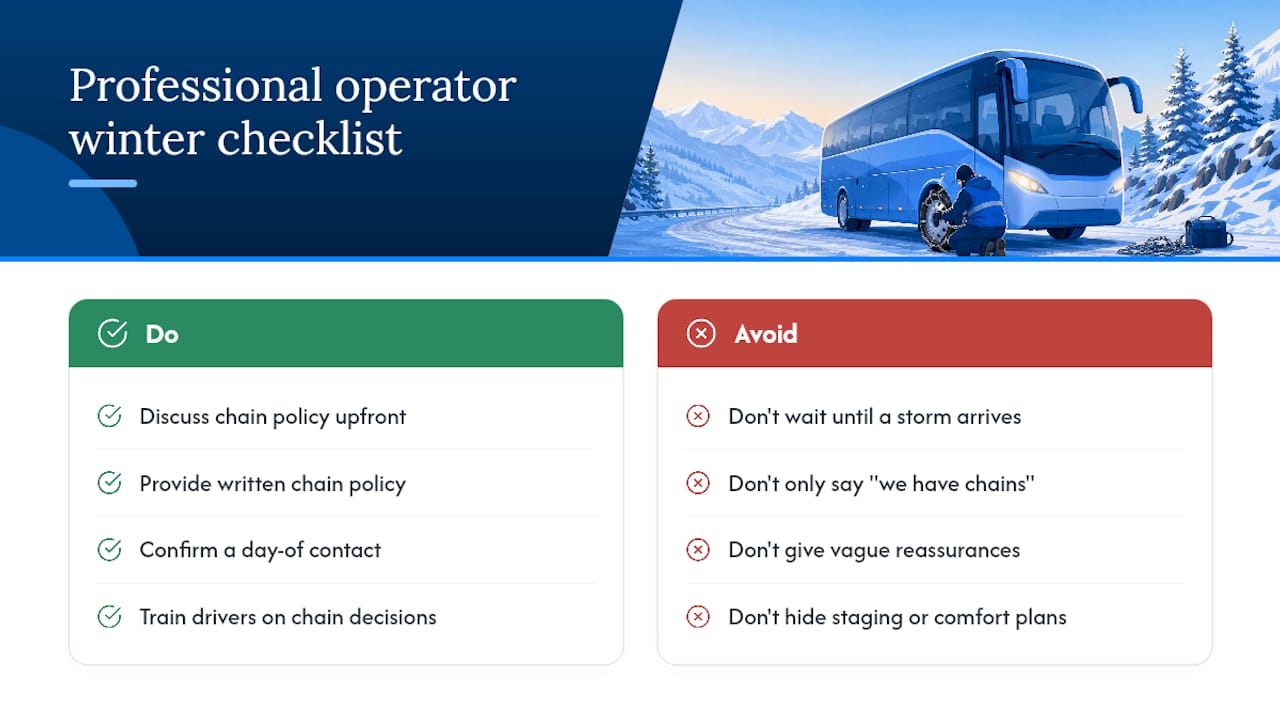
Some charter operators run service across areas like the Portland metro, the Willamette Valley wine region, and the Hood River area, where posted chain requirements are a real possibility during winter months. That geography shapes how some operators approach bookings during shoulder and winter seasons: chain policy gets discussed upfront, not after a storm shows up on the radar.
Planners working with some operators get specifics rather than reassurance. That means written policy language, a confirmed day-of contact, and a real answer about staging and passenger comfort if a chaining stop becomes necessary. Reliant’s planner resources reflect that same standard of detailed, checklist-driven communication across event types, not just winter trips. Consistent service ratings often come from treating logistics, including details like chain policy, as important to document clearly.
— Dusty
Ready to Book a Winter-Ready Charter?
If you’re planning an event anywhere in the Portland metro, the Willamette Valley wine region, or Hood River during chain season, the details matter more than the sales pitch. Choosing an operator that provides winter-safety answers before signing a contract, rather than after departure, supports better travel preparedness.
When you request a quote, ask for a winter-safety addendum: chain policy in writing, confirmation of driver winter training, a clear contingency plan, and a direct day-of contact. That documentation should arrive as easily as your price quote does. Reconfirm those details again 72 hours before departure, since forecasts and posted requirements can shift fast in the Cascades and the Gorge.
Start by checking which charter bus size fits your group, then head to the booking page to request a quote and add your winter-safety requirements directly to the reservation. Planning a wedding shuttle through wine country in the colder months? Reliant’s wedding transportation guide covers the event-specific details worth locking in early.
Sources
- Minimum Chain Requirements in Oregon | TripCheck – Oregon Traveler Information
- Oregon Secretary of State Administrative Rules — Division 17 Chains or traction tires (734-017-0010)
- Oregon Department of Transportation: Chains and traction tires