
To reduce bus motion sickness, sit forward-facing near the front or over the middle of the bus, keep your eyes on the horizon, and take an antihistamine like dimenhydrinate or meclizine 30 to 60 minutes before departure if you’re prone to symptoms. Ginger and slow breathing help with milder cases. If nausea keeps hitting every trip, or you notice new neurological symptoms, talk to a clinician instead of just riding it out.
TL;DR:
- Sitting near the front or over the bus’s middle reduces motion sickness by minimizing sway and sensory conflict during turns and stops.
- Taking antihistamines like dimenhydrinate or meclizine 30 to 60 minutes before travel effectively prevents symptoms for most prone individuals.
- Fixing your gaze on the horizon, eating light, and using cool airflow or ginger can help prevent or ease nausea during the trip.
- Selecting forward-facing seats early and planning routes to avoid rough stretches can significantly reduce the risk for motion-sensitive passengers.
- Habituation through repeated exposure can lower susceptibility over time, especially with clinician-guided vestibular training for persistent cases.
Table of Contents
- Why Buses Trigger Motion Sickness in the First Place
- Where Should You Sit to Avoid Getting Sick on a Bus?
- What Can You Do Before Boarding to Prevent Nausea?
- What Medications Work Best for Bus Motion Sickness?
- What Should You Do the Moment Symptoms Start?
- Can You Train Your Body to Stop Getting Motion Sick?
- The View From Reliant Transportation on Passenger Comfort
- Booking a Charter That Plans Around Motion Sickness, Not Around Luck
- Where This Guidance Comes From
- Sources
Why Buses Trigger Motion Sickness in the First Place
Motion sickness comes down to a mismatch between what your eyes see and what your inner ear feels. Your vestibular system detects the bus swaying, braking, and turning, but your eyes, especially if you’re reading or staring at your phone, tell your brain you’re sitting still. That contradiction is sensory conflict, and it’s the mechanism behind nearly every case of travel-related nausea.
Buses are particularly good at causing this. The motion frequencies that provoke symptoms most reliably fall between 0.2 and 0.4 Hz, a slow, rolling rhythm that matches exactly what a bus produces on winding roads or in stop-and-go traffic. Add lateral sway from turns, vertical bounce from potholes, and a limited forward view for anyone not in the front rows, and you’ve built a near-perfect trigger.
Some people are simply more wired for this. Younger riders and women tend to report higher susceptibility, and a personal or family history of motion sickness raises your odds too. If nausea shows up with vertigo, double vision, or slurred speech, that’s not standard motion sickness. It could point to a vestibular or neurological issue, and it deserves a medical evaluation rather than a ginger chew.
Where Should You Sit to Avoid Getting Sick on a Bus?
Seat choice matters more than most passengers realize. The rows near the front, or anywhere close to the bus’s center of gravity, move the least during turns and braking, which cuts down on the sensory mismatch driving your nausea.
- Choose forward-facing seats near the front third of the bus or over the middle axle.
- Skip the back rows, where bouncing and sway are amplified.
- Never take a side-facing seat if you have a choice. It adds perpendicular motion your inner ear has to process on top of everything else.
- Rest your head against the seatback so it isn’t bobbing independently of the bus.
- On a crowded bus, ask to stand near the front rather than the back, or swap seats with someone early, before symptoms start rather than after.
If you’re organizing group travel, this is worth sorting out before boarding. Reliant Transportation’s guide to charter bus seating charts walks through how to assign front seats to riders who are prone to sickness without turning it into a whole negotiation on travel day.
What Can You Do Before Boarding to Prevent Nausea?
Most of the effective prevention happens before symptoms ever show up, and it doesn’t require a pharmacy trip.
- Fix your gaze on the horizon. Looking at a distant, stable point gives your eyes and inner ear matching information. Reading, texting, or watching videos does the opposite and is one of the fastest ways to bring symptoms on.
- Eat light before you travel. A bland snack, crackers, toast, plain rice, settles the stomach better than a heavy or greasy meal. Skip alcohol and go easy on caffeine beforehand.
- Use breathing and airflow to your advantage. Slow, controlled breathing can ease the urge to vomit, and pointing a vent or cracking a window for cool air on your face helps more than most people expect.
- Try ginger. Ginger chews or ginger ale are simple, low-risk options that show up again and again in medical prevention guidance. Acupressure wristbands are popular too. The evidence for them is closer to placebo, but if one helps you personally, there’s little downside to wearing one.
- Plan the trip itself. Book earlier or later departures if traffic-heavy routes make you queasy, request forward-facing seats ahead of time for a group, and know where rest stops are along the route.
Pro Tip: Pack your ginger chews and any medication in your bag the night before, not your suitcase underneath the bus. You want them within arm’s reach the moment you feel the first wave of queasiness, not thirty minutes into the trip.
What Medications Work Best for Bus Motion Sickness?
For people who get sick reliably, behavioral tricks alone often aren’t enough, and that’s where over-the-counter and prescription options come in.
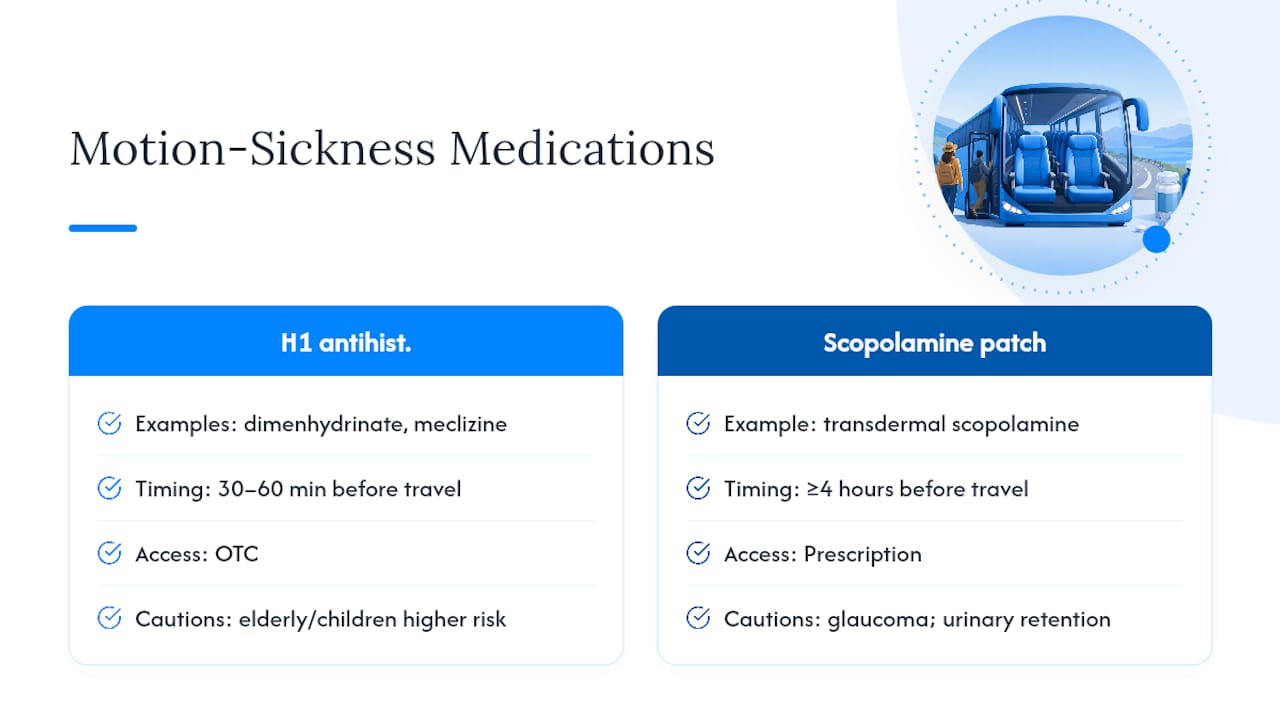
Dimenhydrinate and meclizine are the two most common H1 antihistamines used for motion sickness, and both work best taken 30 to 60 minutes before travel, not after you’re already queasy. That timing matters more than people think: once vomiting starts, the stomach slows down absorption of anything you swallow, which is why prophylactic dosing beats trying to catch up later.
The scopolamine transdermal patch is a prescription option that needs to go on at least four hours before departure, and it’s not for everyone. It carries specific cautions for people with glaucoma or urinary retention issues, and both children and older adults face higher risk of side effects.
Across all of these medications, expect some combination of drowsiness, dry mouth, and blurred vision. Don’t drive or operate machinery after dosing. If you’ve never tried a particular medication, test it at home on a low-stakes day first, not on the morning of a wedding or a work conference you can’t afford to sleep through. Pregnant travelers or anyone already taking other central nervous system depressants should check with a clinician before adding another sedating medication into the mix.
What Should You Do the Moment Symptoms Start?
Once nausea hits, the goal shifts from prevention to damage control, and speed matters.
- Face forward immediately and brace your head against the seat so it stops moving independently of the bus.
- Fix your eyes on a distant point out the front window, not the seat in front of you, and slow your breathing down deliberately.
- Suck on a ginger candy or take small sips of a carbonated drink; both can settle the stomach faster than doing nothing.
- Aim any available vent or window crack toward your face for cool air.
- Try pressing on the P6 acupressure point on the inside of your wrist, about three finger-widths below your palm.
- If none of this is working and vomiting starts, ask the driver about the next safe stop rather than pushing through.
Severe or repeated vomiting, signs of dehydration, or any sudden numbness, confusion, or slurred speech are not things to wait out. Those need medical attention, not another ginger chew.
Can You Train Your Body to Stop Getting Motion Sick?
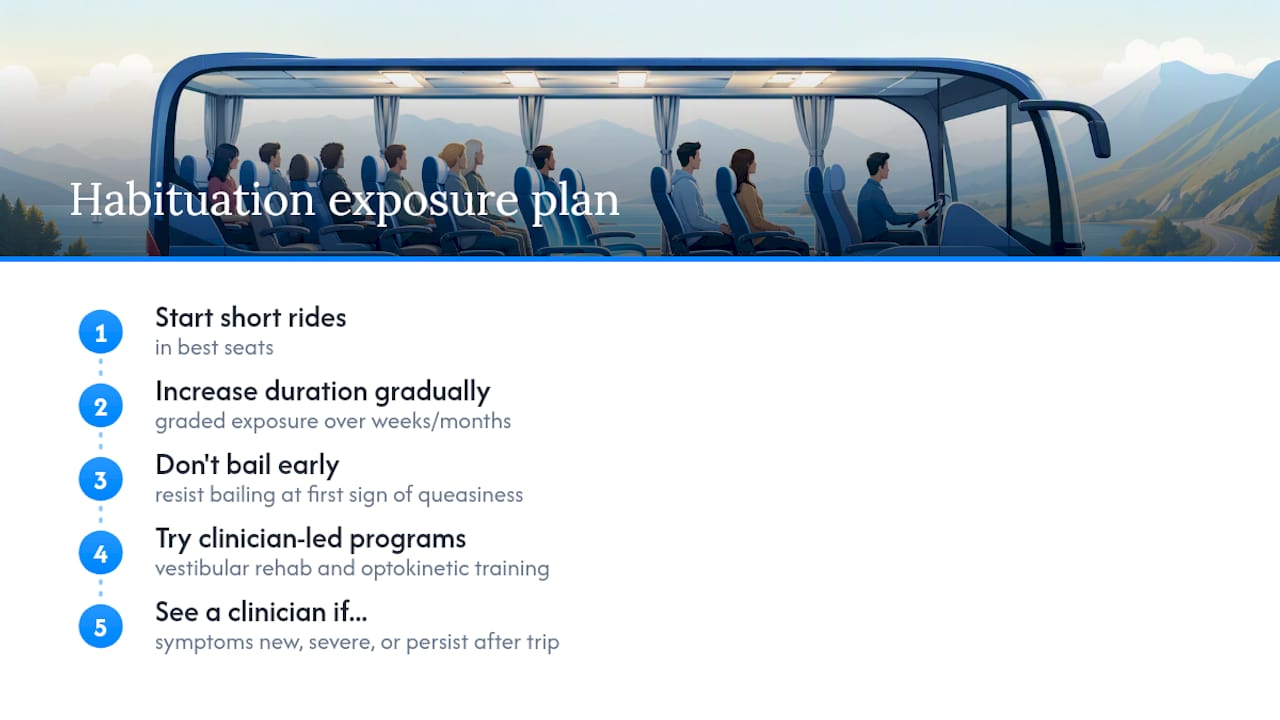
Yes, and it’s the one strategy nobody mentions until you ask a specialist directly. Habituation, repeated, graded exposure to motion, genuinely reduces susceptibility over time, though it works in weeks and months, not a single bus ride.
If you travel by bus often, a simple exposure plan helps: start with short rides in the best seats, gradually extend the duration, and resist the urge to bail at the first sign of queasiness. For more stubborn cases, clinician-led vestibular rehabilitation and optokinetic training programs speed this process up considerably.
If your symptoms are new, unusually severe, or don’t resolve after the trip ends, that’s a signal to get checked for vestibular migraine or another inner-ear disorder rather than assuming it’s ordinary motion sickness.
The View From Reliant Transportation on Passenger Comfort
We’ve watched enough charter groups board to know seating fights are avoidable. Assigning front rows to motion-sensitive riders, planning smoother routes when possible, and keeping ventilation steady all cut down on mid-trip requests to pull over. Our seating chart guide and notes on onboard restroom access help organizers plan for this before the group ever steps on the bus.
— Dusty
Booking a Charter That Plans Around Motion Sickness, Not Around Luck
If you’re organizing a wedding shuttle, corporate trip, or wine country outing anywhere in the Portland metro area, the Willamette Valley wine region, or Hood River, Reliant Transportation lets you request forward-facing seating and route planning in advance instead of hoping seat assignments sort themselves out on the day. That’s the real advantage over leaving seating to chance: your motion-sensitive guests get the front rows reserved before boarding, not after someone’s already queasy.

Our drivers know the Willamette Valley’s winding wine routes and Hood River’s mountain roads well enough to plan around the roughest stretches when timing allows. If you’re putting together a group trip and want seating handled ahead of time, you can request a quote and reserve your charter online and mention any seating needs when you book.
Where This Guidance Comes From
This article draws on prevention and treatment guidance from the CDC’s Travelers’ Health and CDC Yellow Book, Mayo Clinic, and a peer-reviewed review of motion sickness neurophysiology.
This article is general information, not a substitute for advice from a qualified doctor. Consult a qualified healthcare professional about your own circumstances before acting on anything here.
Sources
- Motion sickness | Travelers’ Health (CDC)
- Motion sickness — Mayo Clinic (First aid)
- The Neurophysiology and Treatment of Motion Sickness — PMC
- Motion sickness — Sensation and Perception (Open Textbook Library)