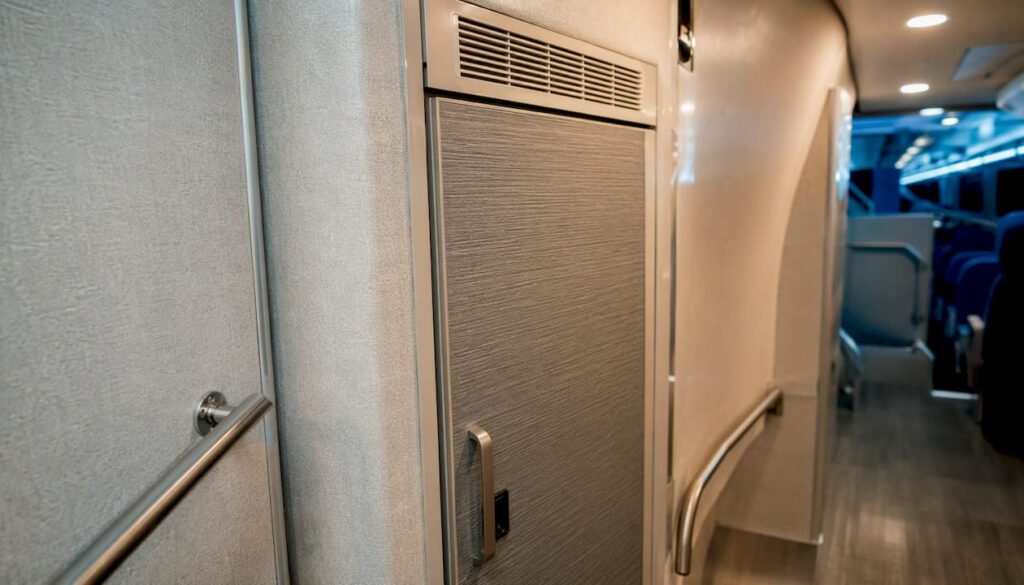
Most full-size motor coaches include an onboard restroom. Minibuses, shuttle vans, and Sprinter vans typically do not. That’s the short answer — and if you’re coordinating a long-distance group trip, it’s the first thing worth confirming before you sign anything.
A few quick planning anchors: full-size coaches typically seat between 40 and 56 passengers and almost always include a rear restroom, while smaller vehicles trade that amenity for lower cost and easier city navigation. Holding tanks on full-size coaches typically range from 25–50 gallons, which supports light use over a few hours before servicing is needed. The standard industry rule-of-thumb is to schedule a rest stop every 90–120 minutes for large adult groups regardless of whether the bus has a restroom.
Who should insist on a restroom-equipped coach:
- Long-distance groups (trips over 2–3 hours with no planned stops in between)
- Mixed-age groups, families with young children, pregnant passengers, or anyone with a medical condition affecting bathroom frequency
What to ask when you book:
- Request the specific vehicle class (full-size motorcoach) and ask for written confirmation that the assigned vehicle includes an onboard restroom
Key takeaways
Most full-size motor coaches include an onboard restroom, but confirming that in writing at booking is the single most important step a planner can take.
| Point | Details |
|---|---|
| Full-size coaches have restrooms | Full-size motorcoaches (40–56 seats) almost always include an onboard restroom; minibuses and vans typically do not. |
| Book a full-size coach for long trips | Any trip over 2–3 hours, or any group with children, seniors, or medical needs, warrants a restroom-equipped coach. |
| Plan stops regardless | Schedule rest stops every 90–120 minutes; tighten to 60–90 minutes for groups with children or seniors. |
| Get restroom confirmation in writing | Ask for the vehicle model and restroom availability as a line item on the quote before signing. |
| Follow basic etiquette | Keep visits brief, flush only toilet paper, and notify the driver immediately if something is wrong. |
| Ridereliant handles the details | Ridereliant confirms restroom availability in writing and follows a documented pre-trip prep checklist for every charter. |
Table of Contents
- Does your charter bus have a bathroom? Vehicle types explained
- How charter bus bathrooms actually work
- What’s inside a charter bus bathroom
- Space limits, accessibility, and what to plan for
- Cleaning, hygiene, and what to do if something goes wrong
- Restroom etiquette and safety while the bus is moving
- When to request a bus with a bathroom and how to weigh the cost
- Questions to ask a charter company before you book
- How Ridereliant prepares onboard restrooms before every trip
- What I’ve learned from watching groups skip the restroom conversation
- Ridereliant can set you up with the right coach for your trip
- Sources
Does your charter bus have a bathroom? Vehicle types explained
Not every charter vehicle is built the same, and restroom availability breaks down almost entirely by vehicle class. Here’s how the lineup typically looks:
- Full-size motorcoach (40–56 seats): Almost always includes a rear onboard restroom. This is the standard for long-distance group travel.
- Mid-size coach (25–40 seats): Restroom availability varies. Some mid-size coaches include one; others don’t. Always confirm.
- Minibus (15–30 seats): Rarely includes a restroom. Designed for shorter runs where stops can cover bathroom needs.
- Shuttle van / Sprinter van (8–14 seats): No onboard restroom. These are optimized for short local routes under roughly 90 minutes.
- Limo bus / party bus: Varies widely by operator and configuration. Some include a restroom; many do not. Ask specifically.
The practical rule: if your trip leg runs longer than 2–3 hours or your group exceeds 30–40 people, a full-size motorcoach is the right call. Smaller vehicles make sense when bathroom access is available at regular stops and the route is short enough that onboard facilities aren’t a real need. Either way, confirm restroom availability in writing on the quote — fleet variation between operators means you can’t assume based on vehicle class alone.
Pro Tip: When comparing quotes from different operators, ask each one to specify the exact vehicle model, not just the class. Two operators quoting a “mid-size coach” may be offering very different vehicles.
How charter bus bathrooms actually work
The plumbing on a motor coach is nothing like a house bathroom. Understanding the system helps you set realistic expectations for your group and plan your trip accordingly.
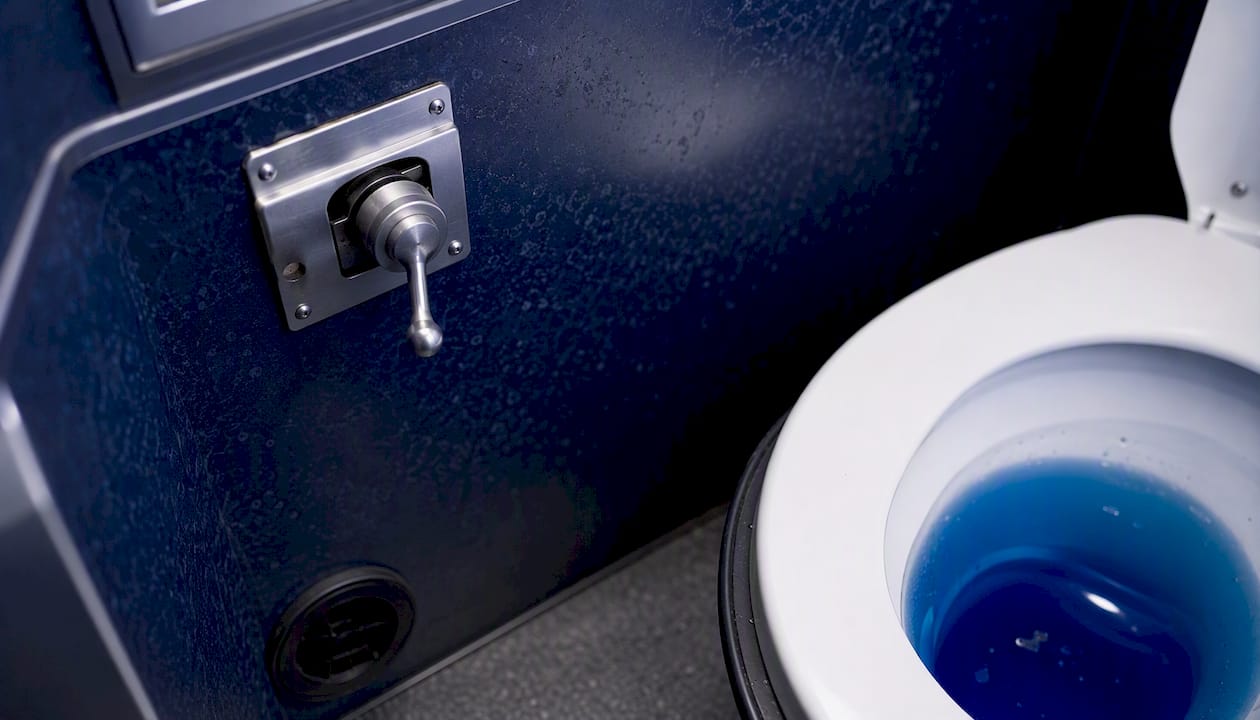
Charter bus restrooms use a sealed holding-tank system. Waste goes into a self-contained tank beneath the vehicle rather than connecting to any municipal sewer line. Most coaches use a recirculating chemical or blue-water flush system, similar in concept to an airplane lavatory, which controls odor and keeps the bowl clean between uses. Industry sources report typical tank volumes in the 25–50 gallon range, which is enough for light use over a multi-hour trip but not designed to handle heavy, continuous traffic.
| System Component | How It Works | Planning Implication |
|---|---|---|
| Holding tank | Sealed tank stores waste onboard | Sized for light use; not a substitute for rest stops |
| Recirculating flush | Chemical solution recirculates to flush | Controls odor; requires proper chemical levels |
| Roof vent stack | Ventilation pipe exits through the roof | Reduces interior odor; works best when bus is moving |
| Tank servicing | Emptied and cleaned between trips | Multi-day charters need a documented service schedule |
Servicing happens between trips, not mid-route on a standard day charter. For multi-day trips, this is a critical detail: ask your operator how and when the tank gets emptied, and get that schedule in writing. A tank that isn’t serviced on a two-day trip becomes a problem by day two.
What’s inside a charter bus bathroom
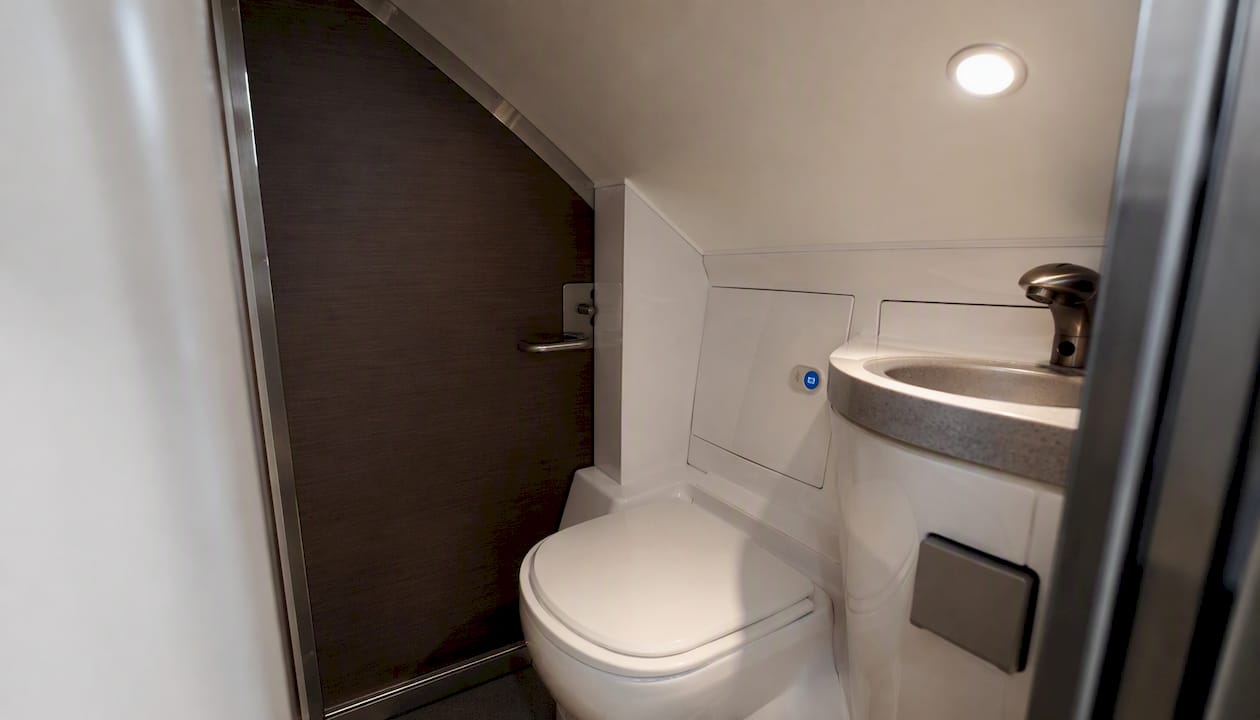
The interior is compact and functional. Think airplane lavatory, not hotel bathroom. Here’s what you’ll typically find:
- A recirculating toilet with a foot pedal or button flush
- A small sink or hand-sanitizer dispenser (running water is not always available)
- Toilet paper stocked before departure
- A locking door with an occupied indicator
- A motion-activated interior light
- A roof vent stack for ventilation
- A small trash receptacle
What you won’t find: a shower, a full-size sink with hot running water, a changing table, or room to maneuver with luggage. Standard charter bus restrooms are designed for brief, single-user visits — they handle the basics and nothing more.
Ventilation quality varies. The roof stack works best when the bus is moving, so odor can build faster during long stops. That’s another reason planned rest stops matter even when you have an onboard restroom.
Space limits, accessibility, and what to plan for
The onboard restroom is small. There’s no other way to put it. A single adult can use it comfortably, but the turning radius inside is tight enough that passengers using wheelchairs, walkers, or other mobility aids will likely find it inaccessible without significant difficulty.
FMCSA accessibility guidance covers passenger bus accessibility and supports explicitly requesting accessible equipment when your group includes passengers with mobility needs. That means asking for a vehicle with a lift or ramp, not just assuming the onboard restroom covers accessibility requirements. The restroom itself is not ADA-accessible in most standard configurations.
Practical alternatives when accessibility is a concern:
- Request a coach equipped with a wheelchair lift or ramp at booking
- Schedule planned stops at locations with confirmed ADA-accessible restrooms
- Identify accessible rest areas along the route in advance and build them into the itinerary
- Notify the operator of specific passenger needs so they can recommend the right vehicle
Pro Tip: When booking for a group that includes passengers with mobility needs, put those requirements in writing in the initial quote request. Verbal confirmations are easy to miss; written specs in the contract protect everyone.
Cleaning, hygiene, and what to do if something goes wrong
A well-run operator services the restroom before every trip. That means emptying and cleaning the holding tank, restocking paper goods and hand sanitizer, adding fresh chemical solution to the tank for odor control, and testing the lock, light, and ventilation before passengers board.
Here’s what passengers can do to keep things clean throughout the trip:
- Use hand sanitizer after every visit, even if a small sink is available.
- Keep visits brief. The restroom is for urgent needs, not extended use.
- Flush only toilet paper. Wipes, diapers, and paper towels clog the system even if they seem flushable.
- Dispose of trash in the receptacle, not the toilet.
- Report any issue to the driver immediately. Don’t wait until the next stop.
If the restroom is unclean or malfunctioning when you board, notify the driver before departure. Passenger guidance from Scholastica Travel recommends notifying the driver immediately if onboard facilities are unclean or not working, and requesting an additional stop if the situation can’t be resolved. Document the issue with a photo if it affects your group’s comfort, and follow up with the operator after the trip.
Restroom etiquette and safety while the bus is moving
Yes, you can generally use the restroom while the bus is moving. Most operators permit it, and for a long-distance trip, that’s the whole point of having one onboard. That said, a moving coach is not a stationary bathroom, and a few common-sense rules apply.
Do:
- Hold the grab bar or wall when moving through the aisle
- Lock the door before use
- Keep the visit short
- Follow any driver instructions about restroom use during specific conditions
Don’t:
- Use the restroom during sharp turns, heavy braking, or when the driver asks you to stay seated
- Flush anything other than toilet paper
- Leave the door unlocked while the bus is in motion
- Let young children go unaccompanied
For children, pregnant passengers, and seniors, the smarter move is to plan extra stops rather than relying on the onboard restroom for every need. The aisle can be narrow, the floor moves, and the risk of a fall is real for anyone with limited balance or mobility. Operator guidance consistently permits use in motion but emphasizes caution and following the driver’s lead.
When to request a bus with a bathroom and how to weigh the cost
Not every trip needs an onboard restroom. Here’s a straightforward way to decide.
Adding a restroom-equipped coach usually means stepping up to a full-size motorcoach, which carries a higher price point than a minibus or shuttle. The trade-off is real: fewer stops means less time lost, which matters on a tight event schedule. A group of 45 people making an unplanned stop at a highway rest area can add 20–30 minutes to a trip that was supposed to run on time.
For trips with children or seniors, industry planning guidance recommends tightening stop spacing to every 60–90 minutes even with an onboard restroom available. The restroom handles emergencies; planned stops handle comfort.
Questions to ask a charter company before you book
Use this checklist in your booking email or on the phone. Getting these answers in writing before you sign protects your group and removes day-of surprises.
- Vehicle class: What specific vehicle model will be assigned to our trip?
- Restroom confirmation: Does that vehicle include an onboard restroom?
- Hand-washing provisions: Is there a sink with running water, or hand sanitizer only?
- Tank servicing: For a multi-day trip, when and how is the holding tank emptied?
- Written confirmation: Can you include restroom availability as a line item in the quote?
Sample script for a booking call or email:
“We’re booking a [X]-hour trip for [Y] passengers. Can you confirm the assigned vehicle includes an onboard restroom and provide that in writing on the quote? For a multi-day trip, we’d also like to know the tank servicing schedule.”
That one ask, made early, is the single most effective thing you can do to avoid a restroom-related problem on trip day. Buslane’s booking guidance reinforces that confirming restroom availability in the quote is a standard and reasonable request — don’t skip it.
How Ridereliant prepares onboard restrooms before every trip
A professional carrier’s restroom checklist isn’t glamorous, but it’s what separates a comfortable trip from a miserable one. At Ridereliant, pre-trip restroom preparation follows a documented process for every charter.
- Holding tank emptied and cleaned before departure
- Fresh chemical solution added for odor control and flush function
- Toilet paper and hand sanitizer restocked to full
- Door lock and occupied indicator tested
- Interior motion light confirmed working
- Roof vent stack checked for obstruction
- Tank service schedule documented and confirmed for multi-day routes
These checks connect directly to passenger comfort and on-time performance. A restroom issue mid-trip forces an unplanned stop, which costs time and disrupts the schedule for everyone. Catching it before departure takes five minutes.
Pro Tip: Ask your carrier whether restroom prep is part of their documented pre-trip checklist or just an informal habit. A carrier who can hand you a written checklist is a carrier who takes it seriously.
For longer Oregon routes, Ridereliant also maps planned rest stops in advance, balancing onboard restroom use with scheduled breaks so the tank never gets pushed past its capacity. You can see how that kind of logistics planning works in practice on longer Oregon trips.
What I’ve learned from watching groups skip the restroom conversation
The most common restroom problem on a charter trip isn’t a broken toilet. It’s a group that assumed the bus had one and booked a minibus for a three-hour run.
That scenario plays out more than you’d think. A planner books a 28-seat minibus for a corporate outing, assumes restroom access is standard, and finds out at pickup that the vehicle doesn’t have one. Now the driver is fielding requests for stops every 45 minutes, the schedule is blown, and the group is frustrated before they’ve arrived.
The fix is simple: brief your group on restroom etiquette before departure, and confirm the restroom in writing at booking. Two minutes of conversation before the trip saves an hour of problems during it. Tell passengers to use the restroom at the departure point, keep onboard visits brief, and flush only toilet paper. Groups that get that two-minute briefing almost never have restroom-related delays.
Ridereliant can set you up with the right coach for your trip
Planning a long-distance group trip and want to make sure the restroom situation is handled before day one? Ridereliant operates a fleet of full-size motorcoaches out of Portland, Oregon, purpose-built for the kind of group travel where onboard restrooms aren’t optional.

Every restroom-equipped coach in the Ridereliant fleet goes through a documented pre-trip prep checklist, and the team confirms restroom availability in writing on every quote. Whether you’re coordinating a wedding shuttle, a corporate event run, or a multi-day group outing, Ridereliant matches the vehicle to the trip profile so you’re not guessing on the day. To get started, request a quote with your trip length, group size, and any accessibility or restroom requirements — the team will confirm the right vehicle class and put it in writing.
Sources
- Accessibility for buses — Federal Motor Carrier Safety Administration
- Do Charter Buses Have Bathrooms | Buslane Help
- 9 Things to Know Before Traveling by Motor Coach Bus — Scholastica Travel