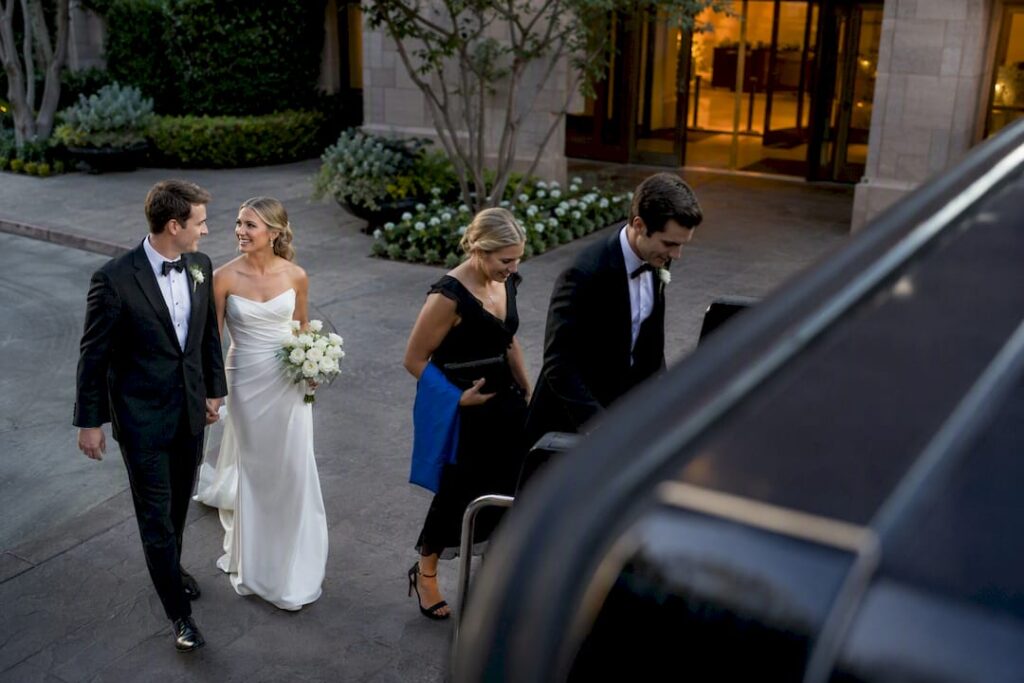
Pick one memorable vehicle for your grand entrance or exit, then lean on charter shuttles or a minibus fleet to move your wedding party and guests without a hitch. That’s the whole formula. Book your transportation 6 to 9 months before the wedding, and if you want a vintage car, trolley, or anything with limited availability, lock that in 9 to 12 months out, especially if you’re marrying between May and October.
TL;DR:
- Book vintage or specialty vehicles at least 9 to 12 months in advance, especially if marrying between May and October or if seeking rare options.
- Use a minibuss or shuttle van for guest transportation, with capacity options from 8 to 35 seats, depending on guest count and venue size.
- Clearly communicate all transportation details, including schedules, vehicle types, accessibility needs, and backup plans, and get everything in writing before signing.
- Allocate a single point person to manage logistics and designate an accessible vehicle for guests with mobility challenges to ensure smooth movement.
- Consider consolidating guests into fewer vehicles and choosing eco-friendly options like hybrid shuttles to reduce costs and environmental impact.
Table of Contents
- Creative Wedding Transportation Ideas for the Couple
- Transportation Ideas for the Wedding Party and VIPs
- How Do You Plan Wedding Guest Shuttles?
- What Does Wedding Transportation Cost?
- Wedding Transportation Booking Checklist
- Expert Logistics Tips From Wedding Transport Pros
- Accessibility and Special Needs Transportation
- Eco-Friendly Wedding Transportation Ideas
- Safety Tips and Regulations for Wedding Transportation
- Personalizing and Decorating Wedding Vehicles
- Coordinating Transportation With Your Wedding Timeline
- Balancing Memorable Moments With Reliable Logistics
- How Reliant Transportation Can Help With Your Wedding
- Sources
Creative Wedding Transportation Ideas for the Couple
This is where you get to have fun. The couple’s ride is the one vehicle at the wedding that shows up in every getaway photo, so it’s worth spending your creative energy here rather than spreading it thin across every guest vehicle too.
Here’s how the most popular options stack up:
- Vintage car (1960s convertible, classic Rolls Royce): Gorgeous for photos, but confirm it has AC and a backup plan for breakdowns. Book 6 to 9 months out.
- Classic convertible: Great for a sunny Willamette Valley afternoon; skip it if rain is even a maybe.
- Trolley or streetcar: Charming where local operators offer them, though routes and permits can limit where they’ll actually go.
- Sprinter van: The most practical “showy but sensible” pick. Private, photo ready, and flexible enough for a quick venue change.
- Helicopter or small plane: Unforgettable, but you’ll need permits, a real backup transportation plan, and a venue with legal landing clearance.
- Boat: Stunning on the right waterfront venue, but confirm the venue actually permits water arrivals before you fall in love with the idea.
- Horse-drawn carriage: A fairy-tale option for rural or vineyard venues; requires wide, flat access roads.
- Tandem bike or canoe: Sweet for a small, casual wedding, but treat it as a photo moment, not your actual transportation plan.
Pro Tip: Pick one showstopper moment, the arrival or the exit, not both. Trying to make every transition photogenic usually means something gets rushed, and rushed photos never look as good as the relaxed ones.
Transportation Ideas for the Wedding Party and VIPs
Your wedding party and immediate family need transportation that gets them to photos on time, looking unrumpled, with a little privacy to breathe before the ceremony.
For groups of six or fewer, a sprinter van works well and feels more intimate than a full-size vehicle. Larger parties (eight or more) usually do better in a limo or party bus, which gives everyone room for dresses, suits, and nervous energy. Parents and grandparents often appreciate their own car rather than being folded into the party’s schedule; elders shouldn’t have to wait around while the wedding party finishes one more photo location.
A few staging basics matter more than people expect:
- Load the wedding party in reverse order of who needs to arrive first at the photo location.
- Stage vehicles away from guest sightlines if you want the “first look” to stay a surprise.
- Keep at least one accessible vehicle on hand if any member of the party or family uses a mobility device.
Give the wedding party a dedicated vehicle whenever their schedule differs from guests’ (earlier call times, extra photo stops). Mix them with guests only for simple, single-location weddings.
How Do You Plan Wedding Guest Shuttles?
Shuttles earn their cost the moment your venue sits more than 30 minutes from where guests are staying, parking is tight, or you’re serving alcohol and don’t want anyone driving home. Out-of-town guest lists are another trigger. If half your guests don’t know the roads, a shuttle removes the anxiety of them getting lost on the way to your ceremony.
Three routing patterns cover most weddings:
- Full loop (hotel to ceremony to reception to hotel): Best for weddings where the ceremony and reception happen at different venues; simplest for guests to understand.
- Single drop: Works when ceremony and reception share one venue; guests are dropped once and picked up once at the end.
- Return loops every 30 to 45 minutes: Essential once your reception runs late, since running shuttles on a loop avoids the mess of everyone trying to leave the venue at the same time.
Sizing depends on your guest count. A sprinter fits 8 to 14 people, a shuttle van handles 14 to 24, and a minibus running 24 to 35 seats is the industry workhorse for most guest lists because it balances capacity with maneuverability at tighter venues. A full coach makes sense once you’re moving 50 or more guests on one route, and mixing vehicle sizes across different pickup points often beats trying to force one vehicle type to do everything.
Pro Tip: Post the shuttle schedule on your wedding website, put signage in the hotel lobby, and send a reminder text the morning of. Clear communication does more for ridership than adding extra shuttles ever will.
What Does Wedding Transportation Cost?
Couple transportation typically runs $700 to $1,200, and once you add guest shuttles, total transportation costs commonly land between $1,500 and $2,500.
For a five-hour booking window, expect roughly $750 to $1,250 for a sprinter van, $625 to $1,000 for a minibus, and $750 to $1,375 for a full charter coach, plus a standard gratuity of 15% to 20%.
Watch for overtime charges, fuel surcharges, and cleaning deposits, which rarely show up in the initial quote. A few ways to trim costs without cutting corners:
- Consolidate guests onto fewer, larger vehicles instead of running several small ones.
- Ask about off-peak rates if your wedding falls on a weekday or outside peak season.
- Bundle couple and guest transportation with one vendor for a package rate.
- For very small weddings, rideshare codes can replace a shuttle entirely.
Wedding Transportation Booking Checklist
Get every one of these in writing before you sign anything:
- Date, start time, and total booked hours.
- Exact vehicle make, model, and passenger capacity.
- Pickup and drop off addresses with specific times.
- Overtime rate and cancellation policy.
- Backup vehicle policy in case of mechanical issues.
- Gratuity: included or added separately.
- Driver qualifications and insurance coverage.
- Name and direct phone number of your day-of contact.
Hand your transportation point person a master call sheet with every driver’s contact information, plus venue loading zone instructions and buffer time between stops.
Expert Logistics Tips From Wedding Transport Pros
Assign one transportation point person so you’re not fielding driver calls on your wedding day. Reliant Transportation’s experience with Oregon venues backs up the industry standard: a minibus in the 24 to 35 seat range handles most guest lists well, and it’s smarter to size up than guess low.
Accessibility and Special Needs Transportation
Every guest deserves a way to get there without stress, and that means planning accessibility into your transportation from the start rather than fixing it at the last minute.
Ask any vendor upfront whether their fleet includes wheelchair-accessible vehicles with proper lift equipment, not just a vehicle that can technically fit a folded wheelchair in the trunk. If you have guests with mobility limitations, hearing loss, or chronic conditions that make standing for long periods difficult, request a vehicle with lower step height or a ramp, and make sure the driver knows in advance who needs extra time boarding.
Seating matters too. Reserve front row or aisle seats near the door for guests who need easier entry and exit, and skip vehicles that require climbing several steps if you know elderly relatives will be riding. If your ceremony and reception venues have gravel paths, uneven ground, or long walks from the drop off point, ask your venue coordinator about a closer accessible drop off zone.
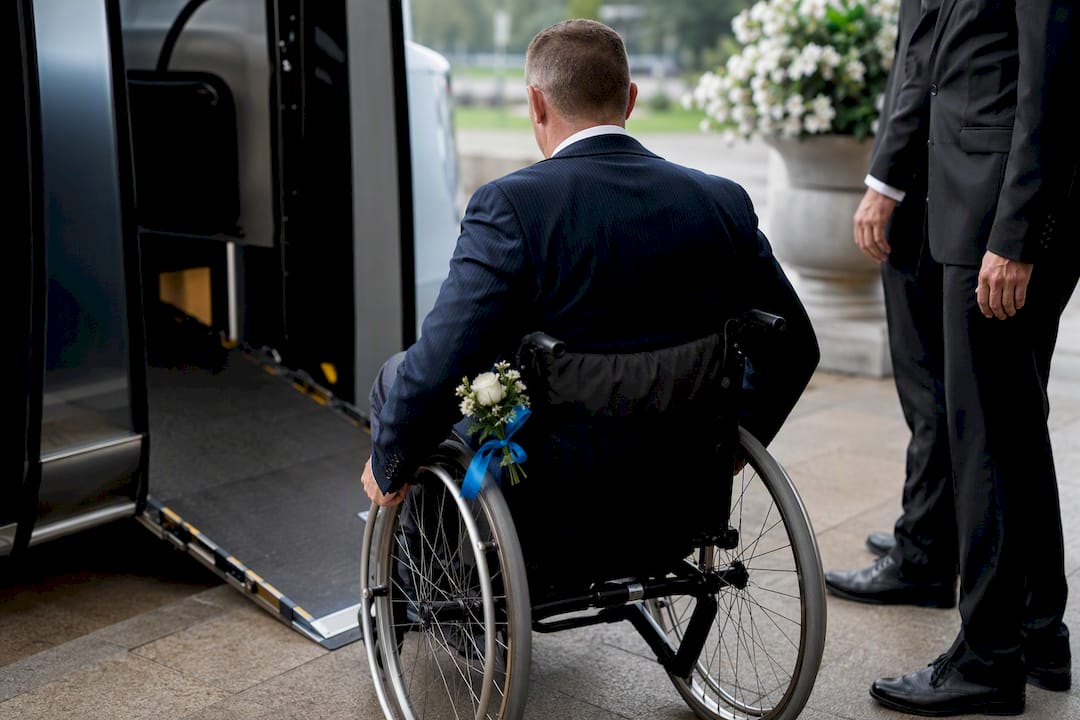
Communicate accessibility needs directly to your transportation provider when you book, not the week before the wedding. A vendor who knows in advance can send the right vehicle instead of scrambling for a last-minute substitute. If a family member uses a mobility device, confirm the exact dimensions of both the device and the vehicle’s door and aisle width. A wheelchair that fits through a sprinter van door doesn’t always fit down the aisle of a coach.
Eco-Friendly Wedding Transportation Ideas
Reducing your wedding’s carbon footprint doesn’t require sacrificing style. It usually just means moving more people in fewer vehicles.
The simplest eco-friendly move is consolidation: one full minibus replaces four or five guest cars, which cuts emissions per person dramatically compared to everyone driving separately. If your venue and guest list allow it, a single shared shuttle loop beats a fleet of individual sedans on almost every measure that matters, cost included.
Some couples now look for hybrid or electric vehicles for the couple’s car, though availability varies a lot by region and vendor, so ask early rather than assuming your first-choice company has one in the fleet. Bikes, e-bikes, or a walking processional make sense for couples marrying at a compact venue where guests are already staying on site, like many Willamette Valley wineries with on-property lodging.
Local sourcing counts too. Choosing a transportation provider based near your venue, rather than one driving in from out of the metro area, cuts the empty miles a vehicle logs before your event even starts. For Portland and Willamette Valley weddings, that’s one more reason a local charter service makes practical and environmental sense.
Skip disposable decorations on vehicles if sustainability matters to you. Reusable ribbon, fresh greenery instead of plastic florals, and battery-powered string lights all look just as good in photos and leave nothing behind.
Safety Tips and Regulations for Wedding Transportation
Book with a licensed, insured commercial transportation company, not a private driver working off the books. Ask directly whether the company carries commercial auto insurance and whether drivers hold the proper commercial license for the vehicle size you’re renting. A 15-passenger van and a full coach have different licensing requirements, and a legitimate operator will answer this question without hesitation.
Confirm the vehicle has passed a recent safety inspection and ask how the company handles a mechanical breakdown mid-event. A real backup vehicle policy, not a vague promise, is one of the clearest signs of a professional operator.
If alcohol will be served, transportation isn’t optional for anyone driving in from out of town. Build your shuttle schedule around your bar service hours, and make the last shuttle departure clear on every piece of signage and every reminder text.
Weather matters more than couples expect in the Pacific Northwest. Confirm how the vendor handles rain, ice, or high winds, particularly for open-air options like a convertible or horse-drawn carriage, and ask what their rain plan looks like before you book.
Finally, physically check large-vehicle access with your venue. Gravel driveways, low bridges, and narrow gates can turn a beautiful vineyard venue into a logistical problem for a full-size coach. It’s worth a phone call to the venue coordinator well before your wedding date.
Personalizing and Decorating Wedding Vehicles
A few well-placed touches make a rental vehicle feel like your vehicle without slowing anyone down or risking damage fees.
Ribbon and floral swags on the front grille or side mirrors are classic for a reason: easy to attach, easy to remove, and they photograph beautifully against almost any vehicle color. A “Just Married” sign in the rear window works for the exit, but skip anything taped directly to paint, since most rental contracts include a damage clause for adhesive residue.
String lights along the interior ceiling of a sprinter van or party bus create a warm look for evening photos, and battery-powered versions avoid any wiring concerns. If your colors are part of your wedding identity, small ribbon bows in your palette on door handles tie the vehicle into your overall look without overwhelming it.
Always ask your vendor what’s allowed before you decorate. Some contracts prohibit anything attached with tape or adhesive, and a cleaning deposit can disappear fast if glitter or confetti ends up in the upholstery.
Coordinating Transportation With Your Wedding Timeline
Transportation only works when it’s built around your actual schedule, not bolted on afterward. Start with your ceremony time and work backward: your first shuttle should arrive 20 to 30 minutes before the ceremony starts, with 10 to 15 minutes of boarding buffer built into each stop.
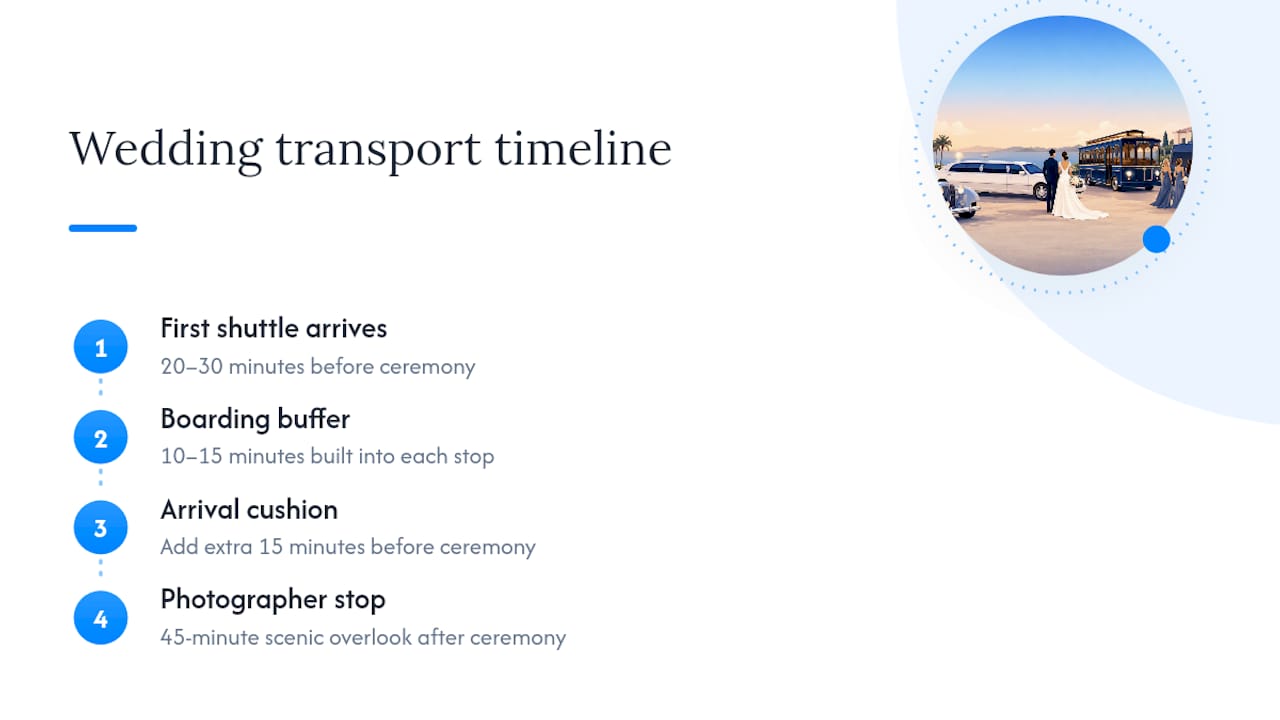
Share your transportation schedule with your venue coordinator and photographer at the same time you finalize your timeline. If your photographer wants 45 minutes at a scenic overlook between ceremony and reception, your driver needs that written into the schedule, not discovered on the day. Venues with strict load-in windows, common at working wineries during harvest season, may only allow large vehicles to arrive during a specific hour, so confirm that window before locking your ceremony start time.
Build in a buffer between the last shuttle’s arrival and your ceremony start, ideally 15 minutes beyond what feels necessary. Weddings run late more often than they run early, and a buffer protects your photos, your vows, and your stress levels equally.
Balancing Memorable Moments With Reliable Logistics
Pick one transportation moment that’s actually worth photographing, then let the rest run on rails. A gorgeous exit means little if half your guests missed the shuttle because nobody told them the schedule. Match your vehicle choices to what your venue can actually handle, book early, and name one person whose only job is answering transportation questions on the day.
— Dusty
How Reliant Transportation Can Help With Your Wedding
A local transportation company offers charter minibuses, coaches, and sprinter vans for weddings in the Portland metro area, the Willamette Valley wine country, and Hood River, with experienced drivers and logistics support included.

If you’ve read this far, you already know the two things that make wedding transportation work: the right vehicle size and a contract that spells out overtime, gratuity, and backup vehicle policy in writing. That’s exactly what Reliant Transportation puts on paper before you sign anything, including charter bus sizing guidance if you’re unsure whether your guest list needs a sprinter, a minibus, or a full coach. Request a quote, tell us your headcount and venue, and we’ll help you confirm the right vehicle and a clear, written contract before your booking window closes. Get a quote and reserve your dates today.
Sources
- Wedding Transportation Guide: Types, Costs & Planning Tips (2026) – Joy
- The Ultimate Guide to Wedding Transportation for Your Guests – The Knot
- How to Plan Wedding Bus Transportation: A Step-by-Step Guide | Buslane
- How to Plan Wedding Shuttle Service for Guests – DA Executive Service