

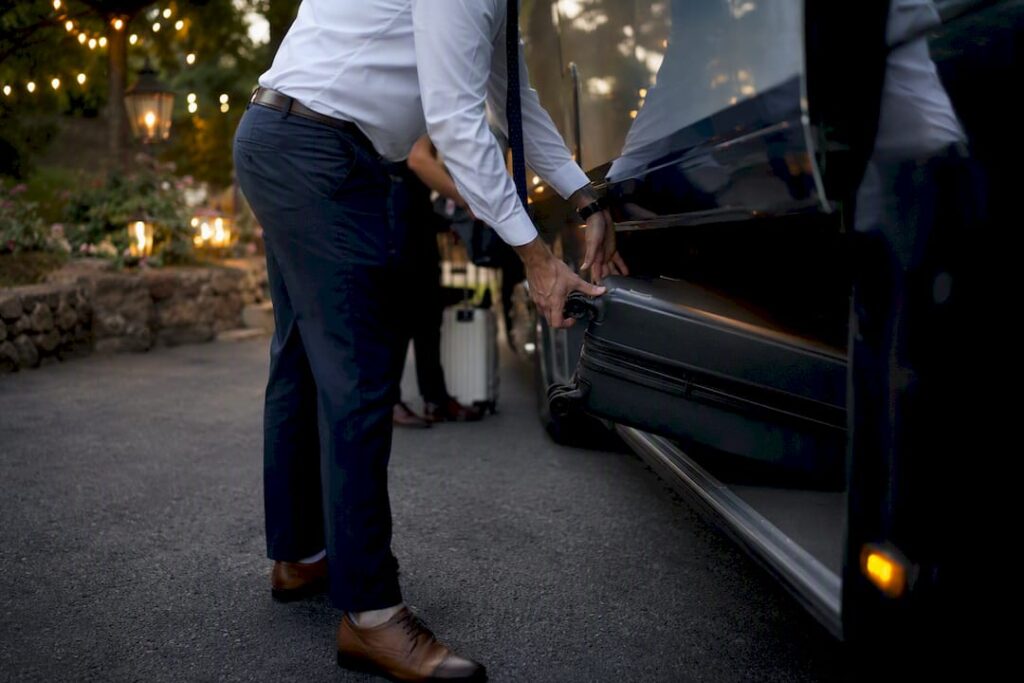
Here’s the line to build from: “Shuttle pickup is at the Hood River Hotel lobby doors — please be ready by 4:15 PM, shuttle departs promptly at 4:30 PM.” That single sentence covers the pickup spot, the departure time, and a built-in buffer, and it stays polite while making the timing non-negotiable. Everything else in your wedding shuttle wording just repeats and expands on that formula.
TL;DR:
- Clearly specify the pickup location, departure time, and last-call schedule in all messaging to prevent guests from missing or late for the shuttle.
- Send initial high-level details at the invitation, then provide full schedules via email or website one to two weeks before the wedding, with reminder texts the morning of.
- Confirm all shuttle times, vehicle descriptions, and contact information with your operator in writing two weeks ahead to avoid day-of confusion or delays.
- Use friendly, welcoming language that emphasizes the reason for transportation and includes precise instructions to encourage timely guest participation.
- State capacity limits or reservation requirements explicitly if the shuttle fleet is restricted, and provide a straightforward way for guests to RSVP or inform you of special needs.
Table of Contents
- Where to Put Your Wedding Transportation Wording
- Copy-Paste Wedding Shuttle Wording Templates
- When to Send Each Piece of Shuttle Wording
- Day-Of Text Messages and Announcement Scripts
- Accessibility Wording and What Guests Should Do if They Miss the Shuttle
- Operator Coordination Checklist for Shuttle Wording
- How to Phrase Shuttle Etiquette Without Sounding Bossy
- Making Shuttle Wording Feel Welcoming, Not Like a Memo
- Wedding Shuttle Wording Examples by Style
- Should You Mention Shuttle Capacity or Reservations?
- An Operator’s View on What Actually Breaks a Shuttle Plan
- Let Reliant Transportation Handle the Logistics Behind Your Wording
- Sources
Where to Put Your Wedding Transportation Wording
Guests scan different messages differently, so match the detail level to the outlet. Cramming full logistics into an invitation insert overwhelms it; leaving your website vague means guests show up at the wrong door.
- Wedding website: Full details — clickable address, embedded map link, operator name, and a contact number. This is the one place guests return to when they forget something.
- Invitation insert: One line only. Time and pickup spot, nothing more. “Shuttle departs the Sentinel Hotel at 4:30 PM” is plenty.
- Welcome bags or hotel room cards: A short reminder plus the operator’s phone number as a fallback if someone oversleeps.
- Email: Good for the fuller schedule sent a week or two out, since guests can reference it later.
- Text message: Reserved for morning-of action, kept to three lines max.
- On-site signage: A printed sign at the pickup point with the couple’s names and departure time cuts down on the “is this the right shuttle?” questions almost entirely.
Each outlet does one job. Overlap them and you’ll bury the important detail; separate them and guests find exactly what they need when they need it.
Copy-Paste Wedding Shuttle Wording Templates
Every solid piece of shuttle wording needs the same core elements before you touch the phrasing: a specific pickup spot (not just “the hotel,” but “the Hood River Hotel lobby entrance”), an exact departure time, a request to arrive early, return or last-call times, a contact number, and an accessibility note if it applies. A clear shuttle schedule needs pickup locations, departure times, an arrival window, and a last-call time at minimum, and skipping any one of those leaves guests guessing.
Here are eight versions you can adapt directly:
- Invitation line (formal): “Transportation will be provided from the Sentinel Hotel lobby at 4:30 PM.”
- Invitation line (casual): “Hop on the shuttle! Pickup at the Sentinel Hotel, 4:30 PM sharp.”
- Website paragraph: “Guests staying at the Sentinel Hotel can catch our shuttle to the ceremony. Please gather in the main lobby by 4:15 PM; the shuttle departs at 4:30 PM. Return shuttles run at 9:00 PM, 10:00 PM, and a final pickup at 11:30 PM. Questions? Call Sam at 555-0134.”
- Hotel room card: “Wedding shuttle departs the lobby at 4:30 PM today. Please arrive 10 minutes early. Last return shuttle leaves the venue at 11:30 PM.”
- Multiple-departure schedule: “Shuttles run every 20 minutes from 3:30 PM to 4:30 PM, then again for the return trip starting at 8:30 PM.”
- Parking-limited phrasing: “Venue parking is limited, so we’re arranging shuttle service from town. We’d love for you to leave the driving to us.”
- Remote-venue wording: “Our venue sits down a gravel road with no cell service, so shuttle transportation is strongly recommended. Departure is 4:30 PM from the Hood River Hotel.”
- Firm arrival request: “Please arrive 10 minutes early. The shuttle cannot wait for late arrivals, and it’s the only transportation to the ceremony site.”
Tone comes down to two dials: friendly and firm. Friendly phrasing (“We’d love for you to join us on the shuttle!”) works for casual weddings and low-stakes timing. Firm phrasing works better when the venue is remote, parking doesn’t exist, or the ceremony can’t be delayed. You can blend both, as in template 8, where warmth and a hard deadline sit in the same sentence.
When to Send Each Piece of Shuttle Wording
Timing your messages matters as much as writing them well. Send shuttle details in four waves, each one adding detail without repeating what already went out.
- At invitation time: High-level only. Time and pickup spot.
- One to two weeks before: Full schedule via email or your wedding website, including return times and the contact number.
- The night before: A short overview text. “Reminder: shuttle pickup tomorrow at the Sentinel Hotel, 4:30 PM. Full schedule on our website.”
- The morning of: A short, actionable text sent with local timing in mind, since morning-of reminders get the highest response rate of any shuttle communication.
Before you send any of these, confirm every time and pickup location with your operator in writing. Wording that doesn’t match what the driver actually does creates the exact confusion you’re trying to prevent.
Day-Of Text Messages and Announcement Scripts
Keep the morning-of text under three lines: time, place, buffer, and a phone number. Something like “Shuttle pickup: Sentinel Hotel lobby, 4:30 PM. Please be ready by 4:20. Questions? Text Sam at 555-0134” covers everything a guest needs without making them scroll.
- Running-late text: “Running a few minutes behind. Shuttle now departing at 4:40 PM instead of 4:30.”
- Last-call text: “Last shuttle to the reception leaves the ceremony site at 11:30 PM. Don’t miss it!”
- Usher or emcee script: “Reception wrapping up soon? Shuttles back to the hotel leave from the main entrance at 9:00, 10:00, and 11:30 PM.”
Describe the actual vehicle in your message, not just the company name. “Look for the white shuttle with the blue ‘Reliant’ sign in the windshield” solves the problem of guests standing at the wrong curb, especially at hotels or venues with more than one entrance.
Accessibility Wording and What Guests Should Do if They Miss the Shuttle
Ask about mobility needs privately, not in a group text. Something like “Please let us know by [date] if you’ll need accessible transportation so we can arrange it in advance” on your RSVP card works well, since reserving accessible vehicles requires direct confirmation rather than assuming the fleet already accommodates every guest.
For guests who miss the shuttle, a short public fallback line prevents panic: “Missed the shuttle? Call Sam at 555-0134 or grab a rideshare. Ceremony address: 123 Vineyard Lane.”
Pro Tip: Reserve one accessible vehicle in advance and state it plainly on your website: “An accessible shuttle is available on request. Contact us by [date] to arrange it.” That one sentence does more than any general accommodation note.
- Offer accessible options without making guests ask twice.
- Keep the fallback line short, public, and easy to find on your website.
Operator Coordination Checklist for Shuttle Wording
Your wording only works if the vendor behind it delivers on time. Before you publish anything, send your operator a short checklist and get answers in writing.
- Confirm departure and return times in writing, including the last-call run.
- Request a written vehicle description (color, signage) to match your day-of text.
- Ask for a day-of operations contact separate from the booking office.
- Confirm drivers arrive 30 minutes early with a clear boarding buffer.
- Lock in final passenger counts and pickup times about two weeks out.
Reliant Transportation has spent more than a decade running exactly this kind of coordination for weddings across the Portland metro, the Willamette Valley wine region, and Hood River, and the pattern holds: couples who confirm these five points in writing almost never deal with a stranded guest.
How to Phrase Shuttle Etiquette Without Sounding Bossy
Etiquette wording works best when it explains the reason behind the ask instead of just issuing a rule. “Please arrive 10 minutes early so we can depart on schedule” lands better than “Be on time,” because it tells guests why punctuality matters instead of just demanding it.
Keep behavior expectations short and specific. If you’re asking guests not to eat or drink on the shuttle, say so plainly: “We ask that food and drinks stay off the shuttle to keep things tidy for the next group.” If there’s a dress code consideration, like heels on gravel, a gentle heads-up works: “Our venue has some gravel paths, so flats or comfortable shoes are worth considering for the shuttle ride.”

Avoid stacking too many rules into one message. Two or three etiquette notes, tucked into your website’s transportation section rather than the invitation, keep the tone light. Something like “A few friendly reminders: shuttles depart on schedule, seating is first come first served, and we ask that everyone buckle up for the short ride” covers the basics without reading like a permission slip.
The firmest line you’ll write is usually about lateness, and that’s fine. “The shuttle can’t wait for late arrivals, since it’s the only transportation to the ceremony” sets a boundary while still sounding like it’s coming from a couple who cares, not a transportation company issuing a policy.
Making Shuttle Wording Feel Welcoming, Not Like a Memo
The difference between wording that feels like an obligation and wording that feels like an invitation usually comes down to word choice. “Guests must use the shuttle” reads like a rule. “We’d love for you to hop on the shuttle with us” reads like part of the celebration.
Small touches carry a lot of weight. Naming the driver or the vehicle color turns an anonymous logistics note into something personal: “Look for Dave in the white shuttle with the ‘Congrats!’ sign.” Adding a short reason for the shuttle, like “parking is limited at our venue” or “we wanted everyone to relax and enjoy the ride together,” gives guests context instead of a bare instruction.
Humor helps too, especially for casual weddings. “No need to be a designated driver tonight, the shuttle’s got you covered” does double duty: it’s warm, and it quietly encourages guests to actually use the transportation you arranged.
Whatever tone you pick, keep the actual logistics unambiguous underneath the warmth. A friendly sentence still needs the exact time and pickup spot; charm doesn’t replace clarity, it just makes the clarity easier to read. Pair every warm line with the hard details, and read your wording out loud before you publish it. If it sounds like something a friend would text you, it’s probably right. If it sounds like a legal notice, soften it.
Wedding Shuttle Wording Examples by Style
Formal wedding: “Guest transportation will be provided from the Sentinel Hotel. Departure is promptly at 5:00 PM from the main lobby entrance. Return service will run at 9:30 PM and 11:00 PM.” Formal wording skips contractions and exclamation points, and it treats the shuttle like part of the event’s overall production.
Casual wedding: “Ditch the parking headache! Our shuttle leaves the Sentinel Hotel at 5:00 PM and brings you right back at the end of the night. Hop on, we’ll see you there!” Casual wording uses contractions, a light exclamation point or two, and frames the shuttle as part of the fun rather than a logistics requirement.
Destination wedding: “Because our venue is a bit remote, we’ve arranged shuttle transportation from the Hood River Hotel for all out-of-town guests. Departure is 4:00 PM sharp, with return shuttles at 9:00 PM and 10:30 PM. We know travel is a big ask, and we want getting to the ceremony to be the easy part.” Destination wording tends to run longer because guests need more reassurance about an unfamiliar location, and acknowledging the travel commitment goes a long way.
Whichever style fits your wedding, the underlying elements stay the same: pickup spot, exact time, return schedule, and a contact number. Only the phrasing around them changes.
Should You Mention Shuttle Capacity or Reservations?
Most wedding shuttles run on a simple show-up-and-ride basis, and for smaller guest counts, that’s all you need to say. But if your venue has a hard capacity limit or you’re running a single shuttle instead of a fleet, say so directly: “Shuttle seating is limited to 30 guests per departure. If you’re planning to ride, please let us know by [date] so we can plan accordingly.”
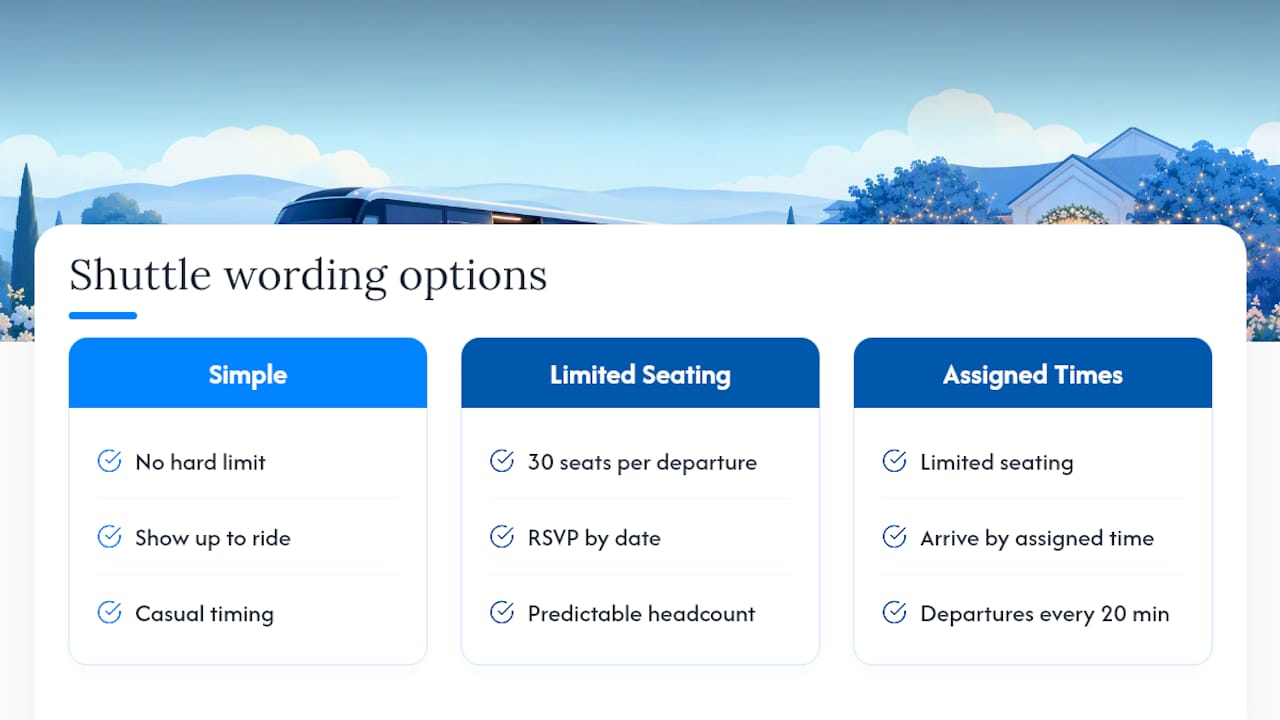
Reservation language works well for weddings using a mix of hotel blocks, since it lets you predict headcounts. “Please indicate on your RSVP if you’ll need shuttle transportation from the Sentinel Hotel” gives you a number to hand your operator instead of guessing.
If capacity is genuinely tight, be upfront about the tradeoff rather than letting guests find out at the curb: “Because our shuttle has limited seating per trip, we’re running departures every 20 minutes starting at 4:00 PM. Please plan to arrive by your assigned time if possible.” That kind of note also gives you a natural place to link your full schedule for anyone checking available vehicle types and seating capacity before they commit to riding.
For most weddings, though, simplicity wins. If you don’t have a hard capacity constraint, don’t invent one in your wording just to sound organized. Extra rules where none are needed just add friction to a message that should feel easy to read.
An Operator’s View on What Actually Breaks a Shuttle Plan
Most shuttle failures aren’t about the vehicle. They’re about a time that got confirmed verbally, changed once, and never made it back into the couple’s wording. Send the morning-of text yourself, even after you’ve published everything else. A brief, specific message beats a beautifully worded paragraph nobody rereads on the actual day.
— Dusty
Let Reliant Transportation Handle the Logistics Behind Your Wording
Writing the perfect shuttle wording only works if the vendor behind it shows up exactly as promised, and that’s where Reliant Transportation removes the guesswork for couples across the Portland metro, the Willamette Valley wine region, and Hood River. We handle the schedule, ADA accommodations, vehicle descriptions, and day-of operations directly, so the wording you publish on your invitation or website matches what actually happens on the road.

That means when you write “look for the white shuttle with the blue sign,” we make sure that vehicle shows up on time, with a driver who knows the route and a contact number that actually gets answered. If you’re weighing a charter bus for your wedding against piecing together rideshares or asking a friend with a van, a dedicated operator gives you one confirmed schedule instead of a dozen moving parts. For couples getting married in Oregon’s wine country, our guide to the region can help you plan pickup points around some of the area’s most scenic venues. Ready to lock in your schedule? Request a quote today and get your shuttle wording backed by a vendor who confirms every detail in writing.
Sources
- Wedding Guest Transportation Planning | Plan A Wedding
- How to Tell Guests Your Wedding Shuttle Times | Dearest Guest
- How To Communicate Wedding Shuttle Schedules Clearly To Out-Of-Town Guests

Pingback: Wedding Transportation Ideas: Pick One Showstopper, Book 6–9 Months Out
Pingback: Event Organizers: $2–$10 Per Person Tips, Scripts & Worked Examples