


Your first shuttle should arrive at the ceremony well before it starts, giving guests ample time to get seated and settled. From there, plan boarding windows of 10 to 25 minutes per stop, include a 15 to 20 minute buffer for every transit leg to accommodate traffic and delays, and run return loops regularly, about every half hour to 45 minutes, once the reception begins. Book your transportation 3 to 6 months out (earlier if you’re marrying between May and October), then lock in your final passenger counts one to two weeks before the big day.
- First shuttle arrival: 30 to 45 minutes pre-ceremony
- Boarding window: 10 to 25 minutes per stop
- Buffer per transit leg: 15 to 20 minutes
- Return loops: every 30 to 45 minutes
- Booking lead time: 3 to 6 months, confirmed 1 to 2 weeks out
Your next move right now: list every hotel or origin point your guests are starting from, then use the math above to set a first-departure time. Everything else in your wedding shuttle timeline flows from that single number.
TL;DR:
- Shuttle departure time should be set at least 30 to 45 minutes before guests need to be seated, accounting for drive and buffer time.
- For guest groups over 50, plan for multiple vehicles or staggered waves, with each shuttle holding up to 40-56 passengers comfortably.
- Confirm transportation details, including staging, wait policies, and backup options, with your provider at least two weeks before the wedding.
- Communicate shuttle times clearly through multiple channels, ensuring guests know exact pickup locations, departure times, and last return options.
- Working backward from the ceremony ensures an accurate schedule that avoids delays, reduces crowding, and protects key moments like photos and entrances.
Table of Contents
- Copy-Paste Wedding Shuttle Schedule Templates
- How Do You Choose Shuttle Vehicles and Waves?
- How to Build Your Shuttle Schedule Backwards
- When and How Should You Send the Shuttle Schedule?
- What Happens When the Timeline Slips?
- How a Professional Operator Executes This Timeline
- Key Takeaways
- Sources
Copy-Paste Wedding Shuttle Schedule Templates
You don’t need to build a timeline from scratch. Most weddings fall into one of three transportation patterns, and each has a template you can adjust to your own numbers.
Template A: single-site wedding (ceremony and reception at the same venue)
- 3:15 PM: Boarding begins at hotel lobby
- 3:35 PM: Shuttle departs (20 minutes boarding + drive buffer)
- 4:00 PM: Guests seated
- 4:30 PM: Ceremony begins
- 10:00 PM to 11:30 PM: Return shuttle loops every 30 minutes
Template B: hotel block to ceremony to reception to hotel
This is the most common setup for weddings with a separate ceremony and reception site, and it needs two pre-ceremony waves so nobody is left standing in a lobby.
- Wave 1 departs 55 minutes before ceremony (wedding party, family, early arrivals)
- Wave 2 departs 40 minutes before ceremony (general guests)
- Reception transfer shuttle departs 20 minutes after ceremony ends
- Return shuttles run staggered loops starting 90 minutes into the reception
Template C: destination wedding with airport transfers
Add a fourth leg for fly-in guests. Airport pickups need a 90-minute lead time from flight landing to account for baggage claim and rideshare-lot chaos at most regional airports. Hotel-to-venue transfers on the wedding day follow the same math as Template B, just with longer buffers if the drive crosses rural roads in wine country or the Columbia Gorge.
Scaling any of these comes down to two variables: your guest count and your vehicle capacity. Add a wave, not a whole new template, when your headcount outgrows what one vehicle handles comfortably. Buslane’s step-by-step planning guide recommends working backward from the ceremony for exactly this reason. It keeps every wave anchored to the same fixed point instead of drifting.
How Do You Choose Shuttle Vehicles and Waves?
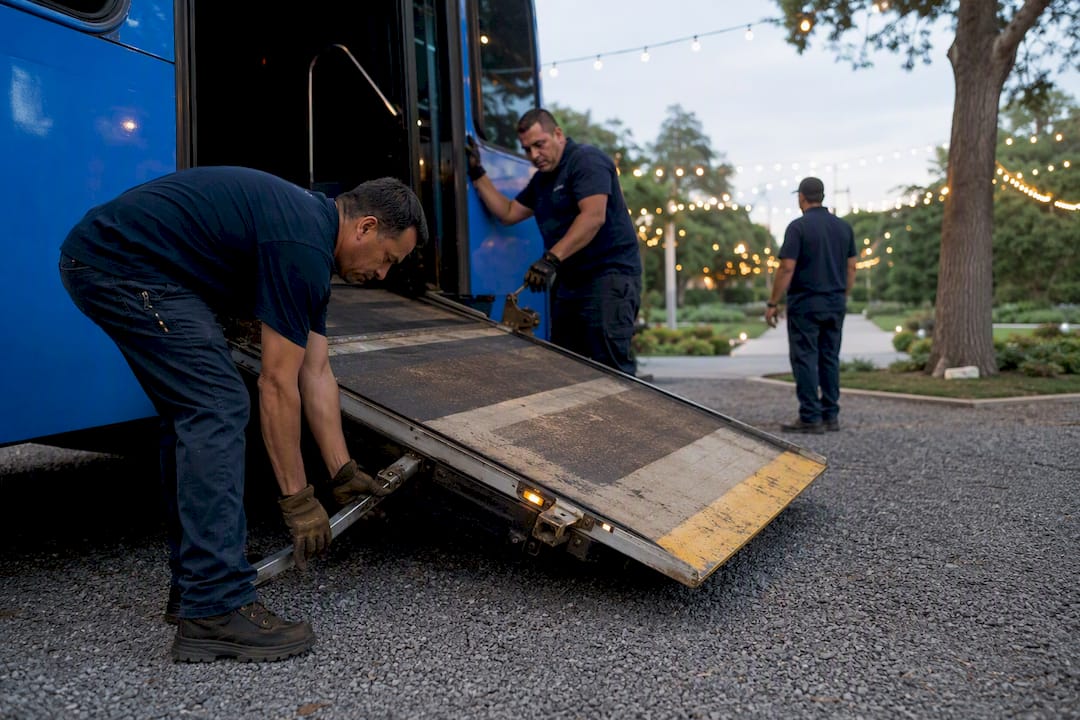
Start with the math, not the guest list’s total headcount. If you have 120 guests needing shuttles and each coach comfortably seats 40 (even though it might be rated for 56), you need three full loads, not two. That “comfortable” number matters more than the legal maximum. Wedding guests in formal wear, holding gifts, or wrangling kids need more elbow room than a commuter bus.
One large motorcoach concentrates your risk. If it breaks down or hits traffic, everyone is late. Multiple smaller shuttles cost more to coordinate but give you flexibility. If one is delayed, the others keep moving. For guest counts under 50, one shuttle running two waves is usually your cheapest, simplest option.
- Under 50 guests: one shuttle, two waves
- 50 to 100 guests: one motorcoach or two shuttles running parallel
- 100+ guests: multiple vehicles, staggered departures
Boarding time expectations shift by vehicle type, too. A 15-passenger van loads faster than a 56-seat coach. Add extra buffer any time guests are boarding from a hotel with elevators, or from a venue where the bus can’t pull right up to the door.
Pro Tip: If your hotel has more than four floors, add a full 10 extra minutes to boarding. Elevator wait times are the most underestimated bottleneck in any wedding transportation schedule.
How to Build Your Shuttle Schedule Backwards
The cleanest way to schedule wedding shuttles is to start at the ceremony and work backward.
- Set your anchor: “guests seated by” 30 to 45 minutes before ceremony start.
- Subtract drive time from the origin point to get your required venue arrival time.
- Subtract boarding time (10 to 25 minutes) to find when the shuttle needs to start loading.
- Subtract a 15-to-20-minute buffer for traffic and unloading to land on your true departure time.
Here’s the math in action. Say your ceremony starts at 4:30 PM and you want guests seated by 4:00 PM. The drive from the hotel is 20 minutes. Boarding takes 15 minutes for a mid-size group. That means the shuttle needs to leave the hotel by 3:25 PM, and boarding needs to start by 3:10 PM. Plan A Wedding’s transportation guide recommends running a second shuttle 15 minutes after the first specifically to catch stragglers without holding up the whole group.
Before you finalize anything, confirm these details with your transport provider:
- Exact arrival and staging window for drivers
- Their wait policy for late guests
- Staffing plan if you’re running multiple waves
- Backup vehicle availability
When and How Should You Send the Shuttle Schedule?
Guests won’t use a shuttle schedule they never see, so timing your communication matters as much as the schedule itself.
- 4 to 6 weeks before: Post a general transportation overview on your wedding website (shuttle available, general pickup area).
- 10 to 14 days before: Send the full detailed schedule with exact times to anyone who RSVP’d yes.
- 24 to 48 hours before: Send an SMS reminder with the pickup time and location.
- Day-of: Post signage at the pickup point and make a verbal announcement if there’s a welcome gathering.
Every schedule you send needs these fields, no exceptions:
- Exact pickup entrance (not just “the hotel,” but “the Burnside Street lobby entrance”)
- Departure time, stated plainly: “shuttle leaves at 3:25 PM sharp”
- Estimated arrival window at the venue
- Last return shuttle time
- A backup contact number in case someone misses the bus
A sample SMS template: “Reminder: Your wedding shuttle departs the Hotel lobby at 3:25 PM tomorrow. Last return shuttle leaves the venue at 11:00 PM. Questions? Text [name] at [number].” Clear, specific departure language like this is exactly what Plan A Wedding’s transportation logistics guide points to as the difference between a shuttle that fills up and one that runs half-empty.
What Happens When the Timeline Slips?
Even a well-built schedule needs a point person on the ground. Assign a shuttle captain, hand them a single master document with every time, address, and driver contact, and have drivers arrive 30 minutes before the first scheduled departure.
Decide in advance whether each departure is fixed or flexible. Fixed departures protect your ceremony start time. Waiting for stragglers protects nobody if it pushes your whole day back.
- Fixed departure: use for anything tied to the ceremony start
- Wait-for-stragglers: acceptable only for late-night return loops
Build in contingencies before you need them:
- Reserve one standby vehicle for no-shows or breakdowns
- Share a rideshare fallback number in your day-of materials
- Hold one shuttle back for the couple’s final departure at remote venues
Pro Tip: Announce a “last call” 15 minutes before the final return shuttle leaves. Guests lose track of time at the bar, not out of carelessness.
How a Professional Operator Executes This Timeline
Reliant Transportation has run wedding shuttle logistics across the Portland metro area, the Willamette Valley wine country, and the Hood River area for over a decade, and the operational habits that come out of that experience track closely with everything above.
- Drivers stage 30 minutes before the first scheduled departure
- Passenger counts get confirmed close to the date, not just at booking
- Fleet options get matched to guest count and venue access, not guessed at
- Day-of communication runs through a single point of contact, not scattered texts
A standby vehicle held for late-night departures at remote venues is one of the simplest ways to prevent guests from getting stranded, particularly at rural or vineyard venues without reliable rideshare coverage.
When you book, ask directly: What’s your arrival window? What’s your wait policy? Where do drivers stage? Can the vehicle handle guests with mobility needs?
Why realistic shuttle timelines matter more than couples expect
A shuttle running 20 minutes behind doesn’t just inconvenience guests. It eats into your first look, your golden-hour photos, or your grand entrance. Good timing planning is invisible when it works, which is exactly why it gets skipped. Do two things this week: map every origin point your guests are coming from, and call your transport vendor to confirm they can build a schedule around your actual ceremony time, not a generic one.
— Dusty
Let Reliant Transportation Handle Your Shuttle Logistics
Reliant Transportation is the option for Portland-area and Willamette Valley couples who want their shuttle timeline built and run by people who do this every wedding season, not figured out from a spreadsheet the week before. We handle charter shuttles, driver staging, passenger-count confirmations, and day-of logistics coordination so you’re not the one checking your phone during your own reception.

Our fleet options scale from a single shuttle for an intimate wine-country ceremony to multiple coaches for a 200-guest Portland reception, and our wedding charter service is built around the same backward-planning method covered above. If your venue is in the Hood River area or the wine country, our regional coverage page covers the routes we run most. Ready to see what a professionally staged shuttle schedule looks like for your date? Request a quote and tell us your ceremony time. We’ll build the rest of the timeline around it.
Key Takeaways
A reliable wedding shuttle timeline works backward from your ceremony start time, using fixed buffers for boarding, transit, and returns.
| Point | Details |
|---|---|
| Set your anchor time | Guests should be seated 30 to 45 minutes before the ceremony starts. |
| Build in buffers | Add 15 to 20 minutes per transit leg and 10 to 25 minutes for boarding. |
| Plan return loops | Run shuttles every 30 to 45 minutes during the reception to avoid crowding. |
| Book and confirm early | Reserve transport 3 to 6 months out and confirm counts 1 to 2 weeks before. |
| Work with a pro operator | Reliant Transportation stages drivers 30 minutes early and builds schedules around your exact ceremony time. |
Sources
- Wedding Guest Transportation Planning | Plan A Wedding
- How to Plan Wedding Bus Transportation: A Step-by-Step Guide | Buslane


Pingback: Use a 40 Minute Buffer: Rehearsal Dinner Shuttle Playbook for Planners